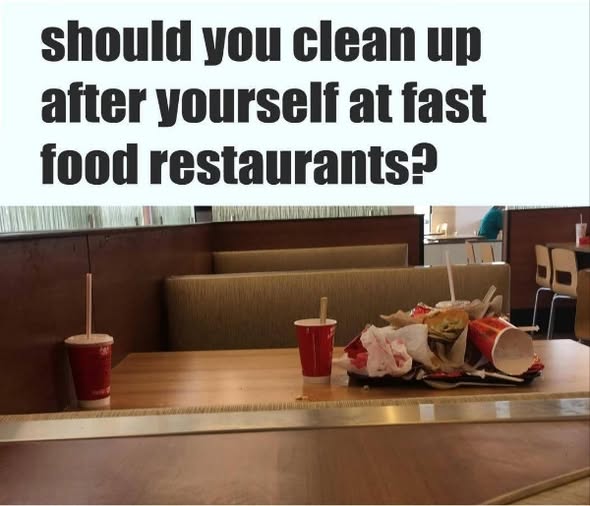
The question of etiquette in fast-food restaurants has long functioned as a quiet test of how people understand social responsibility and the unspoken agreements that govern shared spaces. On the surface, the exchange is simple: money for food. Yet what happens after the meal reveals a deeper divide in how individuals view their role within a public environment. The choice between clearing one’s tray or leaving the remains behind is not merely practical—it reflects broader beliefs about labor, service, and how our actions ripple outward to affect others.
For many diners, throwing away their trash is a basic act of courtesy. In their view, the fast-food model is rooted in self-service, and that responsibility doesn’t end at the counter. Clearing the table is seen as a small but meaningful contribution to a shared effort to keep the space pleasant. It lightens the load of workers who are often stretched thin and signals respect for the next person who will sit there. The table is not something one rents for the right to leave a mess; it is a shared resource. Leaving it clean is a quiet acknowledgment of community.
This mindset rests on the belief that public life functions best through small, collective acts of consideration. Carrying a tray to the bin helps maintain cleanliness and efficiency in a space meant for everyone. It also recognizes that time spent bussing tables is time taken away from other essential tasks—restocking, sanitizing, or keeping the restaurant running smoothly. To those who hold this view, leaving a mess feels less like a neutral choice and more like an unnecessary assertion of entitlement, one that diminishes the dignity of service workers whose jobs are already demanding.
Opposing this is a more transactional perspective. Some customers believe that because they have paid for their meal, the responsibility for cleaning falls entirely on the business. From this standpoint, tidying up after oneself can feel like unpaid labor for a large corporation, or even a practice that could justify reduced staffing. In this view, the cost of the meal includes cleanup, just as it includes utilities or maintenance. Any mess left behind is simply part of the establishment’s operational responsibility.
For these diners, service implies being taken care of, even in a fast-food setting. The expectation to clear one’s own table can feel like a dilution of service standards—a sign that convenience culture has shifted too much responsibility onto the customer. What was once hospitality begins to resemble obligation.
In practice, however, fast-food culture usually exists somewhere between these extremes. While restaurants are designed with the assumption that customers will dispose of their own trash, no one expects diners to sanitize tables or sweep floors. The real issue is not crumbs or minor disorder, but the aftermath of excess: abandoned food, spilled sauces, and piles of trash that render a table unusable.
The condition of a table left behind often reflects a person’s awareness of how their presence affects others. A messy table creates friction for the next customer, who must wait, clean up after a stranger, or eat in discomfort. All of this can be avoided with minimal effort, yet its absence disrupts the flow of a shared space.
The argument that leaving messes “creates jobs” is also widely rejected by those who work in the service industry. Most employees already juggle more responsibilities than time allows. Cleaning up after avoidable chaos is not job security—it is a distraction from essential work in an environment built around speed and efficiency.
Ultimately, this debate mirrors a broader cultural shift in how people navigate communal environments. As service becomes more automated and self-directed, personal responsibility becomes less clearly defined. Yet the core issue remains human. Shared spaces function best when treated with collective care rather than individual entitlement. A fast-food restaurant is a crossroads of countless lives, each person briefly sharing the same stage.
Choosing to clean up is a small acknowledgment of shared humanity. It recognizes the worker as an equal deserving of respect and the next customer as someone worthy of a clean space. While no rule requires a diner to lift a finger once their meal is finished, the ethics of community quietly suggest otherwise. Public life is not only about transactions—it is about interactions. In clearing a tray, we affirm our role in shaping a more considerate world. Even in places built for speed, there is always room for a moment of respect.