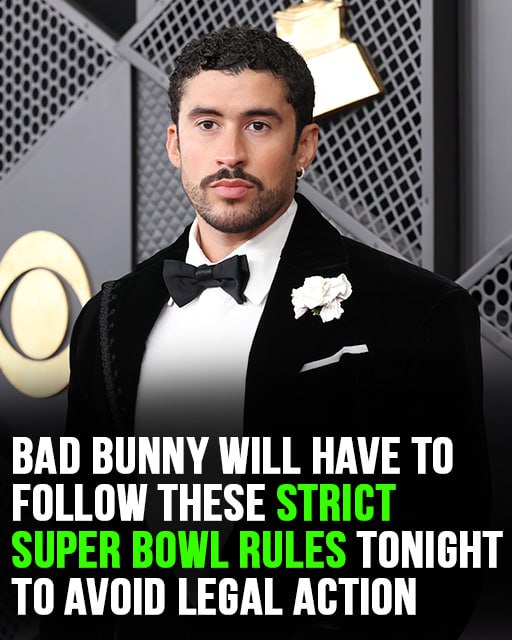
The 2026 Super Bowl has finally arrived, carrying with it an electric charge that can be felt in the air long before a single play is made on the field. Levi’s Stadium in Santa Clara, California, is buzzing like a live wire, packed with tens of thousands of fans and observed by hundreds of millions worldwide. The New England Patriots and the Seattle Seahawks are preparing for a clash of titanic proportions, each team aware that their performance will be remembered not just in the record books, but etched into the cultural memory of a nation. But amid the tension, the true spectacle that commands nearly equal scrutiny is not the quarterback’s arm or a running back’s split-second agility—it is the halftime show. And this year, that spotlight falls squarely on Puerto Rican superstar Bad Bunny, tasked with delivering a performance that promises to be historic, yet is shackled by a labyrinth of rules, expectations, and logistical impossibilities.
For Bad Bunny, the 31-year-old icon who has shattered records and redefined Latin trap and reggaeton on a global scale, the Super Bowl stage is both a crowning achievement and a minefield. Despite the overwhelming support from millions of fans worldwide, he faces a historically vocal chorus of critics. Political groups, traditionalist commentators, and cultural gatekeepers have all weighed in, debating everything from the appropriateness of his genre to the provocative energy he brings to the stage. Unlike a typical concert tour, the NFL stage is not an environment that bends to the performer; here, the rules are unyielding, and missteps are punished not just by social media backlash but by legal consequences and multi-million-dollar contracts.
Among the most punishing constraints is the requirement to condense a career-spanning repertoire into a mere twelve to fifteen minutes. The standard radio edit—so familiar to concert-goers—is luxury; here, each song must be surgically trimmed, every beat meticulously timed, and transitions executed with near-military precision. It is a feat of timing, choreography, and endurance that leaves no room for improvisation. Every note, every visual cue, and every guest appearance must be accounted for, down to the millisecond, because one small error can ripple across the broadcast and compromise not only the performance but the intricate chain of sponsors, television networks, and advertisers watching every second. In many ways, it is as physically and mentally demanding as any high-stakes playoff game, and the pressure is amplified by the knowledge that millions of viewers will scrutinize every detail.
Beyond the clock, there exists the delicate, nearly suffocating requirement of broadcast decency. The Super Bowl is one of the few “four-quadrant” events, designed to appeal equally to young children, teenagers, adults, and grandparents. For an artist whose craft often thrives on unfiltered expression and raw cultural commentary, this is a profound limitation. The NFL demands a strictly PG-rated performance—no profanity, no politically incendiary gestures, and no controversial statements. The ghosts of past violations loom large: M.I.A.’s infamous middle-finger incident during Madonna’s 2012 performance serves as a chilling reminder that a single moment of perceived impropriety can result in a cascade of complaints, lawsuits, and long-lasting damage. For Bad Bunny, one ill-timed lyric, one rebellious gesture, could ignite a firestorm that dwarfs any viral moment he has ever experienced.
The rules of modesty and wardrobe are equally exacting. The memory of Janet Jackson’s 2004 wardrobe malfunction—an accidental exposure that created one of the most infamous scandals in live television history—is still treated as a cautionary tale. Today, performers are subjected to exhaustive costume checks, multiple dress rehearsals, and redundant safety measures designed to eliminate even the slightest risk of exposure. For Bad Bunny, whose fashion often defies convention and embraces avant-garde or gender-fluid aesthetics, maintaining his signature style while complying with these rigid rules is a balancing act of artistic expression and logistical precision. Every zipper, strap, and layer must be tested repeatedly under stage lights, under the heat of pyrotechnics, and against the weight of hundreds of pounds of staging equipment.
The physical logistics of staging a Super Bowl halftime show are themselves a feat bordering on the miraculous. From the final whistle of the second quarter to the first note of the opening song, the production team has exactly six minutes to transform a sprawling football field into a world-class concert arena. Massive stages must be assembled and perfectly aligned; pyrotechnics must be deployed and synchronized; audio-visual systems calibrated with laser precision; and hundreds of dancers and supporting musicians positioned and ready to execute choreographed sequences flawlessly. Audio engineers, stage managers, and lighting directors describe these six minutes as some of the most stressful in live entertainment, where a single misstep could derail months of preparation and years of reputation. Bad Bunny and his team have rehearsed this transition hundreds of times, knowing that the performance does not truly begin until every last detail is in place and the cameras begin rolling.
As evening descends over Santa Clara, the stadium lights blaze to life, and the eyes of the world converge on this single stage. Bad Bunny’s performance is no longer just a musical event; it is a high-wire act between creativity and compliance, expression and regulation, adrenaline and absolute control. Every movement, from his opening step to the final bow, carries the weight of global scrutiny. It is an exercise in precision and artistry, where the thrill of live performance intersects with the relentless expectations of one of the most iconic broadcasts on earth.
For those watching from the stands, the stadium hums with anticipation; for those tuning in around the globe, every pixel, every decibel is amplified in significance. In 2026, the Super Bowl halftime show is a testament to the fusion of artistry, athleticism, and corporate oversight. For Bad Bunny, success is defined not only by the cheers and the applause, but by his ability to navigate a minefield of rules, technological hurdles, and global expectations, emerging with a performance that is both spectacular and flawless. If he succeeds, he will not merely have played a halftime set—he will have delivered a landmark cultural moment, one that will be remembered as a triumph of talent, precision, and audacious creativity against the backdrop of one of the world’s most scrutinized stages.