The 2026 Super Bowl became a cultural flashpoint well before the first kickoff, not solely because of the game itself but because of the competing visions for its halftime entertainment. While the official halftime show featured Bad Bunny, Turning Point USA staged its own alternative event, branding it the “All-American Halftime Show.” This parallel broadcast was designed as much to make a statement as to entertain, attracting attention for both its lineup and the ideological messages conveyed from the stage.
Turning Point USA, widely known as TPUSA, is a conservative nonprofit organization founded in 2012 by Charlie Kirk. Kirk led the organization until his untimely death in September 2025, when he was fatally shot during a speaking engagement at a university in Utah. Following his death, the organization’s board appointed his widow, Erika Kirk, as CEO and chair, signaling continuity in leadership and a commitment to maintaining the organization’s priorities. The All-American Halftime Show became one of the first high-profile initiatives undertaken under Erika Kirk’s leadership, drawing national attention for both its scale and its cultural messaging.
The event was framed as a celebration of what the organizers described as “traditional American values,” deliberately positioning itself as an alternative to the official Super Bowl halftime performance. TPUSA promoted the show under the banner of “faith, family, and freedom,” streaming it separately from the NFL broadcast. The roster featured prominent country and country-rock artists, each with a loyal following and deep ties to mainstream American radio audiences.
Headlining the evening was Kid Rock, whose career has long blended rock, rap, and country influences. Known for hits such as “All Summer Long,” “Bawitdaba,” and “Cowboy,” Kid Rock’s presence underscored the tone TPUSA sought to establish: a patriotic, high-energy, culturally resonant performance that married music with a sense of identity and commentary.
Also performing was Brantley Gilbert, a country-rock singer with multiple No. 1 hits including “Bottoms Up,” “Country Must Be Country Wide,” and “You Don’t Know Her Like I Do.” Renowned for his energetic live shows, Gilbert brought a familiar and passionate stage presence, reinforcing the event’s emphasis on authenticity and audience connection.
Gabby Barrett, the youngest performer on the roster, contributed a crossover appeal, bridging country and pop audiences. Barrett rose to national prominence after her appearance on American Idol and achieved multi-platinum success with hits like “I Hope” and “The Good Ones.” Her participation highlighted the event’s broader cultural reach, aiming to resonate with both younger and more mainstream listeners.
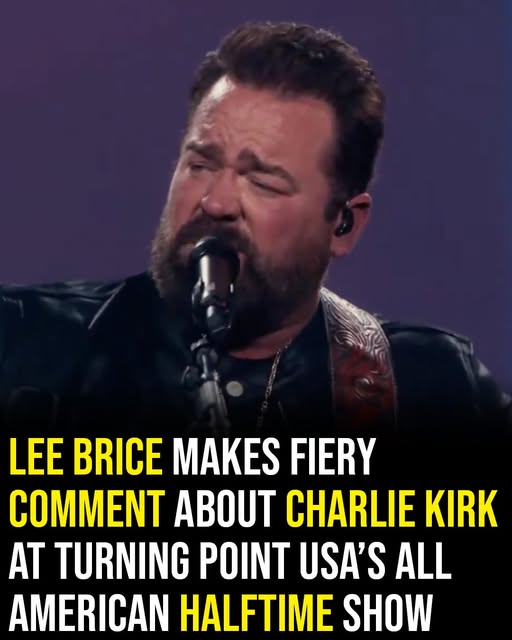
Lee Brice, a GRAMMY-nominated artist known for songs such as “I Don’t Dance,” “Rumor,” and “One of Them Girls,” added further gravitas. Brice’s career has been defined by emotional ballads and anthems reflecting small-town life, personal values, and relational experiences. Yet it was his words before performing that drew particular attention during the All-American Halftime Show.
Before launching into one of his songs, Brice addressed the audience directly, referencing Charlie Kirk’s legacy. He said, “Charlie gave people microphones so they could say what’s on their minds,” before adding, “This is what’s on my mind,” leading into his performance of It Ain’t Easy Being Country in This Country Nowadays. The remark framed the song as a personal statement, signaling that its themes were central to Brice’s message that evening.
The song itself spoke to cultural and political frustrations, capturing a sense of alienation felt by some Americans who identify strongly with rural, conservative, or traditional values. Brice’s lyrics highlighted the difficulties of maintaining a “country” identity in contemporary society, referencing social and cultural debates, while emphasizing faith, moral conviction, and a small-town worldview.
The performance quickly spread online, generating polarized reactions. Supporters praised Brice for speaking openly about his beliefs, seeing the song as an honest reflection of shared values, while critics argued that it reinforced divisive messaging. As with much of the All-American Halftime Show, responses largely followed existing political and cultural lines, underscoring the broader social context surrounding the event.
Unlike the official Super Bowl halftime show, the All-American Halftime Show did not seek to rival in production scale or global spectacle. Instead, it aimed to create a platform for artists and audiences who felt underrepresented by mainstream broadcasts. The inclusion of explicit commentary during Brice’s performance reinforced the show’s purpose as a cultural and ideological statement.
The event highlighted how music, politics, and cultural identity increasingly intersect in high-profile moments. While halftime shows have long carried symbolic weight, this parallel production made that intersection explicit. Rather than presenting a single, unified spectacle, the night offered two competing visions of what a Super Bowl halftime experience could represent—one emphasizing entertainment and mass appeal, the other emphasizing expression, belief, and identity.
By the end of the evening, the All-American Halftime Show had achieved its goal: it drew attention not only to the performers but also to the ideas the event sought to elevate. Lee Brice’s remarks and performance became one of the defining moments, encapsulating the tone TPUSA aimed to convey. Whether interpreted as an exercise in free speech or a polarizing cultural statement, the performance ensured that the alternative halftime show would remain part of the national conversation well beyond Super Bowl Sunday.
In an era where entertainment and ideology increasingly overlap, the All-American Halftime Show served as a reminder that music is rarely neutral. For artists and audiences alike, it functions as a vehicle for identity, belief, and personal truth—capable of sparking discussion long after the final note fades.