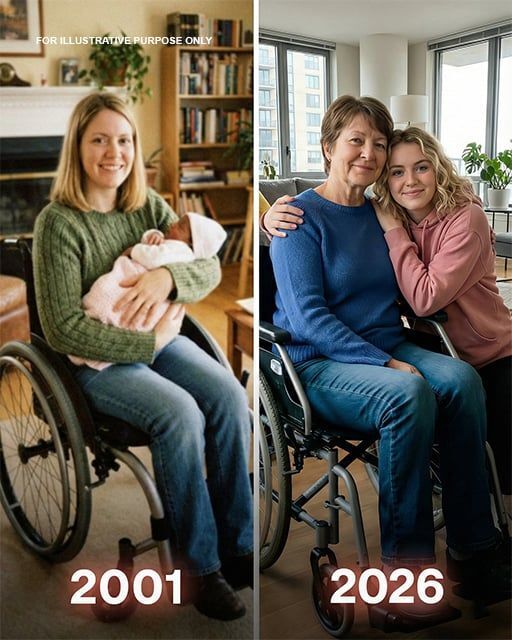
I was left on a stranger’s doorstep as a newborn and raised by a single woman who used a wheelchair. For twenty-five years, she was my entire world. Then, just as my life finally began to take shape, the woman who gave birth to me appeared and demanded a share of everything I had built.
My name is Camille, and this is how I learned what family truly means.
My mother, Ruth, has used a wheelchair for as long as I can remember.
To me, that was never unusual. I never thought of her as “disabled.” She was simply my mom—the woman who braided my hair with quick, confident hands, cooked full meals while seated, and somehow always knew when I was lying before I even spoke.
Long before I existed, her life had taken a very different path.
At twenty-three, a drunk driver ran a red light and slammed into her car. Ruth survived, but her spinal cord did not. Doctors told her she would never walk again. They also told her she would never carry a pregnancy.
She told me later that she cried once in the hospital. Just once. Then she wiped her face, stared at the ceiling, and said, “Alright. This is my life now. I’m not wasting it.”
And she didn’t.
She rebuilt everything. She learned to drive using hand controls. She found an apartment she could actually live in. She trained as a legal assistant, took public transportation when needed, and worked longer hours than most just to prove she belonged.
After the accident, she never planned on having children. That door was closed.
Until one winter morning.
She was getting ready for work when she heard crying outside her apartment door. Not a cat. Not someone passing by. A sharp, desperate sound—an unmistakable newborn’s cry.
She wheeled to the door, heart racing, already afraid of what she might find.
On the doormat sat a baby carrier.
Inside was a tiny newborn girl, red-faced and shaking with cold, fists clenched as if already fighting the world. A thin blanket barely covered her. Beside her lay a folded piece of notebook paper.
Ruth picked it up with trembling hands.
I can’t keep her. I have no choice. I’m sorry.
No name. No explanation. Just an apology that wasn’t enough.
Ruth called emergency services immediately. Paramedics arrived, wrapped me in warm blankets, and told her I was cold but healthy. They said social services would handle everything and asked if she wanted them to take me right away.
She looked down at my face and felt something settle deep inside her.
“No,” she said. “I’m going to be her mother.”
Everyone told her she was unrealistic. She was single. She used a wheelchair. She didn’t have money or family support waiting in the wings. People suggested she let a “normal family” adopt me.
She listened politely. Then she ignored them.
She endured inspections, interviews, and invasive questions about whether she could “handle” motherhood. More than once, someone implied disabled women weren’t ideal parents.
She pushed back every time.
Months later, the adoption was finalized.
She named me Camille.
From that moment on, it was just us.
No grandparents nearby. No extended family. No safety net beyond each other.
And yet, I never felt deprived of anything.
We did homework together at the kitchen table. She attended every school play and clapped louder than anyone else. If a building lacked a ramp, she demanded one. If someone spoke over her, she calmly made them address her directly.
On my first day of school, she adjusted my backpack straps and said, “You’re braver than you feel. Go prove it.”
At home, she taught me how to cook safely, how to advocate for myself, and how to sit with my emotions instead of dismissing them.
When I cried over friendships or grades or first heartbreaks, she never called me dramatic.
“Your heart doesn’t know it’s small,” she’d say. “So it hurts just as much. We respect that. Then we keep going.”
She told me I was adopted when I was young.
“One night, someone left you at my door,” she said simply. “I opened it. From that second on, you were mine.”
I never felt abandoned.
I felt chosen.
When I got into college, Ruth cried and blamed allergies. On move-in day, she rearranged my dorm room until it made sense.
Before leaving, she squeezed my hand. “You’re going to build something,” she said. “Just don’t forget where you came from. And text me.”
That “something” took shape my junior year.
My best friend Nora and I were sitting on the dorm floor, surrounded by clothes we hated.
We started sketching. Soft fabrics. Clean designs. Nothing loud or stiff.
Our dorm became a packing station. We pooled savings, ordered a small batch, printed locally, and posted them online with zero expectations.
They sold out.
We named the brand Threshold.
Ruth was there from the beginning.
After graduation, Nora and I rented a tiny office. No investors. No safety net. Just long days and stubborn hope.
We made mistakes constantly. Wrong sizing. Late shipments. Bad suppliers.
Ruth came by after work, folded shirts into perfect stacks, answered emails, flagged contracts.
“Quality control,” she’d say. “I’m ruthless.”
A few months ago, I bought my first car—nothing fancy, but paid off.
I jingled the keys for Ruth. “Threshold paid for it.”
She cried. “It’s not the car,” she said. “It’s that you did this.”
I thought that was the emotional peak.
I was wrong.
One Tuesday morning, I opened the door and froze.
A woman stood on the porch, mid-knock. Polished. Confident. She stared at my face like she recognized it.
“Camille?” she asked.
She introduced herself as Patricia—my biological mother.
She said she’d been looking for me. That she’d heard about my company.
“You’ve done so well,” she said. “I always knew you would.”
Then she said it.
“Without me, none of this would exist.”
She claimed she’d chosen Ruth deliberately. That she deserved half my business—and my car.
I smiled.
“There’s one condition,” I said.
I opened the door. “We’re not having this conversation without my mom.”
At the table, Ruth listened quietly.
Patricia thanked her for “raising me.”
“You left a newborn and walked away,” Ruth said calmly.
I brought out the photo album.
“Find one picture,” I told Patricia. “Any year. Any moment. Show me where you were.”
She couldn’t.
“I carried you,” she snapped.
“That was your choice,” I said. “Being a mother is everything after.”
I opened the door.
“You don’t get my business. You don’t get my car. You don’t get my life.”
She left.
That night, Ruth cried. “I was afraid you’d wish you’d gone with her.”
I held her. “You opened the door. You stayed. You’re my mother.”
We sat with the album between us—page after page of my life. Page after page of her.
And that’s when it settled completely.
DNA doesn’t make a family.
Showing up does.