Megan Foster had mastered the art of disappearing in plain sight. Inside the relentless, fluorescent-lit chaos of the Riverside Memorial Hospital emergency department, she moved with a quiet precision that made her almost indistinguishable from the machinery around her. Gurneys rolled past. Monitors screamed warnings. Voices overlapped in urgency and fear. Yet Megan flowed through it all like a shadow—present, essential, and somehow unseen.
At forty-eight, she had perfected invisibility so thoroughly that patients she cared for over long, agonizing hours often struggled to remember her face once they were discharged. They recalled the relief, the steady hands, the calm voice—but not the woman herself. Her name rarely lingered. She was known among the staff as the “invisible nurse,” a professional who spoke only when necessary, followed orders with clinical precision, and never demanded attention. She executed instructions flawlessly, without ego or protest, as though her own presence were irrelevant.
Her appearance reinforced that anonymity. Her scrubs were faded from countless wash cycles, the fabric worn thin at the elbows from years of leaning over hospital beds and gurneys. Her hair—once a rich brown, now threaded with silver—was pulled back into a tight, disciplined bun that smoothed the lines of her forehead and erased any softness from her features. There was nothing in her posture or expression that hinted at authority, experience, or a life lived beyond hospital walls. That, too, was intentional.
For Megan, invisibility was not a weakness. It was protection. A refuge. A carefully constructed barrier between who she had been and who she needed to be now. Being unseen meant she was never asked questions she didn’t want to answer. It meant no one looked closely enough to see the weight she carried or the memories she refused to relive. In the ER, she was just another nurse—and that was exactly how she wanted it.
That Tuesday was no different from dozens before it. The emergency room was overwhelmed, stretched thin by a relentless flow of trauma cases: broken bones, chest pains, respiratory failures, injuries that blurred together into a constant triage of urgency. Outside, sirens wailed endlessly, their echoes bleeding through the sliding glass doors. Inside, the air was heavy with antiseptic, ozone, and barely contained panic.
Megan moved from bed to bed with practiced calm. She adjusted IV drips, checked oxygen levels, monitored heart rhythms, and documented changes without hesitation. Her hands never shook. Her breathing never changed. At Bed Seven, a young man lay pale and sweating, his chest rising unevenly. Megan scanned his chart, her eyes narrowing almost imperceptibly as she noticed a dangerous drop in blood pressure paired with a rising heart rate.
She didn’t hesitate. She recalculated the medication dosage, reduced the sedative, and made a quiet adjustment that would prevent his airway from collapsing.
“Who changed this order?”
The voice cut sharply through the room—loud, irritated, and dripping with authority. Dr. Caleb Monroe stood at the foot of the bed, his freshly pressed white coat immaculate, his expression flushed with indignation. He was young, confident to the point of arrogance, and keenly aware of his rising status as the hospital’s newest trauma surgeon. To him, hierarchy was sacred—and nurses were meant to obey.
“I did,” Megan replied evenly.
Her tone lacked the defensiveness Monroe expected. There was no apology. No hesitation.
He stepped closer, invading her space. “You took it upon yourself to override my order?” he snapped. “You’re a nurse, Foster. Your job is to follow instructions, not to play doctor.”
Around them, staff members suddenly found reasons to look elsewhere. No one wanted to challenge the hospital’s golden boy.
“Yes, doctor,” Megan said calmly, turning back to her cart.
She appeared unbothered—but she wasn’t alone in the room.
From the waiting area, a man named Daniel Cross watched intently. His leg was braced in metal, his movements slow and deliberate, and his eyes—older than his face—never left Megan. Something about her posture, her restraint, the way she carried herself triggered a recognition that hit him like a memory he couldn’t ignore.
Ten minutes later, the ER erupted.
The trauma doors burst open as paramedics rushed in, pushing a gurney drenched in blood. “Trauma One!” someone shouted. “Severe blunt force chest injury! Oxygen saturation at sixty and dropping!”
Monroe sprang into action, his voice booming with rehearsed authority. “Chest tube set! Now!”
But as the monitor screamed and the patient’s heart flatlined, his confidence fractured. His hands trembled. The patient’s lips turned blue. Nurses struggled to establish access. Panic crept in.
“Charge the defibrillator!” Monroe yelled, his voice cracking.
Megan stepped forward—and in that instant, everything about her changed.
Her posture straightened. Her gaze sharpened. The quiet nurse vanished, replaced by someone terrifyingly focused.
“He doesn’t need a shock,” she said firmly. “Look at the trachea. Look at the jugular veins. This is a tension pneumothorax. His lung has collapsed and is compressing his heart. If you don’t decompress now, he will die.”
Monroe panicked. He grabbed a scalpel, but his shaking hands betrayed him.
Before he could make a fatal error, Megan moved.
She seized a large-bore needle, found the second intercostal space with instinctive accuracy, and drove it into the patient’s chest. The sound—a wet, violent release—filled the room as trapped air escaped. The patient gasped. The monitor steadied.
Life returned.
Silence followed.
Megan secured the needle calmly. “The pressure is relieved. You can proceed now.”
Monroe’s face burned with humiliation. “You’ve crossed a line,” he hissed. “That’s practicing medicine without a license. I’ll destroy your career. Who do you think you are?”
Megan said nothing.
Then metal scraped against the floor.
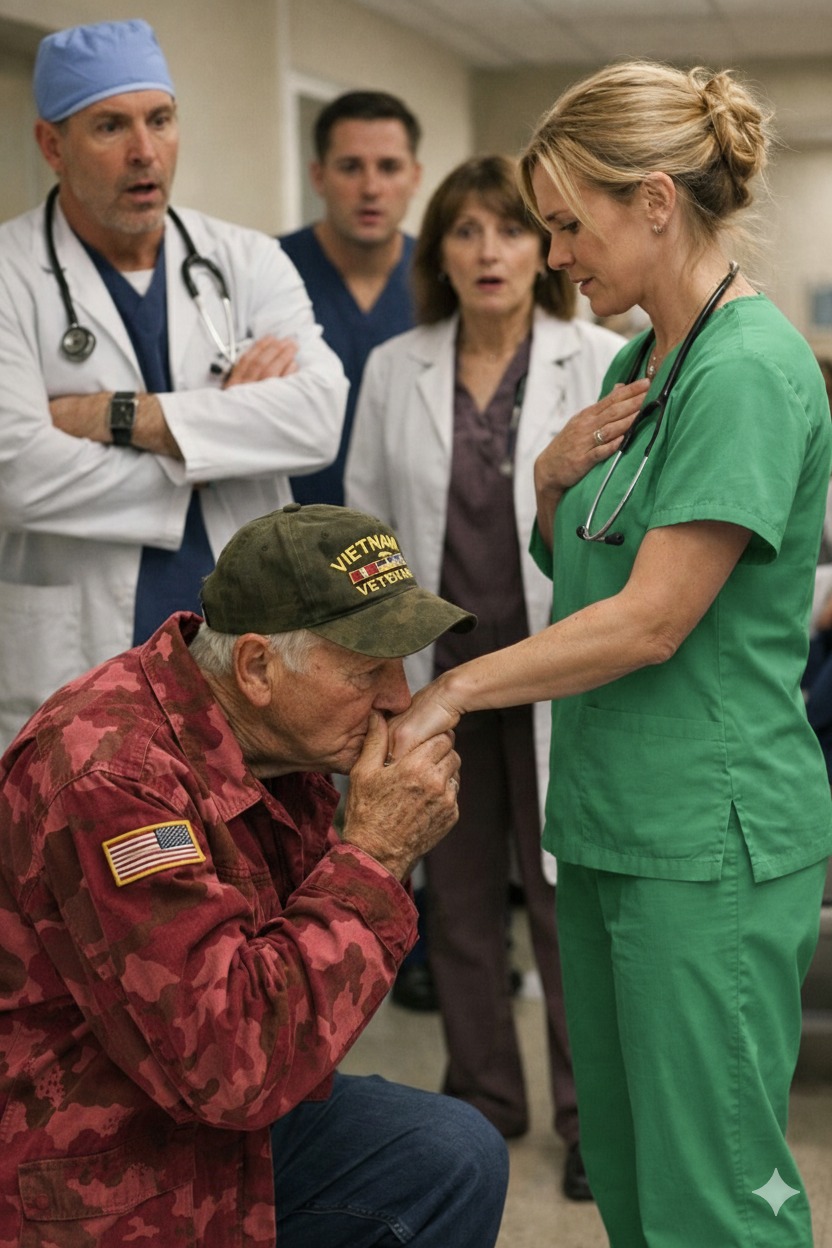
Daniel Cross stood, walked into the trauma bay, and dropped painfully to one knee in front of her.
“She saved my life,” he said.
And with that, the truth came out.
Megan Foster wasn’t just a nurse. She was a former combat surgical specialist. A woman who had operated under fire, in dirt and blood, saving soldiers when evacuation wasn’t possible. She had stayed when others fled. She had carried the dead when helicopters couldn’t.
She didn’t leave because she failed.
She left because she carried too much.
The investigation was swift. The evidence was clear. Monroe was suspended.
Megan returned to work days later, unchanged in appearance—but no longer invisible.
Every morning, veterans stood in the lobby and saluted as she walked past.
And for the first time in years, Megan allowed herself to be seen—not just as a nurse, but as a hero who had finally come home.