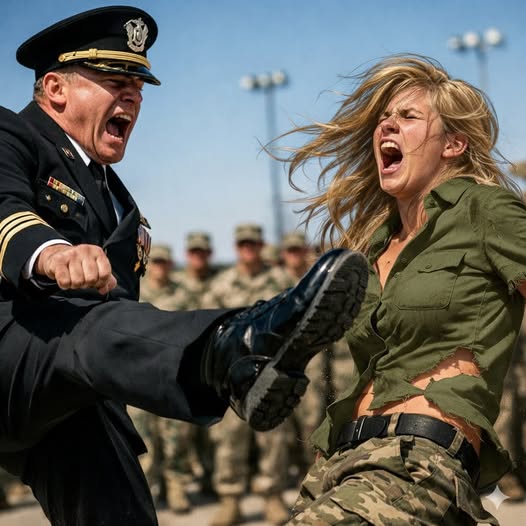
The wind off the Atlantic didn’t just blow—it interrogated. It cut through the open-air corridors of the training compound, rattling metal handrails and snapping loose straps on tactical vests like a rhythmic warning. On this afternoon, the air carried a tension that fabric and bravado could not mask.
It was readiness evaluation day—a controlled test of skill and endurance. Petty Officer First Class Elena Concaid stepped into the cordoned ring, feeling the unspoken scrutiny of 282 Navy SEALs. They stood in the hangar shadows, elite bodies of muscle and steel, sizing her up before she moved.
At twenty-eight, Elena possessed the lean, conditioned frame of a field medic. Her hair was woven into a tight, practical braid, and her face bore only the economy of focus—no extraneous expression. Nearby lay a faded Marine utility jacket, a relic of deployments she rarely discussed. She had survived three: two providing trauma care in combat zones, and one unlisted publicly. Elena didn’t come to talk—she came to teach.
The command had recently rolled out a “joint medic response” module. Officially, it emphasized support; in reality, it was survival distilled—how to keep a medic alive long enough for the medic to save them. It was defensive engagement training under ambush scenarios.
Chief Instructor Harmon, voice gravelly from decades of shouting over helicopter rotors, addressed the formation. “Today’s module focuses on retention protocols and escape under ambush.”
The crowd didn’t applaud. Skepticism rippled through them. Senior Operator Marcus Hail, six-foot-three and tattooed with his victories, and Gold Team trainee Brandon Riker smirked with obvious disdain.
“That’s the medic?” Brandon whispered. “She’s half my size.”
Marcus laughed. “Medic ballet. Let’s clap for support staff.”
Elena didn’t react. She clipped on her gloves, posture neutral—never pleading, never yielding. The first demonstrations were precise: she neutralized simulated ambushers with surgical efficiency, creating space and securing position without theatrics.
Slowly, the room’s mood shifted. Scoffing faded as operators recognized skill. But Marcus and Brandon escalated, their jabs sharpened by ego.
For the final drill, Elena requested a simulated encirclement—two attackers, unscripted motion. Harmon hesitated, then nodded. “One sequence. No head strikes. No intentional trauma.”
Marcus and Brandon approached, arrogance on display. Elena warned, “Two attackers change the protocol. You don’t win—you exit.”
“Then exit,” Marcus said.
The attack began. Marcus lunged right; Brandon surged left, delivering full-force strikes meant to flatten her. Elena absorbed the first blow, the second, and hit the mat with controlled assessment, pain reduced to data. She rose, eyes locked, expression neutral.
“You’ve crossed into live response,” she stated.
The declaration shifted the drill’s reality. Marcus charged again; Elena pivoted, redirecting his momentum. He collapsed with a sickening crack. Brandon lunged, and she neutralized him with the same clinical precision. Both men lay on the mat, undone by their own arrogance.
Elena immediately crouched, assessing circulation and shock. “Call medical. Now.”
Marcus required surgery; Brandon was stabilized. Elena was debriefed, not accused, recognized for her restraint. Thirty operators confirmed: she warned them, responded proportionally, and stopped when the threat ended.
No medal followed, but the culture changed overnight. Marcus and Brandon faced separation; Elena was reassigned as Lead Instructor for Medical Tactics.
Weeks later, Command Master Chief Julian Reyes met her. No handshake, just respect. “I’ve seen men freeze in your position,” he said. “You didn’t. You didn’t overcorrect or perform. That is professionalism.”
Next time Elena entered the training ring, no one called it “medic ballet.” The 282 Navy SEALs didn’t just watch—they listened. Elena wasn’t there to impress—they realized she was there to ensure they survived.