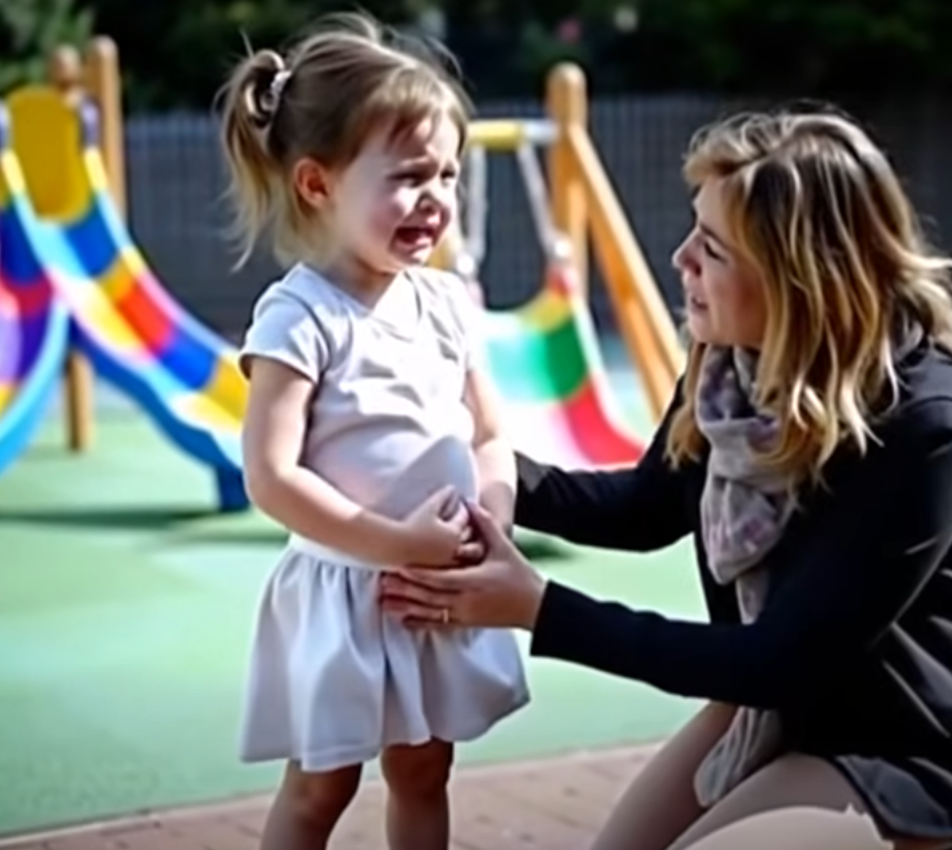
The morning at Lincoln Elementary began like any other, with the familiar symphony of slamming lockers, squeaky sneakers on polished floors, and the high-pitched chatter of children eager to share weekend adventures or a funny story from home. The sun poured through the tall windows, casting geometric patterns across the classroom floor, but for Rachel Thompson, a veteran educator with decades of experience, something felt subtly off. Her instincts, honed through years of listening to children’s silences as much as their words, had been tingling from the moment she set foot in the classroom.
When Emily crossed the threshold, Rachel knew immediately that this was not the energy she normally saw. Emily, usually bright and effervescent, moved stiffly, with a laborious, wide-legged gait, as though every step required an immense, exhausting effort. It wasn’t simply a limp; it was a physical manifestation of a hidden torment, a weight of experience far too heavy for someone of her age. Rachel watched her lower herself into her seat, her small face taut with a kind of stoicism that seemed far beyond her years. The girl’s fingers clutched the edge of the desk as if bracing herself against the world.
Throughout the morning lesson, Rachel’s attention kept returning to Emily’s desk, even as she guided the class through math problems and reading exercises. She knew that children often lacked the words to describe their most pressing fears or suffering. Instead, they communicated through subtle cues—stiff postures, withdrawn glances, or nervous fidgeting. The more Rachel observed, the more she realized that Emily’s struggle went beyond ordinary discomfort or shyness.
When the class was dismissed for a brief recess, Rachel asked Emily to stay behind. The other children spilled into the hall, laughing and chattering, while Emily remained frozen in her chair, her body tense, her eyes downcast. Rachel knelt beside her, meeting her gaze and gently asking if she was okay. Emily’s reply was a hollow, practiced nod. But as Rachel’s eyes traveled downward, she saw the undeniable sign: Emily’s pants were rigid, and a dark, telltale stain had begun to seep through the fabric. It was not a playground mishap or a simple accident. Rachel felt a wave of panic and protective instinct crash over her. She led Emily quietly to the nurse’s office, her mind racing, heart pounding with the certainty that the child was in immediate danger.
In the privacy of the nurse’s office, the severity of the situation became starkly clear. Emily bore visible signs of severe, untreated trauma, evidence of neglect or abuse. Rachel’s hands trembled as she dialed 911, speaking with controlled urgency, requesting immediate medical and police intervention. She stayed with Emily, offering as much comfort as she could while knowing that the world outside was indifferent to the silent suffering of a child.
After Emily was taken away by paramedics, Rachel returned to her classroom, but the familiar routines now felt hollow. The hallways seemed muted, the classroom cavernous, and the laughter of her students faint against the weight pressing down on her chest. One brave student asked where Emily had gone. Rachel chose her words carefully, telling the children she was unwell and going to get help, urging them to keep her in their thoughts. She hid her own grief, determined to shield the other students from the gravity of the morning’s events.
Throughout the day, Emily’s absence was a constant presence. Rachel found herself frequently glancing at the empty desk, half-expecting her student’s cheerful smile to return, yet knowing that Emily’s road to recovery would be long and difficult. Rachel’s thoughts churned with painful questions: How long had this been happening? Had the signs always been there, hidden in plain sight? Were the people who were supposed to protect Emily—the very adults entrusted with her care—responsible for her suffering?
Her reflections were interrupted by Principal Anderson, who appeared at the door with a solemn expression. He gestured for Rachel to step into the quiet hallway. In low, deliberate tones, he informed her that child protective services and the authorities had been notified and would require a detailed statement. Every observation, every subtle sign, would be crucial for the case. He placed a reassuring hand on her shoulder. “Rachel,” he said softly, “what you did today may have saved her life. That takes courage.”
As the school day ended and the halls emptied, Rachel lingered in her classroom. The emptiness was palpable; every sound, even the scratch of a pencil or the faint hum of the radiator, felt amplified. On her desk lay a drawing Emily had made the week prior—a large yellow sun shining down on a house surrounded by colorful flowers. Rachel traced the sun’s outline with her finger, feeling the warmth of Emily’s resilient spirit, the hope and joy she still carried despite the darkness of her home life.
That evening, Rachel returned home, the quiet of her apartment pressing in. She sat at the kitchen table, the image of Emily’s suffering still vivid in her mind. She knew that making a phone call was only the first step; the real responsibility was ensuring Emily’s story would be heard, her needs met, and her rights protected. Rachel contacted a local child advocacy group, offering her testimony and ongoing support, determined that Emily would not become just another file lost in the bureaucratic shuffle.
As Rachel prepared for bed, she visualized Emily in a safe space for the first time, perhaps feeling the security of a room where no one could harm her. She whispered a silent promise—not only to Emily, but to all children who silently carry pain. She vowed that in her classroom, no child would face fear or suffering alone. The day had begun with a limp and a stain, but it ended with the resolve of a teacher committed to being a guardian, a beacon of safety and hope, ensuring that the sun in a little girl’s drawing would continue to shine brightly, regardless of the shadows around her.