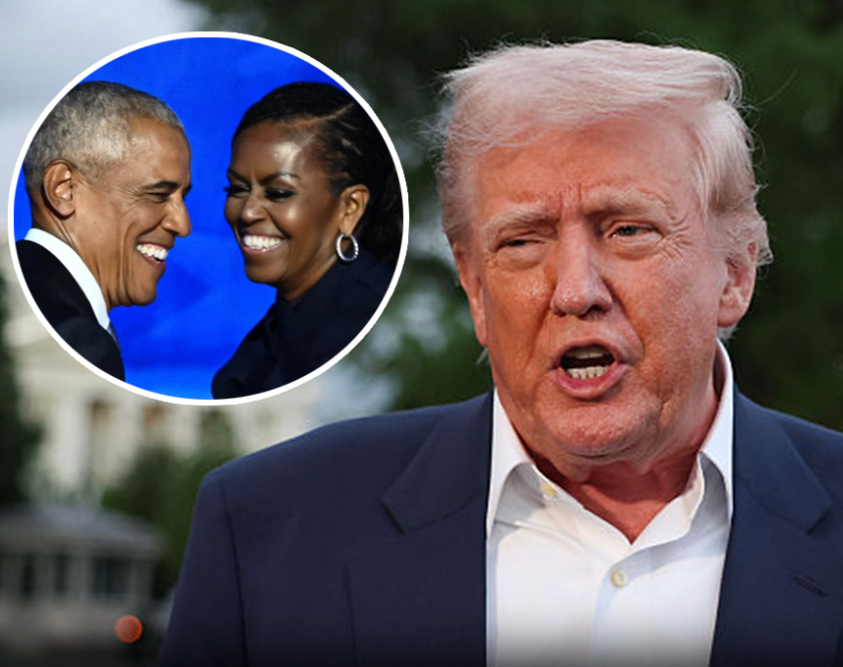
American politics for centuries—and he did it deliberately. With a single Truth Social video, the former president is now accused of pushing political discourse into unmistakably racist territory, depicting former President Barack Obama and former First Lady Michelle Obama as monkeys. The backlash was immediate and ferocious. Social media erupted, civil rights leaders condemned it, journalists dissected it frame by frame, and Republicans found themselves once again cornered by a familiar question: defend Trump, distance themselves, or say nothing at all. The Biden White House responded by downplaying the post, while the continued silence from the Obamas has grown louder with every passing hour.
The video did not appear in isolation. It was buried among more than sixty posts Trump published in a rapid-fire Truth Social spree—an online barrage mixing campaign rhetoric, conspiracy theories, and grievance politics. Yet this clip stood apart. For many Americans, the image crossed a line that cannot be explained away as satire, trolling, or edgy internet humor. Comparing Black people to monkeys is not a new insult; it is one of the oldest and most dehumanizing racist tropes in U.S. history, rooted in slavery, segregation, and pseudoscientific justifications for racial violence. Critics argue that invoking that imagery—especially when aimed at the nation’s first Black president and first lady—was not accidental, careless, or misunderstood. It was intentional.
Civil rights advocates and historians were quick to point out why the reaction was so visceral. This was not merely offensive content; it was symbolic violence. For generations, such imagery was used to deny Black Americans their humanity, justify exclusion from public life, and normalize abuse. To see it resurface in 2026, amplified by a former president and current political contender with millions of followers, felt to many like a grim regression rather than a shocking surprise. Commentators described the post as “vile,” “indefensible,” and “openly racist,” arguing that it marked a new moral low even by Trump’s well-documented standards of provocation.
At the same time, the response exposed how fractured the American political landscape has become. Some Republicans—particularly those already uneasy with Trump’s influence—publicly recoiled. A handful called the post “wrong,” “unhelpful,” or “beneath the office,” carefully choosing words that signaled discomfort without fully confronting the racial implications. Others went further, condemning it outright as racism. But many rushed to Trump’s defense, insisting the outrage was exaggerated, manufactured, or politically motivated. They framed the backlash as another example of “cancel culture” or claimed critics were projecting meaning onto an image that was never meant to be taken seriously.
The White House’s reaction added another layer of controversy. By characterizing the video as harmless internet culture or dismissing it as unserious, officials fueled accusations that institutions remain reluctant to confront racism head-on—especially when doing so risks escalating political conflict. To millions of Americans, the message felt chilling: that imagery carrying generations of pain could still be waved away as a joke if enough power stood behind it.
And then there is the silence. Barack and Michelle Obama have not responded publicly. No statement. No tweet. No rebuttal. That quiet has become its own kind of commentary. For some, it reflects dignity—a refusal to dignify hate with a response. For others, it underscores the exhaustion of repeatedly being dragged into the same cycle: provocation, outrage, denial, and division. Their absence from the noise has only sharpened the contrast between those seeking accountability and those eager to move on.
Ultimately, this moment is about far more than a single video. It is about what is considered acceptable in American political life, who is allowed to dehumanize whom, and how often racism is excused when it comes wrapped in irony or labeled “just a meme.” Trump’s defenders may insist this is nothing more than rough political theater. But for many Americans, especially Black Americans, it landed as a reminder that the ugliest ideas in the nation’s past are never as far away as we like to believe. Whether this episode becomes another fleeting outrage or a true reckoning will depend less on Trump himself and more on how the country chooses to respond when the line is crossed—again.