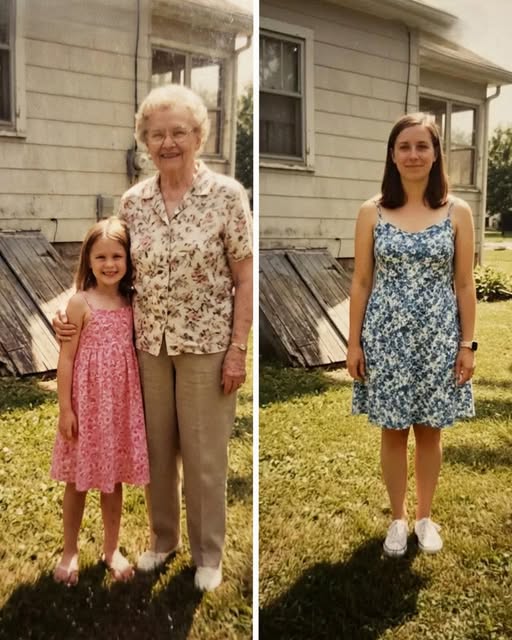
Grandma Evelyn’s legacy rested on sunlit porches, the warm scent of cinnamon-dusted apple pies, and an unshakable strength that had held our family together for generations. To the world, she was the quintessential matriarch of our small town—a woman of few words but strong convictions. After my own mother passed away, she raised me with fierce independence, teaching me how to navigate adulthood, set boundaries gracefully, and stand tall in adversity. But there was one boundary she never allowed me to cross: the basement door.
For forty years, that door stood silent in the hallway, secured with a heavy brass padlock that seemed out of place in her cozy, lace-curtained home. As a child, I imagined elaborate secrets behind it—hidden treasure, wartime relics, or “dangerous old things” she claimed were stored there. As I grew older, the door became part of the house’s geography, a mystery I respected out of love for Evelyn.
Evelyn passed away quietly on a Tuesday, leaving a life marked by steady resolve. After the funeral, when the last mourners had left and the house felt vast and cold, I stood before the basement door. My husband, Noah, was beside me, sensing the tension in the air. The house was now mine—and with it, the responsibility of uncovering the secret held there for four decades.
With one decisive strike of a hammer, the padlock shattered. The door creaked open, releasing a gust of cold, stagnant air scented with cedar and old paper. We descended the narrow wooden stairs, the beam of my flashlight cutting through a thick veil of dust. I expected clutter, but instead, we found a shrine. The basement was meticulously organized. Cardboard boxes, labeled in Evelyn’s elegant cursive, lined the walls.
I reached for the top box. Inside, beneath yellowed tissue paper, lay a hand-knitted baby blanket in faded pink and a pair of tiny wool booties. Beneath them was a black-and-white photograph that made my heart skip: Evelyn at sixteen, holding a newborn with a look of profound, agonizing love. The baby was not my mother.
Noah and I spent hours exploring. Each box revealed a hidden chapter of Evelyn’s life: sealed adoption records from a now-defunct agency, legal rejection slips stamped “Confidential,” and stacks of unsent letters to a daughter she had never known. Finally, I found a leather-bound notebook—a chronicle of her lifelong search.
The pages revealed Evelyn’s private torment. While baking pies and cheering at graduations, she secretly scoured records, made long-distance calls, and pleaded with unhelpful bureaucrats. “They won’t tell me anything,” she wrote in 1974. By the 1990s, her notes grew desperate: “Called the agency again. Still nothing. I just need to know she’s okay.” The last entry, from two years before her death, read shakily: “I am running out of time, but I haven’t stopped looking for you, Rose.”
Evelyn hadn’t locked the door out of shame. She had locked it to protect a grief too heavy to share—the private existence of a daughter she had been forced to give up. She carried two lives: the public grandmother everyone relied on and the private mother who haunted her own basement.
Sitting on the cold concrete floor, clutching the notebook, I whispered to Noah, “She did this all alone. She never stopped.”
I felt a crushing obligation to finish her search. Using DNA databases and social media, I pieced together fragments of Rose’s life. Weeks of dead ends finally led to a high-confidence match with a woman named Rose, living less than fifty miles away.
I messaged her, hands trembling: I was Evelyn’s granddaughter, and I believed we were family. Rose responded the next morning. She had always known she was adopted but had been told her biological mother wanted no contact—a lie, likely enforced by the agency.
We met in a sunlit café. I immediately recognized Evelyn in Rose: in the careful way she held her coffee cup, in her deliberate grace. I slid the photograph of sixteen-year-old Evelyn across the table. Rose’s face drained of color, and she touched the image with a trembling finger, decades of unanswered questions finally landing.
“She looked for me?” Rose whispered.
“Every day,” I said. “She never stopped. She kept everything. Every blanket, every letter. You were never a secret she wanted to forget.”
Over the past year, Rose and I have slowly woven our lives together. Our bond isn’t a Hollywood ending—it’s the quiet, beautiful rhythm of building a new family. We share small things—our shared love of overly sweetened tea, a stubborn streak likely inherited from the same source. When Rose laughs, her voice echoes the kitchen of my childhood, and it feels like a rift in time has finally healed.
The locked door was never an ending—it was a bridge. Evelyn built that bridge silently, waiting for someone strong enough to cross it. She left not a house of secrets, but a map of a love too resilient to be contained by a lock or a grave. Every time I see Rose, I realize the hardest part of packing up my grandmother’s house wasn’t saying goodbye—it was the honor of finally letting the light into the room where Evelyn had waited for so long.