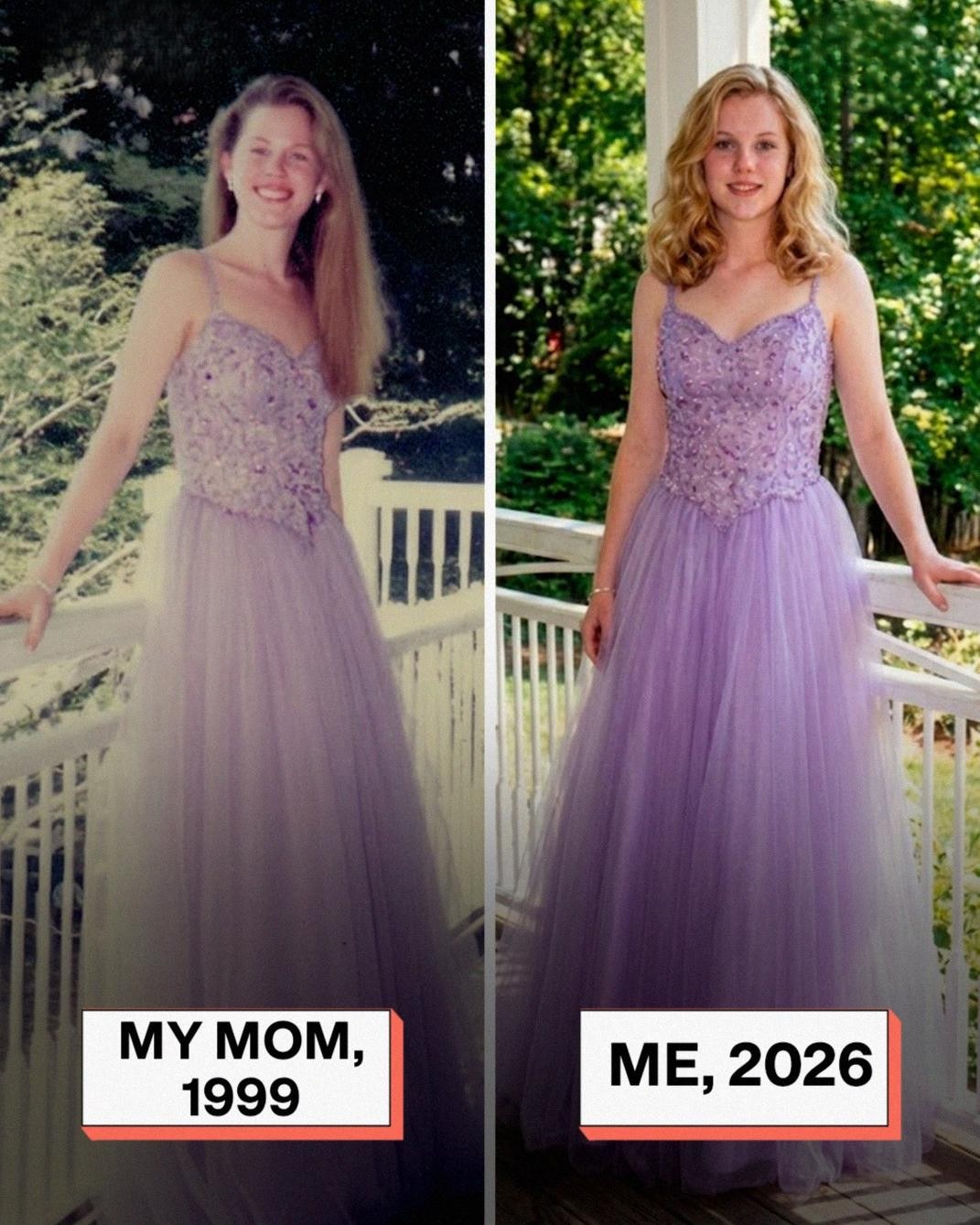
Prom night was supposed to be magical, a dream come true filled with laughter, sparkling dresses, and fleeting moments you hoped would last forever. But for me, Megan, 17, the night carried more weight than most. One cruel act nearly shattered it all—but what my stepmom didn’t realize was that love, memory, and a father’s quiet, unwavering strength are not so easily broken.
Growing up, prom had always been wrapped in a special memory: my mom’s. She had a lavender satin dress with delicate spaghetti straps and embroidered flowers across the bodice, the kind of dress that made the air shimmer around her. The pictures of her wearing it, taken on her graduation night, seemed to glow with everything youthful and radiant—a teen magazine spread come to life.
Her hair fell in soft curls, her lips glossed, her smile lit up every room. I remember sitting on her lap as a little girl, tracing the pictures in her scrapbook, whispering, “Mom, when I go to prom, I’ll wear your dress too.” She’d laugh softly, the kind of laugh that made you feel safe and understood. She would touch the satin lightly, smoothing it like a secret treasure. “Then we’ll keep it safe until then,” she’d say, and I believed her. I trusted that someday, I’d walk across that dance floor in her dress and carry a piece of her with me.
Life doesn’t always keep promises.
Cancer took her when I was twelve. One month she was tucking me in, singing softly, and the next she was too weak to stand. I barely had time to comprehend her absence before she was gone, leaving a silence that swallowed our house whole. My dad tried to hold it together for both of us, but I could see his grief in the way he stared at her side of the bed every morning, in the quiet pause of his footsteps in the kitchen, in the hollow laughter that never reached his eyes. We were surviving, not living.
After her funeral, that lavender dress became my anchor. I tucked it away in the back of my closet, hidden in a garment bag. When nights were long and unbearably quiet, I would unzip it just a crack to touch the satin, pretending she was still there. That dress wasn’t just fabric. It was her voice, the smell of her perfume, her laugh off-key while flipping pancakes on Sunday mornings. Wearing it to prom wasn’t about fashion—it was about keeping a piece of her alive.
Then came Stephanie.
My dad, still grieving but needing companionship, remarried when I was thirteen. Stephanie moved in with her expensive taste, her perfectly arranged white leather furniture, and her constant critiques of everything in our home. “Tacky,” “outdated,” “cheap”—nothing was safe from her judgment. My mom’s ceramic angel collection vanished in the first week; she called them “junk.” The family photo wall disappeared next. One day, I came home from school to find our oak dining table—the one where we carved pumpkins, celebrated birthdays, and shared every holiday meal—out on the curb.
“Refreshing the space,” Stephanie said brightly as she added another throw pillow to the now sleek, impersonal living room. “It’s for a modern touch.”
My dad asked me to be patient. “She’s just trying to make it feel like home,” he said, but it was clear—this wasn’t our home anymore. It was hers.
Stephanie’s disdain extended quickly to the dress. The day before graduation, I twirled in front of the mirror, imagining my mom’s smiling face behind me. Stephanie walked in, her nose wrinkled as though I had shown her something repulsive.
“Megan, you can’t be serious,” she said, clutching a glass of wine like it would give her authority. “You want to wear that to prom?”
I held the garment bag protectively. “It was my mom’s. I’ve always dreamed of wearing it.”
She set her glass down too hard. “Megan, that dress is decades old. You’ll look like a ghost from a thrift store donation bin.”
“It’s not about the look,” I said, my throat tightening. “It’s about the memory.”
Stephanie stepped closer, her finger pointing like a dagger. “You can’t wear that rag! You’ll disgrace our family. You’re part of my family now, and I won’t have people thinking we can’t afford to dress you properly.”
“I’m not your daughter,” I whispered before I could stop myself.
Her jaw tightened. “Well, maybe if you acted like one, we wouldn’t have these problems. You’re wearing the designer dress I picked out, the one that cost thousands!”
I stood my ground. “This is special. I’m wearing my mom’s dress.”
Stephanie laughed, sharp and empty. “Your mom’s gone, Megan. She’s been gone a long time. I’m your mother now. You’ll wear what I say and smile while doing it!”
I held the satin against my chest, feeling my mother’s presence in every inch of the fabric. “This is all I have left of her,” I whispered.
The argument left me trembling. That night, I cradled the dress on my bed, whispering apologies to a mother who could no longer hear me. And I made a decision: no one would erase her, not entirely.
The next morning, butterflies swirled in my stomach as I prepared. I curled my hair, used the lavender clip my mom once pinned hers with, and touched the soft satin once more. But when I unzipped the garment bag, my heart stopped.
The satin was ripped down the seam. The bodice was stained with a dark, sticky substance resembling coffee. The embroidered flowers were smudged with black ink. I fell to my knees, clutching the ruined fabric, whispering “No… no…” over and over.
Then I heard her voice, sweet and venomous.
“Oh. You found it.” Stephanie leaned in the doorway, smug, her voice syrupy. “I warned you not to be stubborn.”
“You… did this?” I whispered, tears streaming.
“I couldn’t let you humiliate us,” she said. “You were going to look like a ghost from a bargain bin.”
“It’s my mom’s,” I choked. “It’s all I have left.”
Stephanie rolled her eyes. “Now, I’m your mother. Enough with this obsession! You’ll wear the gown I chose. It belongs in this century.”
I shook my head. “I don’t want it.”
She stepped closer. “Stop playing pretend. Smile. Be grateful. Stop clinging to a dead woman’s things.”
My chest ached as she left, her shoes clicking down the hall like gunshots.
But then, a soft voice interrupted.
“Megan? Sweetheart? No one answered, so I let myself in.”
It was my grandma, my mom’s mother. She rushed upstairs, found me crumpled on the floor, and gasped at the dress.
“She destroyed it, Grandma. She actually destroyed it,” I sobbed.
Grandma examined the tears and stains, then her eyes blazed with a fire I hadn’t seen in years. “Get a sewing kit and peroxide. We’re not letting that woman win.”
For hours, we worked together. Grandma scrubbed, stitched, and repaired with painstaking care. When she was done, the dress gleamed as though reborn.
“Try it on,” she said.
I did. It fit, slightly stiff in places, but beautiful. Still hers. Still mine.
At prom, the lavender dress sparkled. Friends gasped, classmates whispered. I danced, laughed, and let myself be seventeen.
When I got home, my dad hugged me tightly. “Megan… you look beautiful. Just like your mom.”
Stephanie appeared at the end of the hall, scoffing and sneering. Dad’s voice was calm but firm, steel wrapped in velvet: “No. She honored her mother. You will never hurt her again.”
Stephanie stormed out, furious.
Grandma stayed late that night, and returned the next morning with muffins. We sat in the kitchen—just the three of us. Peace had returned.
I hung the lavender dress back in my closet, proof that love and memory survive.
And I survived too.