In the quiet suburbs of Michigan, a place where life usually moves to the rhythm of high school football scores, weekend trips to the donut shop, and the occasional whisper of autumn wind through the maples, my world was once illuminated by a warmth so vivid it could not be ignored. My mother, Sarah, was that warmth. She carried herself with a gentle luminosity, a steady courage that never wavered, even after she was diagnosed with cancer when I was only eleven. Her presence was like a soft, constant light in the periphery of every day, a reassurance that life, though fragile, was still beautiful.
Among her many signatures, her scarves stood apart. They were not mere accessories, but extensions of her personality, her moods, and her resilience. There were soft pastels for spring, rich silk florals for Sunday mass, chunky knits for winter evenings, and delicate chiffon for those rare summer nights when the air seemed to hum. Even through the grueling cycles of chemotherapy, when her hair thinned and the hospital became a second home, she refused wigs. She tied her scarves in intricate knots and flowing loops, a visual affirmation that she was still Sarah, still radiant, and still unbowed by illness.
When she passed, those scarves were carefully folded into a floral box with a lid adorned in pink hydrangeas and placed on a high shelf in my closet. It became my sanctuary, a place where her presence lingered in the gentle scent of jasmine and vanilla. Whenever the silence of the house became almost unbearable, I would retrieve the box and inhale the fragrance, letting it fill the empty chambers of my chest as if receiving a hug from someone who no longer existed in the material world. For three years, it was only my father and me navigating the wreckage of our grief. He was a man of quiet industry, burying himself in home repairs and overtime projects to avoid confronting the stillness, the emptiness.
Then, Valerie arrived.
She was a woman of finance, a creature of beige tones and minimalism. Her scent was powdery and citrusy, neat and controlled, just like the spaces she inhabited. At first, her presence seemed innocuous—a gentle addition to our lives—but gradually, a chill began to seep into the corners of our home. Valerie had a surgical approach to order that always came at the cost of memory. She removed what she considered “clutter,” but in practice, this meant the erasure of my mother. Photos disappeared from counters, favorite mugs vanished, trinkets and scarves alike were quietly banished. “Focus on what’s ahead, Emma, not what’s gone,” she instructed me, as if grief were a choice that could be neatly shelved. I learned to mourn in the shadows, keeping my box of scarves hidden behind sweaters and old coats, like a secret shrine to the woman I still loved.
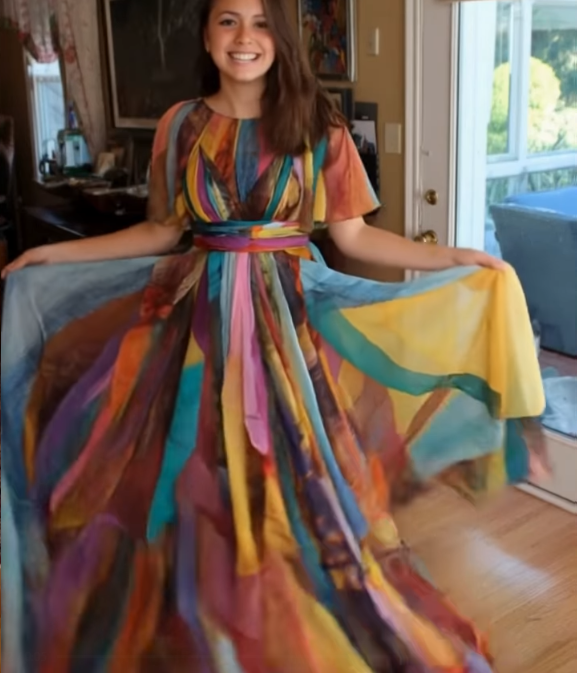
As my senior year approached, the excitement of prom season overtook the school. While other girls obsessed over sequins and designer labels, I found a quiet, defiant inspiration: I would sew my own dress. Using my mother’s scarves, I would transform memory into fabric. For two weeks, I retreated to my room after school, piecing together the silk she wore to church, the turquoise cotton from my twelfth birthday, the deep red wrap my father gave her for our last Christmas together. Every stitch became an act of devotion, each seam a thread connecting past and present. By the time I finished, the dress shimmered with memory—a swirling tapestry of color, texture, and love.
Prom morning arrived with a rare sense of peace. I curled my hair as Mom would have, fastened the gold locket she gave me for my tenth birthday, and stood ready to face the world. But when I opened my closet door, the world fractured. My dress was gone. In its place, the scarves lay shredded, limp, and torn—a graveyard of silk and cotton. My breath caught, and my knees buckled as I tried to gather the pieces. Behind me, the click of heels announced Valerie’s calm, terrifying presence.
“You’re welcome,” she said, holding her coffee mug like a scepter of control. She had “saved” me from humiliation, she claimed, by destroying the very relics that kept my mother alive in my heart. The cruelty was casual, surgical, precise. My father arrived then, having heard the commotion. The grief in his eyes ignited into a protective blaze. He did not see just a ruined dress; he saw the violation of a life and love he had cherished. Valerie was told she had no right, none, and she was ordered to leave that night. For the first time, I felt my father’s grief shield me. I was no longer the quiet one; I was a daughter whose sorrow mattered, fiercely defended.
Seeking a sanctuary, I carried the scraps to Mrs. Henderson, our textiles teacher. She became my collaborator, my witness, my ally. Together, we transformed the wreckage into a new creation. Frayed threads were reinforced; torn silk was repurposed. The yellow panel became a heart-shaped bodice, the red wrapped with stronger lining. Though the dress bore the scars of destruction, it radiated resilience and love in a way the original had never done.
That evening, I stood before the mirror, seeing not just fabric, but survival woven into each stitch. When I entered prom, I was not a victim of grief or vandalism; I was a canvas of love, memory, and defiance. My peers saw not the torn remnants, but a story made tangible. One girl whispered, “It looks like the dress is telling a story.” I smiled, because it was telling the story of my mother, my grief, and my refusal to let love vanish.
Returning home that night brought the final resolution. The porch light was off; the house felt open, bright, unburdened. Valerie was gone, her scent and cold orderliness replaced by emptiness that felt like relief. My father met me at the door, eyes glistening, and told me I looked like my mother on the day they met. Together, we admired the patched dress, imperfect yet profoundly real. Piece by piece, seam by seam, we had stitched not only fabric, but life itself. The house, once a shadow of grief, was finally, truly, home again.