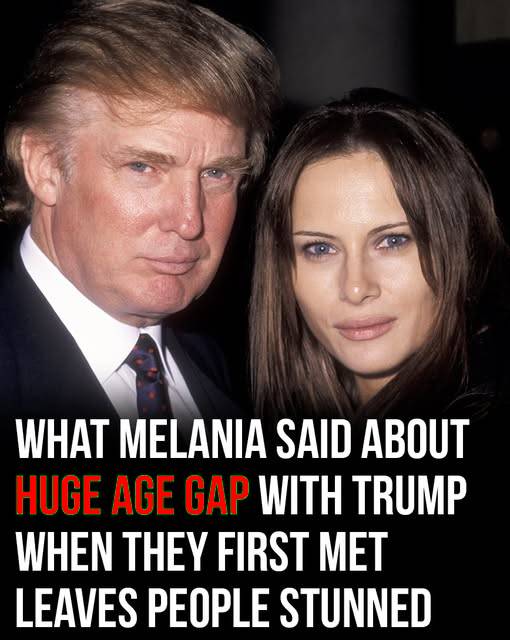
The enduring fascination with the partnership between Donald and Melania Trump often centers not only on the stark optics of their public lives but also on the subtle psychological dynamics that govern high-profile relationships. While much of the discourse surrounding the couple tends to focus on the twenty-four-year age gap, Melania’s personal reflections offer a rare, intimate perspective that challenges the assumptions of casual observers. This gap, far from being a barrier, appears to have been an invisible thread that facilitated mutual understanding, emotional grounding, and a unique equilibrium in a world that demands constant performance.
To truly grasp the origins of their connection, one must journey back to the autumn of 1998, a year that marked a critical crossroads for both individuals. At the Kit Kat Club in New York City—a legendary venue known for its mix of high-energy socialites, ambitious creatives, and glittering nightlife—Melania Knauss, a twenty-eight-year-old model from Slovenia, encountered Donald Trump, then fifty-two, a man whose presence in real estate and media had already reached iconic proportions. At that time, Trump had navigated two marriages and divorces publicly, raising four children while simultaneously cultivating his empire. The generational divide and his complicated history might have intimidated many, but Melania recalls experiencing an almost immediate resonance with him, a spark that defied the chronological distance between them.
In her memoir, Melania articulates a visceral, almost spiritual reaction to that first encounter. She describes an internal recognition, a sense that she had met someone who mirrored not her age but the emotional and energetic frequency she carried. Despite noting that Trump was “a bit older,” she emphasizes the immediacy of their connection, which she felt was “instant, undeniable, and profoundly real.” Returning home that night, she writes, she was “giddy with joy,” a phrase that conveys not superficial infatuation, but a youthful, genuine excitement born from a rare alignment of personalities, values, and unspoken understanding.
One of the most striking aspects of her account is her depiction of Trump’s demeanor during that period. Contrary to the media caricature of a brash, untouchable mogul, Melania portrays him as imbued with a genuine vitality and charisma, tempered by surprising approachability. She was captivated by what she describes as his “zest for life,” an infectious energy that contrasted sharply with the overly curated social circles she had navigated as a model. For Melania, this authenticity was magnetic, fostering a connection she later described as “as if our souls had known each other for a long time,” an experience she frames as almost timeless rather than tethered to a specific age or social expectation.
However, the formation of their relationship was not devoid of complexity. Accounts of that night at the Kit Kat Club reveal that Trump had arrived with another date, prompting Melania to initially resist his advances. This initial rebuff highlights her independence, self-assurance, and a selective approach to trust—a defining characteristic that would later shape the balance of their partnership. Undeterred, Trump persisted, eventually securing her phone number, and their correspondence and subsequent meetings laid the groundwork for a relationship that would eventually dominate social columns, power circles, and media narratives in New York City.
By the turn of the millennium, their courtship had evolved into a public partnership, marked by appearances at gala events, fashion shows, and prominent social gatherings. The trajectory culminated on January 22, 2005, in a wedding that fused opulence with symbolic personal expression. Melania’s custom Christian Dior gown, valued at $200,000 and crafted with over 1,000 hours of labor, epitomized both the grandeur of their union and the meticulous care she invested in representing herself. The strapless bodice and dramatic train were complemented by an elaborate celebration at Mar-a-Lago, attended by 450 luminaries from politics, business, and society. The menu included caviar and a cake adorned with 3,000 handcrafted sugar flowers—a visual testament to Trump’s penchant for spectacle—but Melania insists that the emotional core of the marriage always rested on their initial “undeniable chemistry.”
Throughout their twenty-one years of marriage, transitioning eventually to the White House stage, the couple has maintained a notably private core amid immense public scrutiny. The birth of their son, Barron Trump, added layers of parental responsibility and protection, which Melania has consistently safeguarded. She asserts that, despite relentless commentary on the age difference and the controversies surrounding Trump, their connection has always felt intuitive and natural. This perspective challenges reductive narratives that frame large age-gap marriages solely as transactional or socially strategic arrangements.
The contrast between Melania’s public persona—often stoic, enigmatic, and reserved—and the intimate, almost lyrical descriptions she provides in her memoirs offers a rare window into the internal dynamics of the relationship. While critics emphasize the numerical gap as a source of imbalance or power asymmetry, Melania reframes it as a stabilizing factor: his experience and age provided a sense of security and emotional grounding, allowing her to navigate a new country, a demanding career, and the high-stakes world of elite social circles with confidence and autonomy.
As the Trumps occupy a distinctive space in American cultural memory, Melania’s reflections underscore the divergence between public perception and private reality. She consistently emphasizes that her feelings at twenty-eight were authentic, unmediated by external expectation, and grounded in a perception of soul-level compatibility. Her narrative complicates conventional assumptions about large age differences, illustrating how psychological alignment, shared energy, and emotional resonance can outweigh chronological metrics in sustaining long-term relationships.
Ultimately, Melania’s memoir portrays her not as seeking a mentor, father figure, or patron, but as a woman drawn to a peer in energy and temperament. The story of their union is characterized by a rapid recognition of mutual understanding—a feeling she describes as “soul knowing soul.” This recognition, she suggests, has withstood two decades of public scrutiny, political turbulence, and media commentary. The endurance of their partnership, despite repeated predictions of its collapse, reflects the interplay of attraction, respect, and resilience—a reminder that the internal architecture of a marriage often diverges profoundly from its external narrative.
In reflecting on these revelations, readers gain insight into the subtle mechanics of human connection across generational divides. Melania’s candid observations encourage a reevaluation of assumptions about age, power, and desire, demonstrating that meaningful relationships are forged not in the alignment of numbers but in the resonance of shared presence, authenticity, and mutual recognition. Through her lens, the twenty-four-year age gap ceases to be a superficial talking point and instead becomes an invisible framework supporting a durable, deeply personal connection—one that has endured the pressures of fame, politics, and global attention with surprising stability.
In the end, Melania’s commentary provides a nuanced perspective on modern romance, one that highlights the interplay of maturity, emotional intelligence, and personal agency. It suggests that when attraction is rooted in genuine understanding, shared energy, and emotional resonance, external metrics such as age fade in significance. Her reflections serve not only as a testament to the resilience of her marriage but also as a case study in how partnerships—particularly those under the public gaze—can thrive when founded on authenticity, mutual respect, and the quiet power of an immediate, soul-level connection.