The knock on my door felt heavier than any ordinary sound. It wasn’t just a knock—it felt like a verdict, an unspoken sentence that had been delivered and could not be appealed. One complaint had been made, one seemingly trivial accusation, yet it carried the weight of judgment. And just like that, my life—and the lives of my disabled dogs—felt under scrutiny, as if our little home had transformed overnight into a courtroom and the neighborhood into a jury. Fear wrapped itself tightly around my ribs, squeezing in anxious pulses, as I watched the animal control car roll up the street. The engine’s hum seemed deafening, each click of the tires against the asphalt echoing the accusation in my mind. I peeked through the blinds and saw my neighbor standing at her gate, arms crossed, eyes gleaming with a satisfaction that made my stomach twist. In that moment, it felt like she had already won.
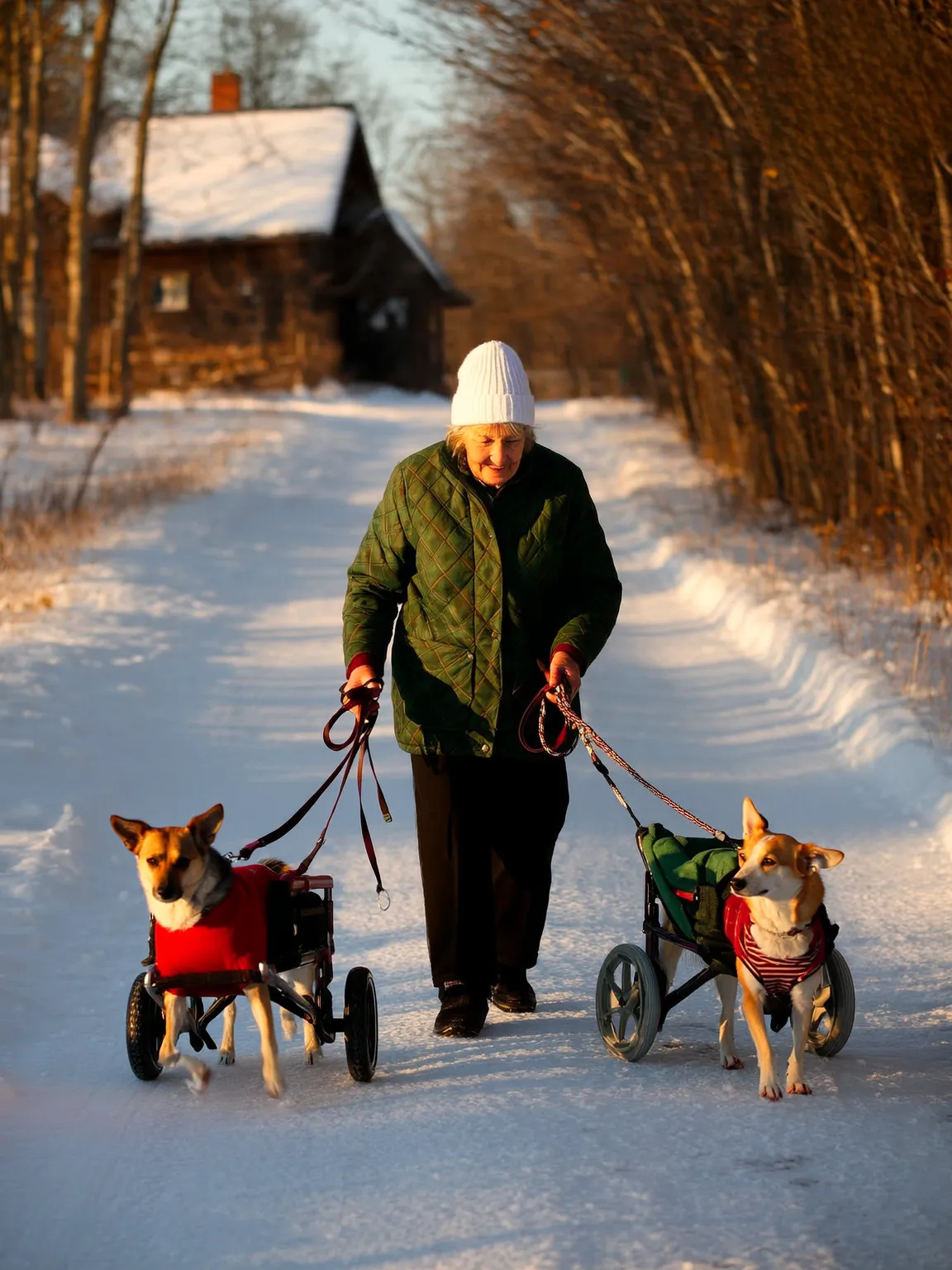
Pearl, my tiny dog with wheels instead of hind legs, tilted her head up at me. Her gaze was curious, unknowing of the tension, and yet somehow comforting. Buddy, her older companion, padded quietly at her side, his coat brushing the carpet softly as though he sensed the gravity of the moment too. When Pearl’s little wheels squeaked across the floor toward the door, I felt a flicker of hope. Perhaps the world wasn’t entirely hostile; perhaps some hearts could see love where others saw inconvenience.
The officer stepped out of the car, and I braced myself for judgment, for the formalities of citation or reprimand. But what happened next was not what I expected. One by one, neighbors—people I had only nodded to in passing on quick walks or exchanged polite greetings over fences—quietly emerged from their porches and lined the sidewalk. There was no anger in their eyes, no whispers of complaint or gossip. Instead, their presence radiated calm certainty. They had seen my dogs, had watched them wobble through the yard and wiggle with joy, and they knew: these animals were loved, cherished, and a source of genuine happiness.
Pearl wheeled herself straight toward the officer, tail wagging furiously, her little wheels squeaking a cheerful rhythm. It was as if she were delivering her own testimony, an argument in motion that spoke louder than any words could. Buddy barked once, sharply, a note of insistence, as though to punctuate the point. The tension dissolved not in a confrontation, not in raised voices or pointed fingers, but in a gentle laugh, a scratch behind Pearl’s ears, and the unspoken acknowledgment that cruelty had no place here.
In the days that followed, the ripples of kindness spread like sunlight over the street. Folded notes appeared under my door, handwritten and warm, expressing gratitude and empathy. Visitors arrived unannounced, drawn not by curiosity alone but by genuine concern and admiration. Children asked to walk alongside Pearl and Buddy, giggling as Pearl’s wheels clattered happily over the sidewalk and Buddy trotted proudly beside her. Parents lingered in the shade of their porches, exchanging small talk that grew into meaningful conversation. Strangers became companions, strangers who had once been merely faces in passing became witnesses to joy and participants in quiet community.
The neighbor who tried to erase us from the street—who had hoped fear or regulation could bend the world to her will—was rendered irrelevant. Her attempts at control were drowned out by a steady, collective tenderness that refused to be silenced. In the end, I realized something profound: sometimes the strongest form of protest is not anger, nor confrontation, nor revenge. Sometimes it is something quieter, yet infinitely more powerful: refusing to stop loving. Refusing to show hesitation, refusing to dim joy, refusing to apologize for the warmth you bring into the world.
And as the weeks passed, as the street seemed to pulse with laughter and the squeak of wheels and the soft pawsteps of dogs, I learned that love has a remarkable way of teaching even the hardest hearts to remember their own humanity. My disabled dogs, once at risk of being seen as burdens, became catalysts for connection. Pearl’s little wheels and Buddy’s gentle presence reminded everyone that community is not built through judgment, but through care, through empathy, and through the courage to be openly and unapologetically kind. In that small, contested corner of the neighborhood, a simple truth emerged: love, persistent and generous, has the power to transform not only hearts but the very streets on which we walk.