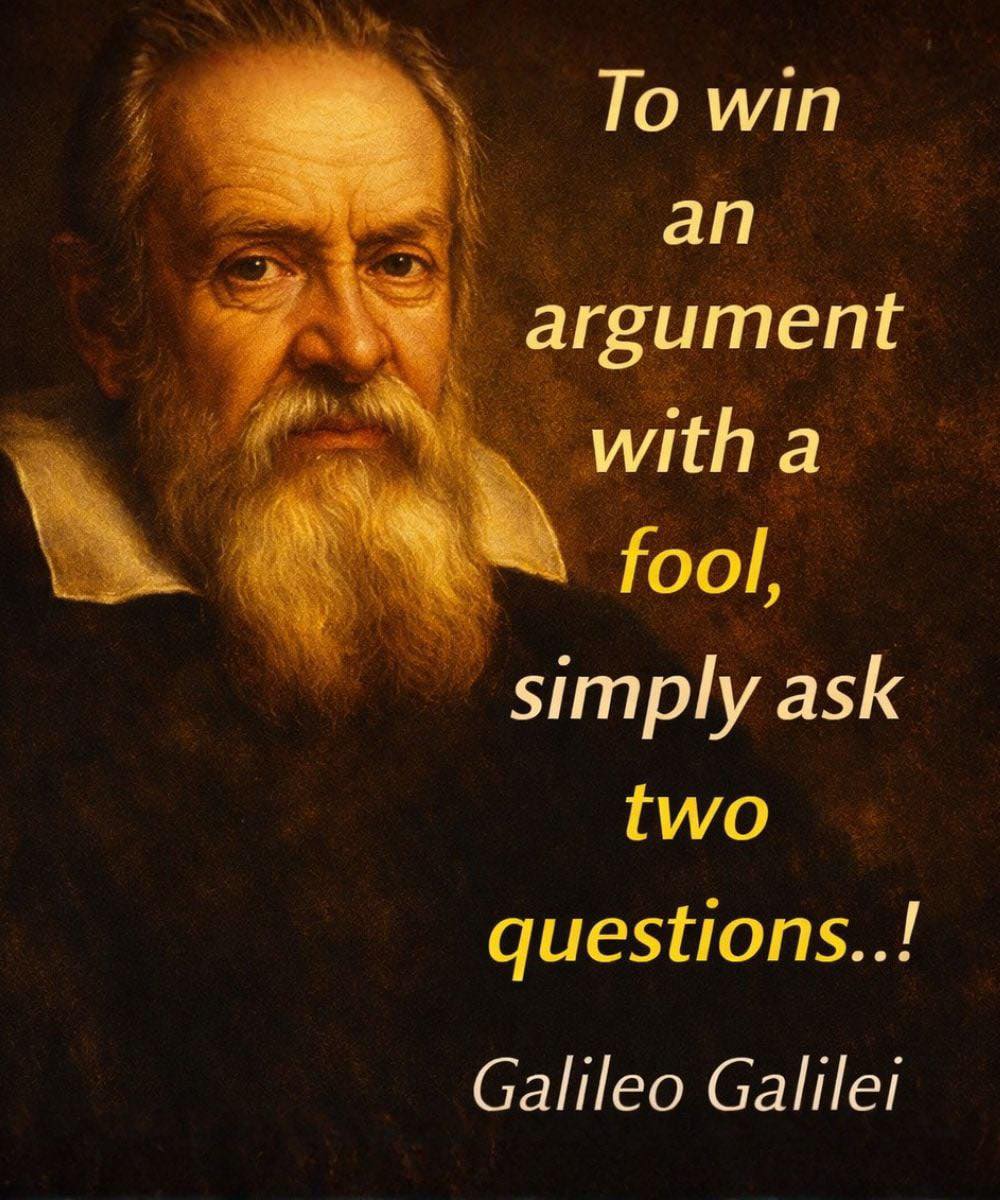
Few individuals have altered humanity’s understanding of the world as profoundly as Galileo Galilei. Known as the father of modern science, he challenged beliefs that had stood unopposed for centuries—and paid dearly for it. Yet his greatest legacy extends beyond astronomy and physics. Galileo left behind a model of intellectual resilience: a way of thinking that teaches how to face ignorance, resistance, and authority without sacrificing clarity, dignity, or inner strength.
In a world obsessed with speaking loudly, arguing endlessly, and proving dominance, his mindset feels strikingly relevant. A quote often linked to him captures this perfectly: never argue with a fool, because he will drag you down to his level and defeat you with experience. Whether Galileo said those exact words is less important than the truth behind them. The message is not about superiority—it is about discipline.
Galileo understood that intelligence is not demonstrated by volume, but by steadiness when chaos surrounds you.
The first lesson is uncomfortable but essential: remain loyal to your own thinking. People often abandon their beliefs not because they are wrong, but because they crave approval. Galileo refused that exchange. Supporting the idea that the Earth revolved around the Sun meant opposing religious doctrine, academic tradition, and political authority all at once. Silence would have been safer. Retreat would have been easier. He chose clarity instead.
That choice cost him persecution, isolation, and years of house arrest. Still, he never surrendered the truth internally. This distinction matters. Sometimes survival demands outward compromise, but integrity of thought is not negotiable. It is wiser to adapt your surroundings than to distort your beliefs. Intelligence is not conformity disguised as diplomacy—it is the ability to stay grounded while the majority drifts.
The second lesson is one most people resist: silence can be power. Modern culture treats silence as weakness. Galileo saw it as restraint. Not every argument deserves your energy. Not every provocation deserves attention. When someone argues without honesty, logic becomes useless. Engagement only feeds stubbornness.
In such moments, silence is not avoidance—it is a boundary. It signals that your focus is valuable and not available for pointless conflict. Galileo understood that trying to reason with someone unwilling to think is futile. Walking away preserves clarity and denies the other side what it wants most: reaction.
When silence is not possible, his approach becomes even more precise. Galileo knew that ignorance is not defeated through humiliation or dominance, but through accuracy. Rather than endless debate, he relied on two quiet strategies that dismantle false certainty without aggression.
First, ask whether the person is completely certain of their claim. This question exposes the foundation of their confidence. Most foolish arguments are built on borrowed certainty, not real understanding. Once someone is forced to examine that certainty, doubt appears and bravado weakens.
Second, ask them to explain their idea again—clearly, and in their own words. Weak logic collapses under repetition. Confusion reveals itself naturally. Contradictions surface without you pointing them out. The argument defeats itself.
This method works because it removes ego. You are not attacking; you are inviting clarity. If clarity cannot emerge, the weakness becomes obvious on its own. This kind of victory is quiet—no shouting, no bitterness, no scars.
At the core of all this is Galileo’s deeper insight: your mind is your greatest weapon. A disciplined mind is hard to provoke and impossible to manipulate through outrage or fear. It does not depend on validation. Independent thinking irritates those who rely on consensus, but it also creates resilience.
Galileo’s opponents were not intellectually superior. They were louder, more numerous, and better positioned socially. What protected him was not approval, but control—control over when to engage, when to retreat, and when to stand firm. That selectivity is strength.
Discipline and perseverance shaped that strength. Galileo’s discoveries were not accidents. They came from years of observation, calculation, correction, and repetition. Much of his work appeared dull to outsiders. But discipline compounds. What others dismissed as tedious became the foundation of scientific revolution.
Greatness is rarely dramatic in real time. It is built quietly through patience and repetition. Comfort produces nothing enduring. Galileo’s legacy exists because he tolerated discomfort long enough for truth to surface.
Courage, too, is often misunderstood. Fear is natural—Galileo felt it. Courage is not the absence of fear, but the refusal to obey it. Pressure shapes character the way heat turns carbon into diamond. The most important battles are invisible, fought internally without applause.
Galileo’s life shows that strength is not aggression—it is composure. It is knowing when to speak, when to question, and when to walk away. It is refusing to dilute your thinking for acceptance or peace. It is understanding that not every conflict is worth winning, and not every victory requires a fight.
Defeating a fool has nothing to do with clever insults or sharp replies. It has everything to do with emotional intelligence—the ability to stay calm while others unravel, to protect clarity in a noisy world, and to let ignorance collapse under its own weight.
Galileo’s lessons endure because human nature has not changed. People still mistake confidence for knowledge, volume for truth, and argument for understanding. His example reminds us where real strength lies.
Never trade your essence for acceptance.
Never allow noise to replace clarity.
And when ignorance demands a response, remember: questioning certainty and repeating logic are often enough.
The strongest mind does not shout.
It observes, chooses, and endures.