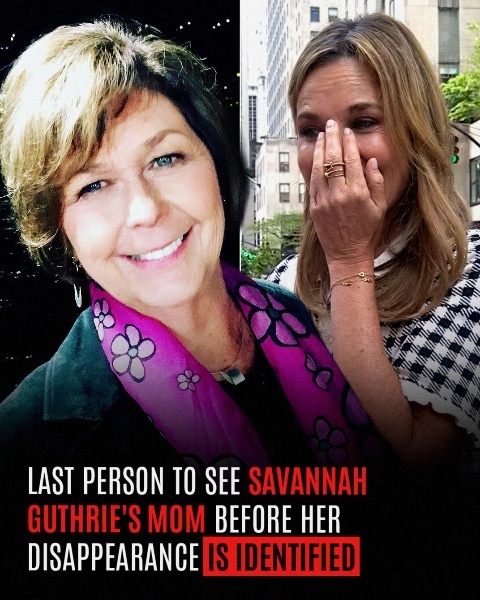
The call didn’t come from a police radio. It didn’t come through a newsroom dispatcher. It came quietly, almost innocuously, from a church pew—a friend on the line with concern that quickly escalated into terror. An 84-year-old mother, Nancy Guthrie, always punctual, always dependable, had simply disappeared. No cane to steady her, no keys to her home, no hint of where she might have gone. It was as if the earth itself had swallowed her. Within hours, the serene foothills of Arizona were transformed. Unmarked vans crawled the narrow streets, helicopters circled overhead, and homicide detectives canvassed every trail, driveway, and hidden alcove. The ordinary tranquility of a small suburban neighborhood became a theater of anxiety and speculation. For Savannah Guthrie, the journalist accustomed to guiding the nation through breaking crises, the transition from studio lights to the raw darkness of personal dread was instantaneous and brutal. Every minute her mother remained missing, every second unaccounted for, stretched like a tight wire over a chasm of fear, each tick of the clock amplifying the terror that no camera lens could ever capture.
By nightfall, the Arizona foothills no longer felt like the comforting backdrop of her childhood or the familiar setting of routine Sunday visits. They had transformed into a labyrinth of questions, each twist and turn concealing new possibilities. Nancy Guthrie’s house, once alive with domestic warmth and ordinary chaos, now stood eerily silent. Yellow evidence tape crisscrossed the front door, a visual proclamation of uncertainty and danger. Inside, the signs of normal life remained undisturbed: her purse sat neatly on the counter, her cane rested against the wall exactly where she had left it. It was as if she had stepped outside for a brief moment and vanished into a void that no one could explain. Detectives meticulously mapped every timeline, connecting the final family dinner with the call from the worried churchgoer. Every tire track, every shadow, every minor detail became a piece of a puzzle with no clear edges—a puzzle designed by fate to unsettle and frustrate.
Outside, the terrain itself offered little comfort. The rugged Arizona foothills, once a place of walks, gardening, and quiet reflection, had become a vast network of potential hiding places. Search teams fanned out methodically, covering every incline, crevice, and narrow canyon. Flashlights cut through the darkness like skeletal fingers, highlighting rocks, scrub, and dry riverbeds as volunteers and officers scoured the area. The wind whispered across the hills, carrying with it the eerie sensation of absence—the feeling that a life so familiar could vanish, leaving only echoes in its wake. Savannah followed closely behind the teams, her eyes scanning the distance where her mother might be, where hope and fear collided under the orange glow of the setting sun. Cameras trailed her, but their lenses could capture only the surface: the taut shoulders, the clenched hands, the stoic face. They could not capture the tremor in her heart, the unspoken questions, the private anguish of a daughter watching her world unravel.
Inside the neighborhood, the atmosphere was thick with tension and speculation. Neighbors whispered across fences, friends called frantically, and social media began to document every development in real time. The story of an elderly woman vanishing without a trace was almost mythic in its simplicity and horror, a narrative that pulled in journalists, local residents, and online spectators alike. Every potential lead—an open window, a displaced garden tool, a misplaced grocery bag—was scrutinized. Investigators combed security camera footage, interviewed passersby, and traced the minor inconsistencies that might indicate foul play or misadventure. The normal rhythms of life—dinners, television, bedtime—were suspended, replaced by a collective holding of breath that spanned the entire community.
For Savannah, the experience was uniquely personal and universally incomprehensible. Accustomed to reporting other people’s tragedies, she now lived her own. Each step she took along the rocky paths behind her mother’s home was heavy with memory and fear. Every glance toward the horizon, where search teams fanned out, was filled with the hope that someone, somewhere, might glimpse what she could not. Each sound—the snap of a branch, the distant call of a bird—was imbued with potential significance. Cameras continued to follow, capturing her figure moving across rugged terrain, yet the story unfolding before them was unscripted, raw, and entirely human. There was no polished narrative, no neatly constructed story arc—only the urgent, desperate hope of a daughter clinging to faith, the silent prayers of a family under siege, and the tension of a nation collectively waiting for resolution.
Night deepened, shadows lengthened, and the foothills seemed to grow more unknowable with every passing hour. Volunteers lit lanterns and flashlights, coordinating grids and calling out names, hoping for a response, any sign that Nancy was still among them. Every leaf disturbed, every rustle in the underbrush, became a potential clue. Savannah’s professional training—the instincts that once guided her through breaking news—intersected painfully with her private terror. She understood the methodology of investigation, the way teams broke down areas, mapped terrain, and collected evidence, yet none of that alleviated the dread that pressed against her chest like a physical weight.
Throughout the night, the media coverage provided information but no solace. Headlines screamed about a missing elderly woman, updates circulated on social media, and experts speculated on motives and possibilities. Yet all the analysis, all the chatter, could not replace a daughter’s desire to see her mother return safe and unscathed. Savannah, walking through darkness and uncertainty, became both reporter and participant, witness and vulnerable daughter, inhabiting a space where public scrutiny and private grief were inseparably entwined.
By the time dawn approached, the Arizona foothills remained both familiar and alien, a place of hope threaded with fear. Nancy Guthrie’s home still waited, silent and unyielding, while search teams prepared to extend their grids and canvass every remaining shadow. Savannah paused often, staring toward the borderlands where volunteers moved like phantoms under the rising sun, each light a tiny gesture of faith that the missing woman might still be found. And in those moments, the story became bigger than headlines, bigger than cameras, bigger than investigation. It was about presence and absence, love and fear, resilience and hope—the stark reminder of how fragile life can feel when someone you cannot replace simply disappears.