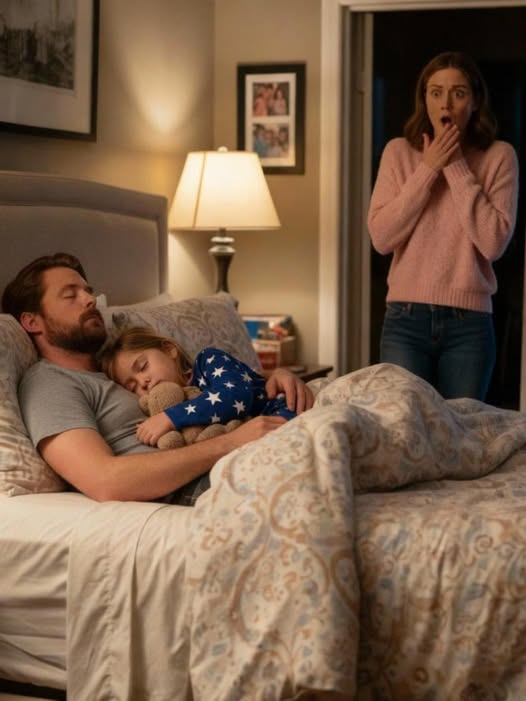
In the calm rhythm of our suburban life, crises rarely announce themselves with drama. They creep in quietly, as a series of small disturbances that seem trivial at first, until the pattern becomes impossible to ignore. For my husband, Daniel, and me, the first ripple appeared in our San Jose kitchen. It was a Tuesday morning, and our eight-year-old daughter, Emily, was rubbing sleep from her eyes at the counter. She looked up at me and said something that seemed unremarkable: “Mom, my bed felt really small last night.”
I smiled, brushed a stray lock of hair from her forehead, and dismissed it as a child’s fleeting dream logic. We had always encouraged Emily’s independence, aiming to nurture confidence and self-reliance. Her room was a sanctuary she had designed herself, with shelves of books, a warm amber nightlight, and a mattress she could grow into. I believed she was safe, cocooned in the boundaries of her world and the careful structure of our lives.
But the comment persisted. Each morning, Emily described the sensation with increasing clarity and unease—“the blankets felt tight,” she said, and then the words that made my chest tighten: “Mom, did you come into my room last night? It felt like someone was lying next to me.”
A mother’s intuition is sharp, able to distinguish imagination from observation. Emily wasn’t scared—she was confused. I mentioned it to Daniel, who was drained from long shifts at the hospital. He suggested vivid dreams were normal at her age, but the unease in my chest wouldn’t fade. To ease my own mind, I discreetly installed a small camera in the corner of her room, a silent guardian to confirm our house remained undisturbed.
The first night revealed nothing. I went to bed, chastising myself for overreacting. Yet at 2:14 a.m. the next night, I woke inexplicably and checked the feed. In the grainy night-vision glow, the bedroom door creaked open. A figure entered, slight and stooped, moving with a careful, hesitant glide.
My heart nearly stopped. It was my mother-in-law, Margaret. At seventy-eight, Margaret had devoted her life to the care of others, especially Daniel. Widowed young, she had labored in kitchens and laundries, folding her own needs into the smallest corners of her life. But lately, her presence had begun to falter—misplaced words, momentary confusion, the vacant look of someone drifting beyond reach.
I watched, frozen, as she gently lifted the edge of Emily’s blanket and lay down beside her granddaughter. There was no speaking, only quiet proximity, a shared warmth across generations. Emily shifted slightly, instinctively making room, and the two of them rested in a silent tableau of fragile connection. In the darkness of my kitchen, phone light casting blue on my tear-streaked face, I felt a mixture of sorrow and awe.
The next morning, I showed Daniel the footage. The room was heavy with silence as he saw his mother navigating the house in her fragile state. Tears filled his eyes, not merely for her decline, but for the truth it revealed: she was searching, in the only way she still could, for a sense of belonging and comfort. Margaret wasn’t intruding; she was returning, unconsciously, to a time when closeness with family meant safety.
We restructured our home and routine. Margaret’s bedroom moved closer to ours, sensors quietly monitoring her nighttime movement. Most importantly, we began nightly rituals together. I would spend an hour listening to her stories, sometimes repeating, sometimes fragmented. My role was no longer correction, but witness.
Margaret was not seeking a bed; she was seeking the reassurance of family, the affirmation of being part of a “we.” Emily, wise beyond her years, accepted the shifts without complaint. She understood intuitively that her bed had not shrunk—it had simply become a vessel for family history she was only beginning to perceive.
This transformed my understanding of independence. While I had devoted myself to teaching Emily to stand alone, Margaret reminded us that leaning on each other is essential. Aging strips away the walls we build; all that remains is the human need for touch, recognition, and security.
Our nights are still quiet, but the silence has changed. It is now a listening silence, a shared one. No one wanders alone. We have learned that the greatest gift is not the order of life, but the willingness to create space for each other, even when beds feel small and nights seem endless. We are no longer separate lives under one roof—we are a circle, holding fast to those drifting toward the horizon, keeping them warm until the end.