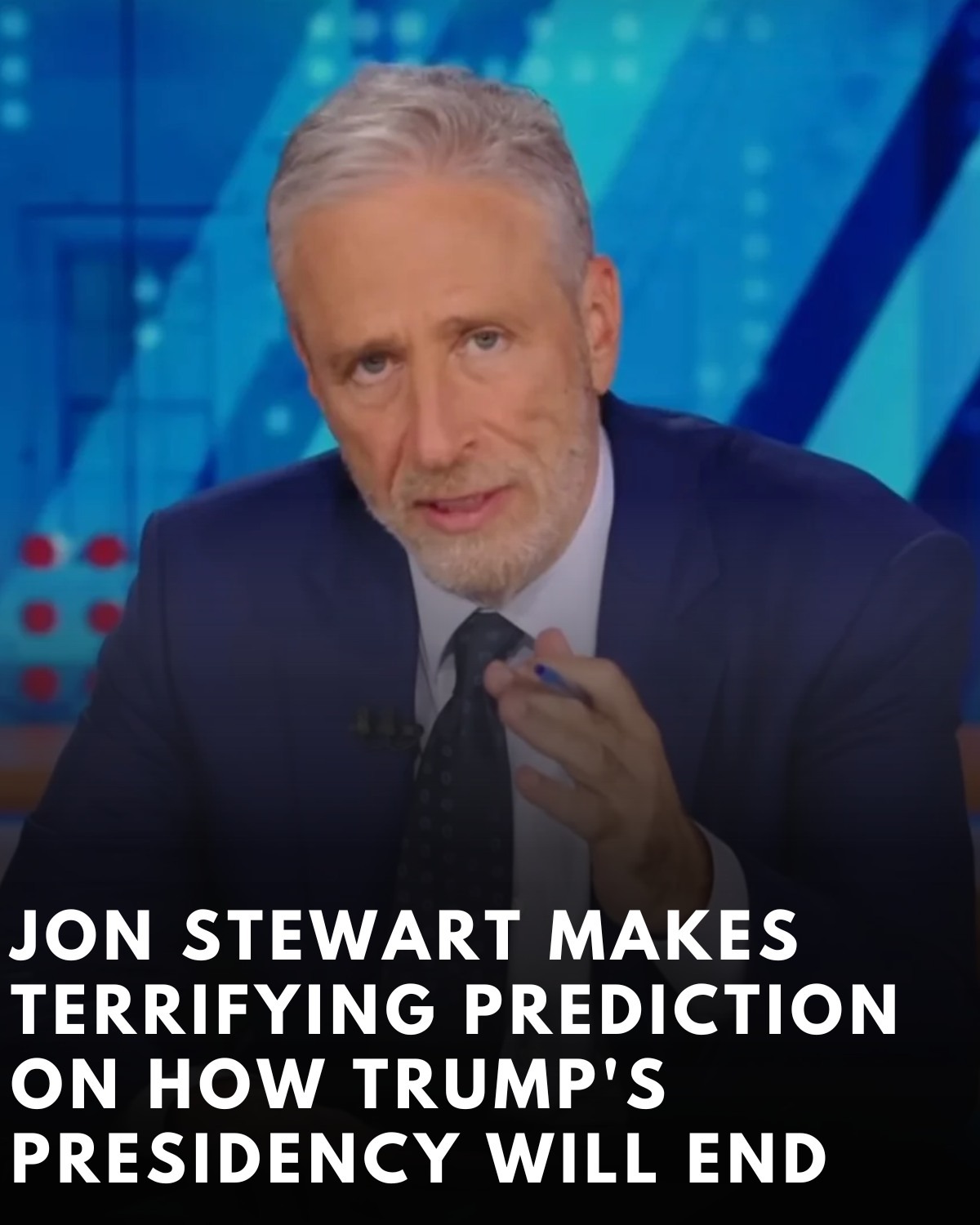
In the ever-shifting landscape of American political discourse, few voices carry as much weight as Jon Stewart’s. For decades, the host of The Daily Show has served as a satirical barometer for the nation, balancing sharp humor with genuine concern. Lately, however, his comedy has taken a backseat to a stark, urgent warning about the state of the American presidency under Donald Trump. On a recent episode of The Bill Simmons Podcast, Stewart stepped beyond his usual role as a critic, acting instead as a civic sentinel alerting the public to a potential institutional crisis. His message was grim: American democracy may not end with a peaceful transition of power but could instead face a deliberate dismantling from within.
Stewart’s concern was sparked by Trump’s $2 billion lawsuit against media giants CBS and Paramount. While legal analysts debate the case’s technical merits, Stewart sees a far darker purpose. To him, this isn’t simply a legal dispute—it’s a calculated move to intimidate and enforce loyalty. He described the lawsuit as a “loyalty test” for the press, a warning to all major institutions that they must bow to political power or risk ruin. Independent media, in Stewart’s view, is being pressured to become a chorus of praise for the executive.
The danger, Stewart argues, isn’t limited to a single court case but lies in the steady erosion of democracy’s “referees”—the judiciary, the free press, and non-partisan civil servants. Democracies rarely collapse overnight. Instead, they die through countless small concessions. By punishing institutions that challenge his narrative, Trump is dismantling the guardrails that prevent executive overreach, creating a precedent where the pursuit of power becomes untethered from accountability.
Perhaps the most unsettling part of Stewart’s commentary is his exploration of a leader willing to sacrifice principle for personal gain. He famously asked if the country might be witnessing someone prepared to “burn the house down for the insurance money.” While metaphorical, it underscores a terrifying possibility: that personal ego and power can outweigh the nation’s foundational principles. Such a “scorched earth” approach suggests a leader who, when losing control, would rather destroy the system than cede power.
Stewart predicts that this era may not end with a conventional political defeat or quiet retirement. Instead, he envisions maximum volatility, a stress test for every pillar of American government. Power transitions could become chaotic, driven by a leader who views “winning” as paramount, justifying any action. This could include stoking civil unrest, undermining the electoral process, and discarding political norms entirely. According to Stewart, the resilience of America’s institutions may be the only thing standing between a functioning republic and lasting instability.
Stewart’s warning is ultimately a call to citizens who may have grown numb to constant outrage. The “referees” he mentions—the judges, journalists, and election officials—are the human infrastructure of democracy. When intimidated or coerced, truth itself begins to erode. If every critique is dismissed as “fake” and every legal challenge labeled a “witch hunt,” the mechanisms that have historically preserved the nation may fail.
This is not mere cynicism from a comedian; it is the sober observation of someone who has spent his career studying media and power. Stewart highlights the fragility of the American experiment, sustained not only by the Constitution’s text but by collective adherence to democratic rules. When a leader discards these rules, the system itself is at risk. His message is a challenge: the outcome of this political chapter will shape the nation for decades to come.
Ultimately, Stewart presents a crossroads. One path restores institutional norms and the difficult work of democracy. The other, which he fears, leads to a volatile climax where personal vindication trumps the common good. His warning is a plea for awareness: when this era ends, will there be a stage left for the next generation? The answer depends on whether Americans value their institutions more than they fear the fire. In the end, a burned-down nation benefits only the one who started the blaze, and Stewart makes it clear who currently holds the match.