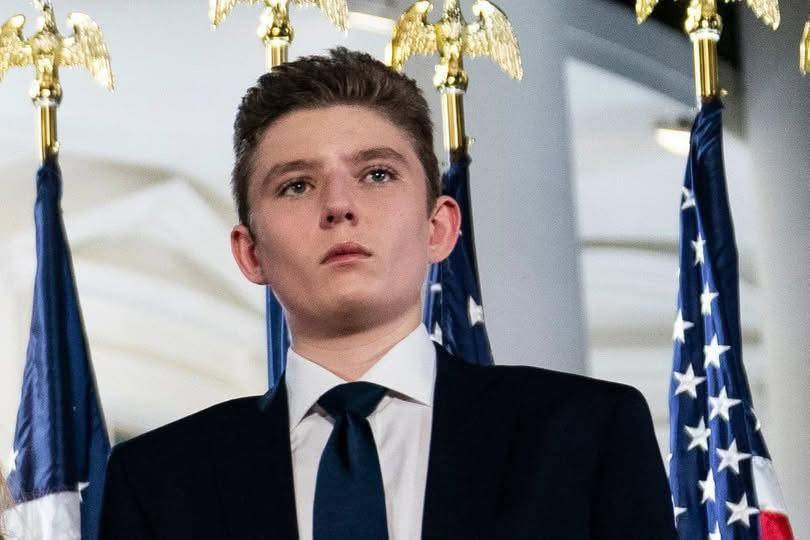
Born in Manhattan on March 20, 2006, Barron Trump entered life wrapped in wealth, influence, and an intensity of public attention few people ever encounter. His last name alone ensured scrutiny before he could even speak. Yet behind closed doors, his upbringing followed a very different logic—one centered not on privilege, but on discipline, limits, and emotional distance from the spotlight.
That approach came primarily from his mother, Melania Trump, who made an early and deliberate choice: her son would not grow up as a public exhibit. While Donald Trump dominated headlines and television screens, Melania concentrated on the unseen labor of parenting—structure, routine, etiquette, and privacy. In a family known for volume and spectacle, Barron was taught the power of restraint.
To outsiders, that restraint was often misunderstood. Public glimpses showed a tall, quiet boy standing slightly apart, composed and expressionless, never engaging cameras or reacting to commentary swirling around him. Some interpreted this as arrogance or detachment. Others projected assumptions onto him because he did not correct them. What many missed was that the quiet was purposeful. It was protection.
Melania understood a reality many public figures learn too late: fame is rarely kind to children. She knew how easily curiosity turns cruel, how quickly awkwardness becomes mockery, how entitled strangers feel to judge a child’s demeanor, body language, or future. So she acted. She restricted exposure. She enforced boundaries. She insisted on manners, normalcy, and emotional distance from public noise.
Barron’s schooling was kept as ordinary as circumstances allowed. His focus was on academics, language skills, and personal development—not attention or validation. Those familiar with the family have long said Melania drew one firm line: Barron would never be used as a political symbol. He would not be paraded, defended publicly, or turned into messaging.
That decision mattered even more as political tensions escalated. During the White House years, every Trump family member became a target of commentary and satire. Barron, still a minor, was pulled into viral jokes and online speculation—until Melania intervened publicly. Her message was unmistakable: politics aside, her child was not fair game.
As Barron grew older, his contrast with the broader Trump brand became sharper. He didn’t speak at conventions. He didn’t cultivate an online presence. He didn’t attempt to shape a public identity. He appeared when necessary and vanished just as quietly. The result was a young man the public believed it knew—while knowing almost nothing about him at all.
That absence of information fueled curiosity, but it also preserved something rare: agency.
Turning eighteen marked a symbolic threshold. Legal adulthood brought the freedom to decide his own path, but there was no dramatic reveal or public announcement. No statement, no pivot. What many had suspected was simply reinforced by consistency: Barron Trump has no interest in spectacle.
Those who know him describe him as observant, thoughtful, and reserved. He listens more than he speaks. He notices how people behave when they think attention is elsewhere. Growing up surrounded by power without being its focus taught him restraint. Years of silence sharpened his judgment.
Whatever direction he chooses—business, technology, private enterprise, or something entirely different—it is unlikely to be driven by impulse or a hunger for attention. He has seen what constant exposure does to people. He understands how fame magnifies mistakes and strips away nuance. His upbringing appears to have cultivated caution, not performative ambition.
That doesn’t imply insecurity. It suggests confidence that doesn’t depend on an audience.
In a culture that rewards loudness and relentless self-promotion, Barron’s presence stands out because of what it lacks. He doesn’t chase relevance. He doesn’t curate an identity. He exists outside the feedback loop that defines so many public figures of his generation.
This outcome was intentional.
It was shaped by years of staying grounded while his family occupied the center of national conflict and media frenzy. It was shaped by a mother who understood that the greatest gift she could offer wasn’t access—but insulation. Not exposure—but protection.
Barron Trump was raised in extraordinary circumstances, yet with surprisingly ordinary expectations: respect others, carry yourself properly, and recognize that not everything belongs in public view. That grounding may prove more valuable than any inheritance.
As adulthood begins, assumptions will persist. Some will expect a political future. Others will predict rebellion, withdrawal, or sudden visibility. The reality is far less dramatic. Barron Trump was taught to act deliberately, not reactively.
Whatever comes next will not be a performance shaped by his surname. It will be the outcome of a childhood spent learning how to remain steady while everything around him was unstable.
And in a family defined by spectacle, that quiet steadiness may be the most unexpected legacy of all.