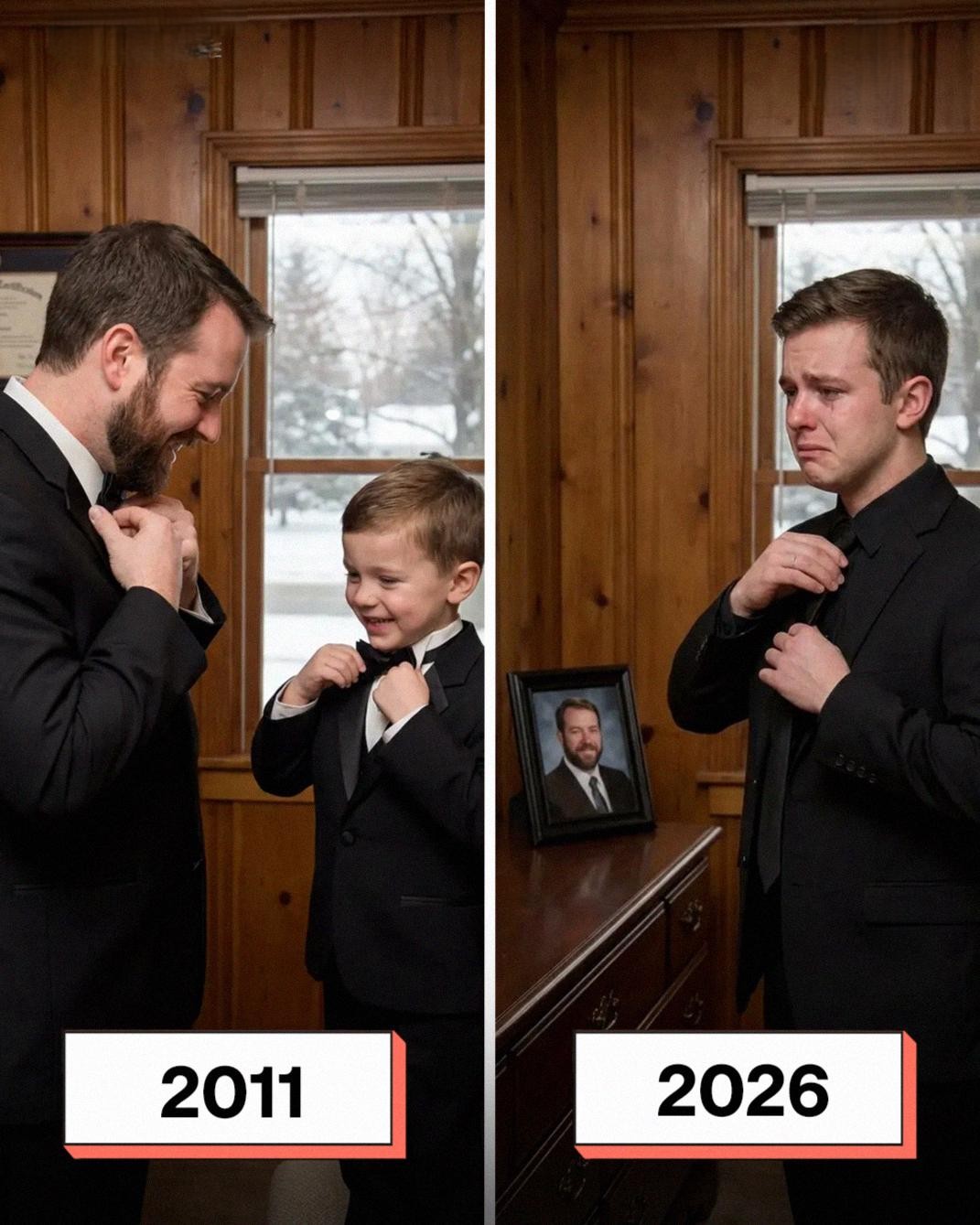
Kevin was my Superman. He didn’t wear a cape or fly, but he accomplished something far harder: he showed up every single day of my life without fail. Growing up in a cramped, drafty apartment, our circumstances were modest, yet Dad had a way of making our four walls feel like a palace. He was the master of Saturday morning pancakes, tossing them high into the air and pretending to fumble just to hear me laugh. He squeezed his large frame into tiny elementary school chairs during parent-teacher conferences, nodding solemnly as he discussed my math progress. He arrived at my baseball games straight from grueling second shifts, work boots caked in mud, clutching a thermos of coffee and cheering louder than any other parent in the stands.
My mother had passed away when I was an infant—or so I had been told. I had no memory of her, only a single photograph on the mantle and Dad’s whispered reminders that I had her eyes. “It’s just you and me, buddy,” he would say, ruffling my hair. “And that’s more than enough.” When I was seven, plagued by nightmares of monsters under my bed, he would sit at the edge of my mattress at two in the morning, rubbing steady circles on my back. “Breathe with me, Brian,” he’d whisper. “In and out. I’ve got you.” And I believed him, because he never gave me a reason not to.
Then, the world stopped. One ordinary Tuesday, while I stocked shelves at the grocery store, my manager pulled me aside, her expression full of pity. A construction accident. A scaffolding collapse. My father was gone before the ambulance even arrived. One moment, he was the sun in my sky; the next, there was only a cold, hollow eclipse.
The funeral passed in a blur of navy blue and suffocating grief. I wore his favorite tie, the one he had taught me to knot at sixteen. Standing by his casket, I felt the air drain from the room, listening to his crew describe how I had been his entire world. Returning to our quiet house, I sat among his belongings, staring at his boots by the bed, unable to imagine a future without him.
The next morning, a sharp ring at the door jolted me from a fitful sleep. Expecting a neighbor with a casserole, I opened it to a woman in her mid-forties, red-rimmed eyes and trembling hands clutching a purse.
“Are you Kevin’s son?” she asked.
When I confirmed, she took a shaky breath. “I’m Ella. Your father’s sister.”
Confused, I shook my head. Dad had never mentioned a sister. “Dad was an only child,” I said.
“We were estranged,” she admitted, voice low and urgent. “But I need to tell you something. Your father wasn’t exactly who you think he was. Kevin owed me fifteen thousand dollars. I helped with adoption fees eighteen years ago, and he never paid me back.”
The word adoption hit me like a punch. I let her in, suspicious, certain she might be lying. She laid out a story that felt like a fever dream. Eighteen years ago, a catastrophic car accident on a rainy night had claimed the life of Kevin’s pregnant wife. In the other vehicle, another couple perished. But a baby—me—had survived.
“Kevin arrived at the scene,” Ella said, her bitterness softening into awe. “He had just lost his wife and unborn child. He was at the brink. But a friend told him you were headed for the foster system. He went to see you the next day. When they put you in his arms, it felt like you were meant to find each other. He spent every cent he had—and fifteen thousand of mine—to make sure you came home.”
I sat, stunned, clutching the adoption papers she produced. The names and dates were undeniable.
“I told him it was a mistake,” she said, tears filling her eyes. “I told him to move on, to remarry, to have his own children. He wouldn’t hear it. You were his son—truly his.”
After she left, I remained in Dad’s armchair, replaying memories. The “lie” didn’t feel like a lie. It felt like the ultimate truth. Kevin hadn’t just been my father by chance; he had chosen to be my father. In his own deepest grief, he reached out and saved a stranger’s child. He didn’t owe me his love, his protection, his Saturday mornings—but he gave them all.
I grabbed his old jersey from the closet and drove to the cemetery. The grass over his grave was still fresh. I collapsed beside the headstone that read simply: Kevin. Beloved Father.
“You didn’t owe me anything,” I whispered, forehead pressed to cold stone. “You could have walked away. You could have let the system take me. But you showed up. You chose me.”
I realized then that my life wasn’t built on a lie. It was built on love so fierce it rewrote the rules of biology. He had turned the worst night of his life into the salvation of mine. I didn’t care about bloodlines; I cared about the man who stayed up with me during nightmares, who left notes in my lunchbox, who loved me without question.
I stood, draped his jersey over my shoulder, feeling a new strength. I knew how to be a man, how to show up, how to love without reservation—because I had been raised by a hero. Walking back to my car, I whispered to the sky, “See you later, Superman.” Some legacies aren’t inherited—they are forged through sacrifice and carried forward by those who remember that being a father isn’t about who you are born to, but who you choose to love.