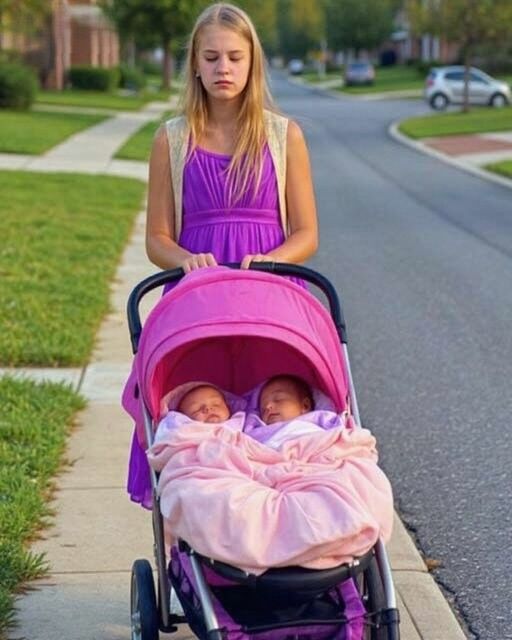
When my fourteen-year-old daughter, Lucy, came home from school pushing a stroller with two newborn babies inside, it felt as if my world had stopped spinning. I stood there, still in my nurse’s scrubs, my hand frozen on the doorknob, staring at her wide-eyed, unable to process what I was seeing.
For a moment, everything went completely silent. Then, as if someone had unmuted reality, I heard the faint, soft sounds of the babies’ tiny whimpers, their little sighs, and Lucy’s trembling voice.
“Mom,” she said, eyes red and wide from crying, “please don’t be mad. I didn’t know what else to do.”
“Lucy,” I managed, my voice barely above a whisper, “what is this?”
She swallowed hard, gripping the stroller handle as if it were her last piece of safety. “They… were in the park,” she said, her voice shaking. “Someone left them there. I couldn’t just walk away.”
My mind struggled to catch up. “You… found two newborns in the park?”
She nodded, tears spilling down her cheeks. “They were wrapped in blankets, Mom. At first, I thought they were dolls, but then one of them moved. I didn’t know what to do, so I brought them here.”
I took a slow breath, forcing myself to stay calm even though my heart was racing. “Okay,” I said carefully, “we’ll call the police. You did the right thing bringing them here.”
But as I reached for the phone, Lucy panicked. “No, please! Don’t call them yet!”
“Lucy—”
“They’ll take them away,” she sobbed. “They’re so tiny. What if they get put somewhere bad? What if no one cares for them?”
Her desperation broke me. I could see how deeply she cared, how frightened she was. She wasn’t being reckless or naive—she was being human. Yet, this was not something we could keep secret.
I pulled her into my arms, hugging her tightly. “Sweetheart,” I said softly, “I know you want to help. But we have to tell someone. They need medical care, and we need to find out what happened.”
She nodded slowly against my shoulder, still crying.
I called the authorities, and within the hour, our small living room was filled with uniformed officers and social workers. They gently took the babies—two identical girls, no more than a week old—to the hospital. Lucy sat silently on the couch, holding my hand, her eyes never leaving the stroller even after it was empty.
For days afterward, she barely spoke. The police later told us there were no notes, no witnesses, no signs indicating who had left the babies. The story made local news, and Lucy’s face, blurred for privacy, appeared under headlines like “Teen Finds Abandoned Newborn Twins.”
People called her a hero.
But to Lucy, it didn’t feel that way. “I should’ve stayed with them longer,” she said once. “They looked so scared.”
A few weeks later, the hospital contacted me. They said the babies were healthy and doing well, but there were still no leads on their mother. Since Lucy was the one who found them, the state asked if we would consider temporary foster care until a permanent home could be found.
I was stunned. I wasn’t sure I could handle two infants; my life was already full with long hospital shifts and raising a teenager alone. But when Lucy overheard the call, she begged me:
“Please, Mom. Just for a while. I’ll help. I’ll do everything.”
Her voice broke on the last word, and I realized she needed this. Maybe it was her way of processing the shock, or maybe she had already bonded with the babies the moment she found them.
So, I said yes.
That’s how the twins, whom we named Grace and Hope, entered our lives.
The first months were chaotic. I was constantly exhausted, juggling work, feedings, and sleepless nights. Lucy amazed me with her care. She’d wake for night feedings, sing lullabies, and even learn to prepare formula perfectly.
Watching her care for these babies with such tenderness filled me with pride. I had always known she had a big heart, but seeing it in action like that was something else entirely.
Six months later, the court called: no family had come forward, and the mother was still unknown. Lucy asked if we could adopt them.
“Lucy,” I said gently, “you’re still a kid yourself.”
“I know,” she said quietly, “but you’re not.”
Her words sank deep.
We had already fallen in love with them; there was no denying it. Every giggle, every sleepy sigh, every tiny hand reaching for mine became part of our family rhythm. When the adoption papers came through a year later, we cried together. Grace and Hope officially became ours.
Years passed. The girls grew into bright, happy children, inseparable from their big sister. Lucy went to college but still came home every weekend to see them. Life wasn’t always easy, but it was ours.
I thought that chapter—the miraculous way those girls came into our lives—was over.
But ten years later, the phone rang.
I was making dinner when I answered. “Hello?”
“Mrs. Davis?” a man’s voice said. “This is Martin Caldwell, attorney for the estate of Mr. Leonard Carmichael. I believe you are the adoptive guardian of two minors, Grace and Hope Davis?”
My heart skipped. “Yes, I am.”
“I’m calling regarding an inheritance matter,” he said. “I’m afraid this may come as a surprise.”
It certainly did.
He explained that Mr. Carmichael, a wealthy businessman, had recently passed away. In his will, he left a trust fund totaling $4.7 million to be divided equally between Grace and Hope Davis.
For a moment, I couldn’t speak. “I—I think there must be a mistake,” I stammered. “They’re adopted. Their birth parents are unknown.”
“I understand,” the lawyer said. “But the will specifies them by full name and date of birth. Mr. Carmichael was very clear. He also provided a letter explaining everything, which I’d like to deliver to you in person.”
I agreed to meet him the next day.
That night, I hardly slept. Who was this man? How did he know the girls? And why would he leave them millions of dollars?
When Mr. Caldwell arrived, he handed me a sealed envelope addressed to me. Inside was a letter, dated just weeks before Mr. Carmichael’s death:
Dear Mrs. Davis,
If you are reading this, it means I have passed, and my truth must finally come to light. The children you have so kindly raised, Grace and Hope, are my granddaughters.
Ten years ago, my son, Andrew, made a series of terrible choices. He was young, scared, and involved with a woman my wife and I disapproved of. When she became pregnant, he hid it from us. The woman disappeared shortly after giving birth. By the time we discovered the truth, it was too late; the babies had been abandoned, and my son was too ashamed to admit it.
He told me everything before he passed last year. I spent months searching and finally discovered the twins had been adopted by you. I cannot express how grateful I am for what you have done for saving them, for giving them love, for being the mother they needed when ours failed them.
Please accept this inheritance on their behalf. It is the least I can do to ensure their future.
With deepest gratitude,
Leonard Carmichael
My hands trembled as I finished reading.
Lucy, now twenty-four, stood beside me, mouth slightly open. “So… Grace and Hope’s biological grandfather just left them millions of dollars?”
“It seems so,” I said, still trying to process it.
Mr. Caldwell nodded. “Mr. Carmichael wanted them to have every opportunity. The trust will be managed until they turn twenty-one. It also includes funds for educational and living expenses.”
Tears filled my eyes. “I don’t even know what to say.”
“There’s one more thing,” the lawyer said gently. “He asked that I give you this.”
He handed a smaller envelope, addressed simply: For Lucy.
Lucy hesitated, then opened it. Inside was a short note and a photo of the two babies in a hospital bassinet—Grace and Hope.
Dear Lucy,
I know you were only a child when you found them, but because of you, my granddaughters lived. Because of your kindness, they grew up safe, loved, and whole. You may not carry my blood, but in my eyes, you are part of this family forever. Thank you for giving them life twice—once from the park, and once from your heart.
With gratitude,
Leonard Carmichael
Lucy pressed the photo to her chest, tears streaming down her face.
We sat together for a long time, trying to process everything that had just happened.
In the weeks that followed, the story made headlines again. People remembered the teenage girl who had found two abandoned babies in the park. Now, those same babies had inherited a fortune from the grandfather they never knew.
The money changed many things—it paid for college, secured our home, and gave the girls a future I could never have dreamed of providing. But more than that, it gave us peace.
And as I watch Grace and Hope run through the yard, their laughter echoing in the afternoon air, I know one thing for certain:
The greatest inheritance they ever received wasn’t money.
It was love—the kind a scared young girl gave without hesitation, the kind that turned strangers into family.
And in the end, that love was worth far more than $4.7 million.