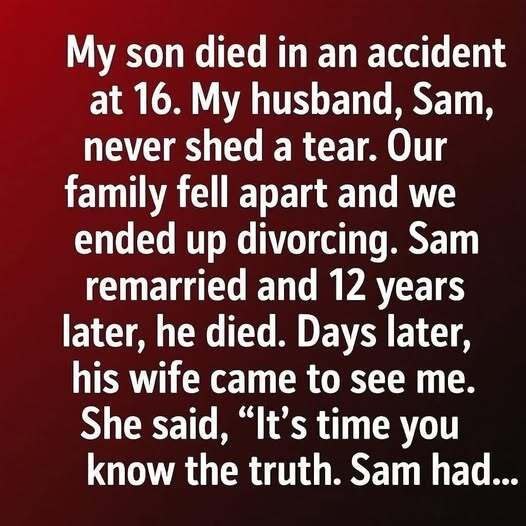
The day our son died, the sun kept shining, and that felt like the first betrayal. Leo was sixteen—wild hair, sudden, booming laughter—and then, in a single heartbeat on a rain-slick highway, he became a memory. In the aftermath, I believed my marriage would be the raft that kept us afloat. Instead, I watched my husband, Sam, disappear into a fog I couldn’t reach.
I drowned openly in grief. I wore it like a soaked burial cloth, crying into empty rooms and demanding that the world acknowledge the crater in my chest. Sam did the opposite. At the funeral, he was terrifyingly composed—shaking hands, thanking neighbors, accepting casseroles with polite detachment. He didn’t cry. He didn’t break. Worst of all, he didn’t reach for me.
What followed wasn’t peaceful silence—it was suffocating. It filled the space between our bedrooms and sat with us at dinner. When I begged him to talk about Leo—to say his name, to remember the way he burned toast every Saturday morning—Sam would quietly stand, wash his plate, and retreat to the garage or his study. I began to confuse his silence with absence. I told myself that if he wasn’t crying, he must not be grieving. And if he wasn’t grieving, then maybe he hadn’t loved our son the way I did.
Within a year, we fell apart—not with shouting or blame, but with quiet erosion. Our marriage dissolved into two strangers linked only by loss. Sam moved out and, far too quickly for my heart to bear, remarried. Seeing photos of him with Claire—a gentle-looking woman untouched by cemetery soil—hardened something inside me. I decided he was cold. That he had chosen a clean beginning over the pain of remembering.
For twelve years, I lived inside that belief. I carried my resentment like armor. Every Sunday, I visited Leo’s grave, brought flowers, spoke aloud to stone, convincing myself I was the only parent who truly remembered. My life existed in “before” and “after.” Sam, it seemed, lived only in “now.”
Then the call came: Sam was dead. A heart attack. Fifty-four. I expected bitterness to return, but instead there was only a hollow stillness. The man who had shared my life—and my greatest loss—was gone, and we had never truly spoken again.
Days after his funeral, Claire came to my door. She looked worn down by grief, her eyes swollen from nights spent crying alone. She didn’t come to defend herself or claim space. She carried a small cedar box, old and scuffed. Sitting at my kitchen table, hands shaking, she pushed it toward me.
“He told me that if anything ever happened to him, I had to give this to you,” she said softly. “He said you were the only one who could hold them.”
Inside were hundreds of envelopes. None addressed to me. None to Claire. Every single one bore the same name.
Leo.
I opened the first letter. It was dated three days after our divorce.
“Dear Leo,” it began. “I saw a boy today wearing your jersey. I almost called your name. Your mother thinks I’m strong. I’m not. I’m just afraid that if I start crying, I’ll never stop—and then who will make sure the world keeps turning for her?”
I read until the light drained from the room. There were letters for nearly every week of the past twelve years.
They were filled with ordinary things—a father’s quiet longing. Sam wrote about fixing the car, about books he read, about autumn light in the trees. He wrote the things he couldn’t say aloud because my grief was thunder and his was a whisper. He wrote about the shame of smiling again, about feeling like a traitor for enjoying a meal. He wrote about Claire, thanking Leo for sending someone who could sit beside him in silence, admitting that he had failed me because he didn’t know how to scream the way I did.
Claire told me that every night, after she went to bed, Sam would sit alone with that box. She heard him cry into his sleeves, quietly, ritualistically. He hadn’t moved on. He had hidden his grief somewhere it wouldn’t be misunderstood. His silence had never been indifference—it was protection. He believed it was his job to stand, even when the ground beneath him had turned to dust.
The letters showed me a man I had never allowed myself to see. Sam remembered every birthday Leo never reached. He imagined who our son might have become at twenty-one, at twenty-five. He apologized for the divorce again and again, confessing that when he looked at me, all he saw was his failure to save our child.
Standing in my kitchen, holding his words, the bitterness I had carried for twelve years finally unraveled. In its place came clarity—sharp, aching, honest. I had judged the way he bore his grief because it didn’t look like mine. I demanded visible pain, never realizing that the fiercest storms often happen behind closed doors.
Grief is not a single path. It is a wilderness. Some of us shout and leave markers, desperate to be found. Others move quietly, carrying their sorrow so deep it leaves no visible trace.
Sam loved Leo as fiercely as I did. He was simply a man of written words, not spoken ones. I lost my son once. I lost my husband because I couldn’t forgive his silence. But as I traced the ink of his final letter—written days before his heart failed—I felt something soften.
The letters were his bridge. The one he couldn’t build while alive. Through them, he finally reached me, telling me I had never been alone in my grief. We had always been mourning together—just in different rooms.
I pressed the box to my chest and let go of the anger at last, allowing the quiet love of a silent man to fall over me like rain that had been waiting far too long to come.