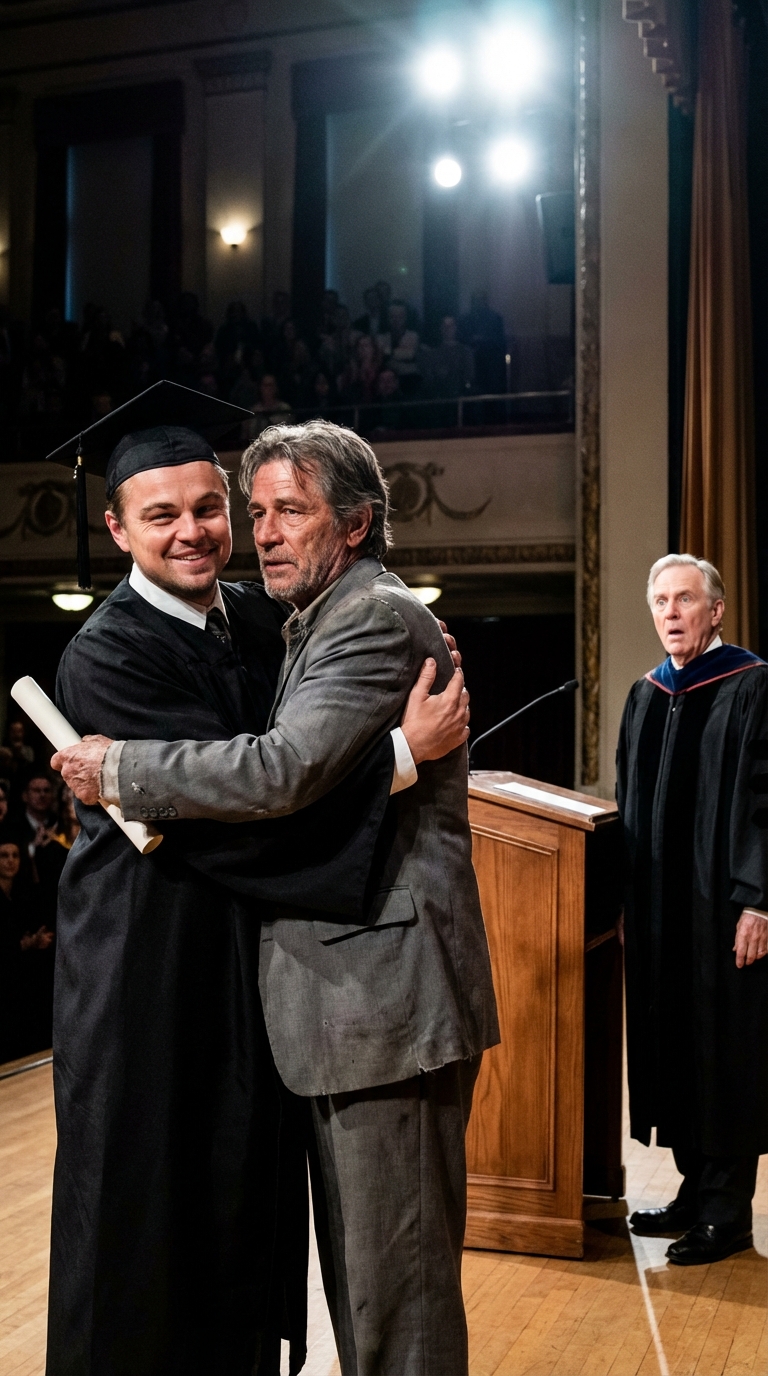
For twenty years, my father carried the scent of wet soil and chalky lime wherever he went. It seeped into our hallway rugs, embedded itself in the couch cushions, and lingered in the kitchen long after he had scrubbed his skin raw with harsh soap. Miguel was a man shaped by silence and endurance. To the neighbors, he was the reserved immigrant who repaired stone walls for cash. To the city, he was just another worker in a reflective vest, unseen and unremembered. To me, he was the embodiment of sacrifice—overwhelming and frightening in its intensity.
Each evening, precisely at six, the front door would creak open. Miguel would step inside looking like a monument eroding under time, his heavy boots leaving pale gray marks across the floor. His hands—split, scarred, their fingerprints worn smooth by decades of brick and mortar—shook slightly as he laid a wrinkled envelope of cash on the table.
“Tuition,” he would rasp, his throat burned by years of dust. “Count it, Leo.”
I despised counting it. The small bills, damp with sweat, felt like proof that his body was being slowly exchanged for my future. I thought of him as a simple laborer, a beast hauling me toward a summit he would never reach himself. He worshipped education but kept his distance from books, never helping with homework, never touching my notebooks—as if the symbols inside might explode. I grew up convinced he couldn’t read, and that the shame of it followed him everywhere.
Everything changed one Tuesday in late October. I was a first-year university student, overwhelmed by advanced calculus and crushed by the realization that I wasn’t as brilliant as I thought. Sitting at the kitchen table, staring at a brutal derivative, my mind felt useless. When Miguel came home, I didn’t even look at him. I buried my face in my hands and muttered that I wasn’t smart enough—that maybe I should just quit and work construction with him.
The silence was suffocating. Miguel didn’t move. Then he slowly approached the table and looked at my notebook. In that instant, the exhaustion drained from his face. His eyes scanned the equation with shocking speed—not confusion, but precision, like an architect spotting a fatal flaw. His fingers twitched toward my pen, then snapped back as he shoved his hands into his pockets.
“You do not quit,” he thundered, his voice charged with something I had never heard. “The variable is not the problem. The variable is the door. You find the key.”
That night, at three in the morning, thirst pulled me from bed. In the dark living room, I heard a low murmur—steady, rhythmic. I thought he was praying. Instead, I heard a rapid stream of equations, theories, and variables, spoken effortlessly, faster than any lecture I’d ever heard. When I shifted, he stopped instantly, eyes catching the moonlight like a predator’s.
“They must never know I’m still counting,” he whispered.
Four years later, I graduated at the top of my class. The ceremony was drenched in prestige, held in an auditorium of velvet and polished wood. Miguel sat hidden in the back row, hunched in a thrift-store suit too short at the sleeves, exposing wrists thick with scars.
The keynote speaker, Dean Sterling—the arrogant head of the mathematics department—boasted about the “Impossible Equation of the Century,” the Riemann-Alvarez Hypothesis, a cryptographic riddle that had stalled global security for decades.
Then Sterling’s eyes locked onto the back of the room.
He froze. The microphone shrieked. His face drained as he stepped off the stage and walked down the aisle like a man confronting a ghost.
“We buried an empty coffin,” Sterling stammered. “The car… the fire…”
Miguel stood. His slouch vanished. He filled the space around him.
“Professor Alvarez?” Sterling whispered. “You solved the hypothesis. And then you died.”
The name rippled through the crowd—the vanished genius. Miguel’s eyes were no longer tired. They were sharp, calculating, terrifyingly alive.
“I didn’t die,” Miguel said calmly. “I stopped.”
Sterling seized his rough, cement-burned hand. “You disappeared and left the equation unfinished. They’ve been hunting ever since. And they’re here.”
Chaos exploded. Miguel moved with impossible speed, pulling me from my seat.
“Leo! Service exit—now!”
We raced through maintenance tunnels as the truth finally emerged.
“Not Dad,” he snapped. “Right now, I’m Alvarez. And you’re the leverage.”
He confessed he had monitored every line of code and equation I ever wrote, steering me away from number theory on purpose—keeping me brilliant, but not dangerous.
“Genius is a target,” he shouted. “That equation unlocks nuclear silos and financial systems. Publishing it would have ended the world. So I erased myself instead. No one notices a bricklayer.”
We burst into an alley—and straight into a black sedan. Two men stepped out, guns already raised. They’d attended graduations for years, waiting for the son to lead them to the father.
“The boy buys cooperation,” one said. “The proof. Now.”
Miguel stepped in front of me.
“A bullet’s path is predictable,” he said softly. “Greed isn’t.”
From his jacket, he pulled a battered notebook bound with rubber bands, stained with twenty years of cement dust. He flicked open a cheap lighter.
“The solution,” he murmured. “If I burn this, the century collapses with it.”
In that moment, I finally understood the gray footprints on our floor. My father hadn’t run from mathematics—he had carried the weight of the world in his hands while building walls no one noticed. For two decades, he lived as a ghost so I could live freely. And now, with a single flame, he was ready to turn genius into ash to keep humanity safe.