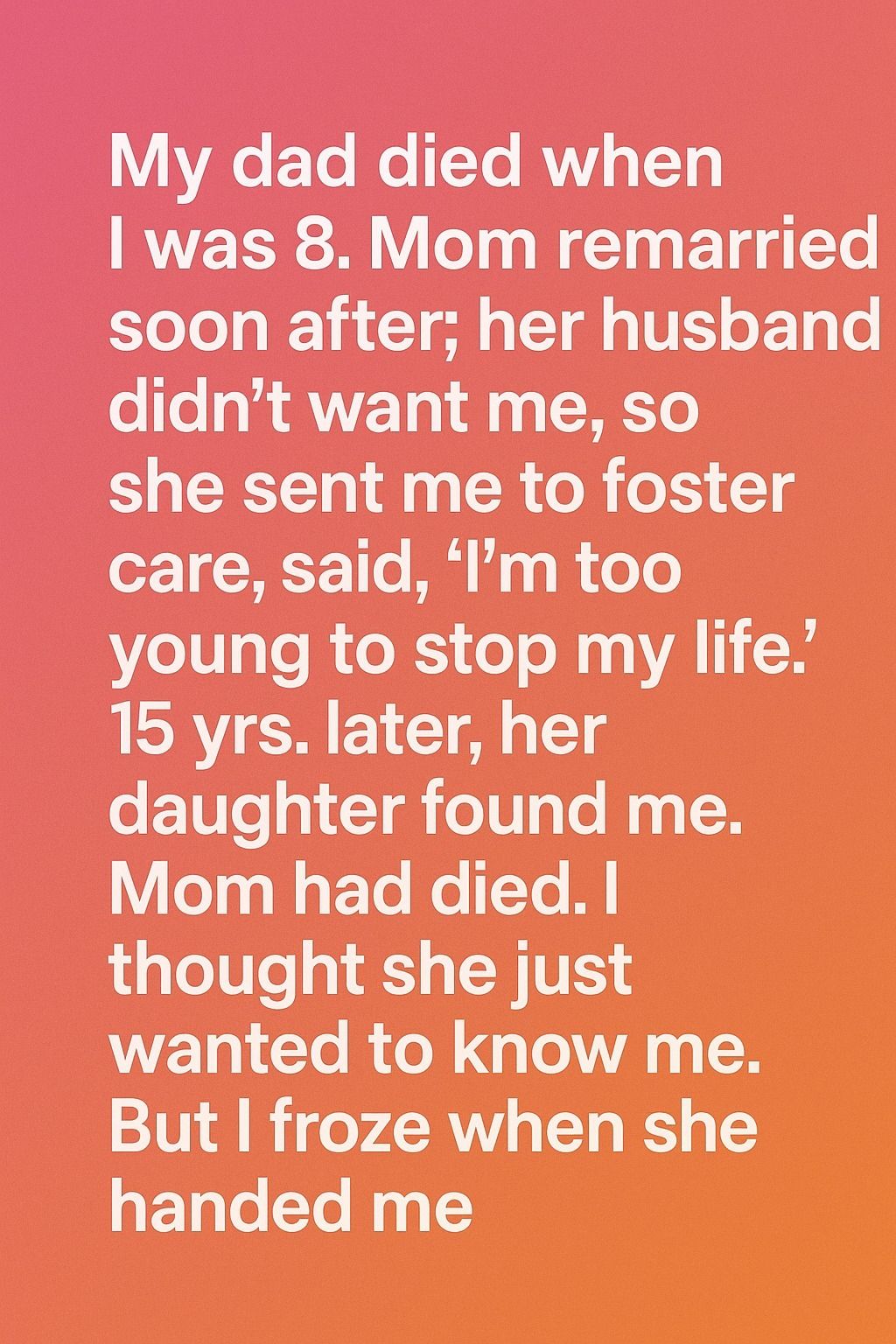
My dad passed away when I was eight, and my world shifted overnight. One moment, life felt familiar and safe, the next, it was as though the ground had been ripped from beneath me. I couldn’t understand why someone so central to my world had simply vanished, and the void left behind seemed impossible to fill. My mom tried to hold things together, but grief has a way of reshaping people, and soon after, she remarried, hoping to find a fresh start and a partner who could help navigate the future.
But her new husband wasn’t ready for a child. He hadn’t anticipated a pre-existing family, and I could sense the tension every time I tried to connect or speak up. I remember the afternoons when their voices would carry through the house, and I felt like an intruder in my own home. Eventually, my mom told me she was too young to put her life on hold, that she needed to embrace the new chapter she had chosen. And just like that, I was sent to foster care, leaving behind the home I had known, carrying only memories of my father, fragments of my old life, and a quiet hope that one day my mom might come back for me.
Growing up in foster homes was like being constantly uprooted. Each new house brought different rules, different people, and a new way of surviving. Yet, through it all, I learned resilience in ways I never expected. I learned independence, how to navigate uncertainty, and how to make a life from nothing but determination and imagination. I discovered that kindness can be found in the most unexpected places, whether in the quiet smile of a foster parent or the companionship of another child who also longed for stability. Still, a part of me always wondered if my mom ever thought of me, if regret ever visited her, or if I had been a fleeting memory she buried under her new life. Fifteen years passed. I tried to move forward gracefully, building routines, friendships, and my own sense of home, though the old memories occasionally resurfaced, tugging at my heart in ways that surprised me.
Then, one quiet afternoon, a knock on my door changed everything. I wasn’t expecting anyone, and the uncertainty made my pulse quicken. When I opened it, a young woman stood there with a gentle, familiar smile. She introduced herself as my half-sister and explained that she had been searching for me, guided by fragments of family history and a desire to connect. She told me, softly, that Mom had passed away. A wave of unprepared grief settled in my chest—an ache I hadn’t anticipated, a mixture of loss and relief that I would finally know some truth. In her hands was a small, carefully wrapped box, almost like a messenger carrying years of untold stories.
Inside the box was a letter from my mother. As I unfolded the paper, my eyes blurred, and my chest tightened with every word. She wrote that she thought of me often and regretted the choices that led to our separation. She confessed the struggle between her desire for a new life and her fear of giving up the only life I had known. She hoped that life had treated me gently, even in her absence, and that I had found joy and resilience along the way. Each word felt like a bridge across the years we had lost, a lifeline thrown through time, connecting the child I had been with the adult I had become.
The letter ended with a line that felt like a whisper across time: “If life allows, I hope we meet again in kindness, not regret.” I closed the letter slowly, tears streaming down my face—not from anger, but from a long-awaited sense of release. I finally let go of the question I had carried for so long, that quiet yearning for understanding and acknowledgment. I felt a strange, peaceful closure, like a chapter I didn’t realize was unfinished had finally been written.
In the days that followed, I found myself reflecting on the twists and turns of life, on the ways loss and love intertwine, and how the human heart carries hope even when circumstances seem impossible. My mother’s letter became a talisman, a reminder that even when life pulls us apart, connections can endure in the spaces between, waiting for the right moment to be acknowledged. Meeting my half-sister soon after, sharing stories and laughter, and connecting over memories both remembered and imagined, I realized that family is not only the people we grow up with, but also the love and understanding we carry forward, sometimes arriving years late, but never truly lost.
And for the first time, I felt that the years of waiting, of wondering, of longing, had led me to this quiet, unshakable truth: that forgiveness, understanding, and compassion have a way of finding us, even when we least expect it, and that life—even in its imperfections—can still bring a sense of home to those willing to embrace it.