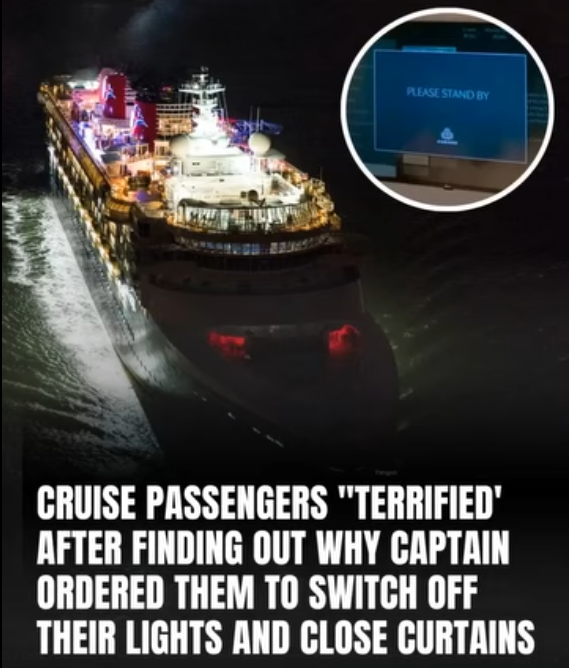
A luxury world cruise promises endless horizons, sparkling midnight seas, and the plush comfort of a ship built as a floating sanctuary. For those aboard the Cunard Queen Anne, the maiden 111-night global journey was meant to be the ultimate voyage—a celebration of maritime tradition blended with modern elegance. Yet, as the ship moved from the open Pacific into tighter tropical waters, the festive atmosphere was abruptly replaced by instructions that felt more suited to a suspense thriller than a high-end holiday.
It started on a calm evening as the Queen Anne sailed through the Sulu-Celebes Sea, the vast stretch of water connecting the Philippines, Malaysia, and Indonesia. Suddenly, the captain’s voice crackled over the intercom with chilling orders: passengers were instructed to immediately turn off all non-essential lights, close the heavy blackout curtains, and avoid open decks. The ship, normally a radiant beacon on the dark ocean, was to disappear from sight. Chandeliers dimmed, balcony lights went dark, and the promenade’s lively hum vanished as travelers were ushered inside.
The reason for this abrupt “ghost ship” protocol was piracy. While many associate piracy with historical lore or movies, the captain explained that modern piracy and maritime kidnapping remain a real, managed threat in the Sulu-Celebes Sea. To protect the thousands on board, the Queen Anne had to become nearly invisible. By cutting its light signature, the vessel would be much harder for small, fast-moving pirate boats lurking near the islands to detect.
Passengers were struck by the eerie contrast. One moment, they were enjoying cocktails in velvet-draped lounges; the next, they were confined to dim cabins, forbidden from standing by the glass. The pinnacle of luxury had been forced into hiding from a primal danger. The calm, open ocean felt suddenly tense, heavy with unseen threats.
A passenger’s video from the blackout quickly spread online, gathering millions of views and prompting widespread discussion about the hidden dangers of global travel. Many were surprised to learn that modern pirates, often equipped with high-speed skiffs and firearms, still pose genuine risks even to the largest ships. The footage captured the ship’s darkened corridors, lit only by faint emergency floor lights, as the massive liner stealthily moved through the night.
Maritime experts and cruise veterans explained that such precautions are standard, though rarely needed, when traversing high-risk areas like the Gulf of Aden or parts of Southeast Asia. Beyond turning off the lights, ships may employ Long Range Acoustic Devices (LRADs) that emit powerful sound beams to deter attackers or even travel with private security teams.
The Sulu-Celebes Sea is a complex environment. While stunning and biodiverse, its thousands of remote islands offer cover for criminals. For a prominent ship like the Queen Anne, the threat isn’t necessarily a full-scale hijacking but a local incident that could endanger passengers or the cruise line’s reputation. Going dark was a proactive measure, turning the liner into a “hard target” unlikely to attract pursuit.
Despite the tension, experts reassured the public that cruise ships remain among the safest travel methods. Modern liners have advanced radar capable of detecting small boats from miles away and maintain constant contact with naval forces in the area. They are fast, and their high sides make boarding nearly impossible without heavy equipment.
For the Queen Anne’s passengers, the sun’s return and reopened decks brought relief, but the experience shifted their perspective. The ocean was no longer just a scenic backdrop—it was a powerful, unpredictable frontier. The “ghost ship” night highlighted the vigilance required to maintain the illusion of safety and luxury.
As the voyage moved on to the Indian Ocean, the blackout remained the most memorable event. It gave travelers an unplanned adventure that outshone staged performances or planned excursions. The night the lights went out became a testament to the captain’s foresight and the complexities of navigating a world that is still wild and uncertain.
The Queen Anne resumed its elegant journey, but the lesson lingered: the sea offers both beauty and danger. Passengers returned to moonlit dinners and shimmering waters with a renewed respect for the dark horizon and the professionals ensuring their safety. The voyage was no longer just about destinations; it was a reminder that a ship, even one built as a fortress of light, sometimes needs to hide in darkness to protect those within.