My name is Liam, and for as long as I can remember, my life has smelled like diesel, industrial soap, and whatever people toss aside when they think no one is watching.
My mother never intended to work in sanitation. She dreamed of becoming a nurse. Halfway through nursing school, newly married, living in a small apartment with secondhand furniture, she had big plans. My father worked construction and came home every night tired but smiling, boots by the door, lunch pail on the counter.
Then one morning, his safety harness failed.
He was gone before the ambulance even arrived.
In the weeks that followed, dreams turned into bills—hospital costs, funeral expenses, student loans with no degree to show. My mother went from “future nurse” to a widow with a toddler and no safety net. Jobs weren’t lining up. Opportunities weren’t knocking.
The city sanitation department didn’t ask about her GPA or unfinished degree. They asked one question: Could she show up before sunrise and keep showing up every day?
She did. She pulled on a reflective vest, climbed onto the back of a truck, and became the woman who collected everyone else’s garbage.
At school, that job became my label.
In elementary school, kids wrinkled their noses when I sat nearby. They joked that I smelled like trash, that rats must be hiding in my backpack. Teachers told them to be kind, but kids are creative when cruelty is casual.
By middle school, the teasing was quieter but sharper. People slid their chairs away, whispered, avoided me in group projects. I learned to eat lunch alone behind the vending machines near the old auditorium—dusty, forgotten, safe.
At home, I played a different role.
“How was school, mi amor?” my mom would ask, peeling off gloves, her hands red and cracked from chemicals and cold.
“Good,” I’d say. “I sat with friends. Classes were fine.”
She smiled like that was enough. She already carried grief, exhaustion, and double shifts. I wasn’t going to add my loneliness to her load.
I promised myself: if she was going to break her body for me, I was going to turn it into something that mattered.
We didn’t have tutors or test prep courses. What I had was a library card, an old laptop she bought with money from collecting cans, and stubborn focus. I stayed in the library until closing, solving math problems while security guards flicked lights to remind me it was time to leave.
At night, she sorted recyclables at the kitchen table while I did homework.
“You understand all that?” she’d ask, nodding at my notebook.
“Mostly.”
“You’re going to go further than me,” she’d say, like it was already decided.
High school wasn’t any kinder. The jokes became looks, whispers, and emoji-laden posts mocking my mom’s job. I didn’t complain. Complaining would have meant explaining. Explaining would have meant hurting her.
Then, in eleventh grade, Mr. Anderson noticed me.
He was my math teacher—messy hair, crooked tie, always clutching a coffee like it was life support. One day, he paused at my desk.
“These problems,” he said, tapping my paper, “they’re not from the book.”
“No. I just… like figuring things out,” I said.
“You ever think about engineering?”
I laughed. “That’s for rich kids.”
“Smart poor kids exist too,” he said. “You’re one of them.”
From that moment, he became my quiet ally. He gave me harder problems, let me eat lunch in his classroom under the excuse of “helping,” and introduced me to schools I thought existed only on TV.
When I said we couldn’t afford application fees, he showed me waivers. When I worried my zip code would disqualify me, he said, “Your zip code is not a sentence.”
By senior year, my grades spoke louder than rumors. People called me “the smart kid” now, some with respect, some with discomfort.
Mr. Anderson pushed me to apply to a top engineering institute. I almost didn’t. Leaving felt like abandoning my mom. But he reminded me: choices mattered.
We applied quietly. I wrote essays late at night about early mornings, orange vests, my father’s empty boots, and the lies I told my mother so she could sleep without guilt.
When the acceptance email arrived, I didn’t breathe until I finished reading.
Full scholarship. Housing. Work-study.
When I told my mom, she cried like she’d been holding her breath for eighteen years.
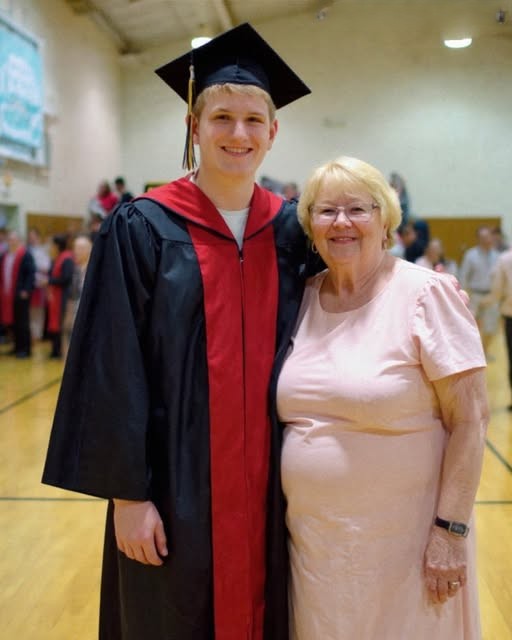
Graduation day came fast. The gym was packed. Caps rustled. Parents clutched phones. I saw my mom in the back row, sitting tall, hands folded, uniform traded for a church dress.
When my name was called as valedictorian, I walked to the microphone with one sentence already locked in my chest.
“My mom has been picking up your trash for years.”
The room went silent.
I told them who she was. What she gave up. What she carried. I named the jokes, the looks, the cruelty—not to accuse, but to tell the truth.
“For years,” I said, “there’s one person I lied to every day. My mom. Because I didn’t want her to think she failed me.”
She covered her face.
“I didn’t fail,” I said. “She built me.”
I thanked my teacher. Then I said the part that changed everything.
“In the fall, I’m attending one of the top engineering schools in the country—on a full scholarship.”
The gym erupted. Cheers, applause, tears.
I finished with one last thought:
“Some of you are embarrassed by where you come from. You shouldn’t be. The people who clean, lift, drive, and haul are the reason the rest of us get to dream. Respect them. Their kids might be standing here next.”
Afterward, my mom hugged me so hard I thought I’d crack in half.
That night, we sat at our kitchen table with my diploma and acceptance letter between us. Her uniform still smelled faintly of bleach. For the first time, it didn’t make me feel small.
It made me feel tall.
I’ll always be the son of a garbage collector. And that’s exactly why I’m going where I’m going.