I’m Caleb. I’m twenty-six, and most days I live on the road more than in my own apartment. I deliver medical supplies—oxygen tanks, refrigerated medications, emergency pharmacy runs. If a clinic pays extra for speed, I’m the one driving. Snowstorms, black ice, roads that look harmless until your tires suddenly disagree.
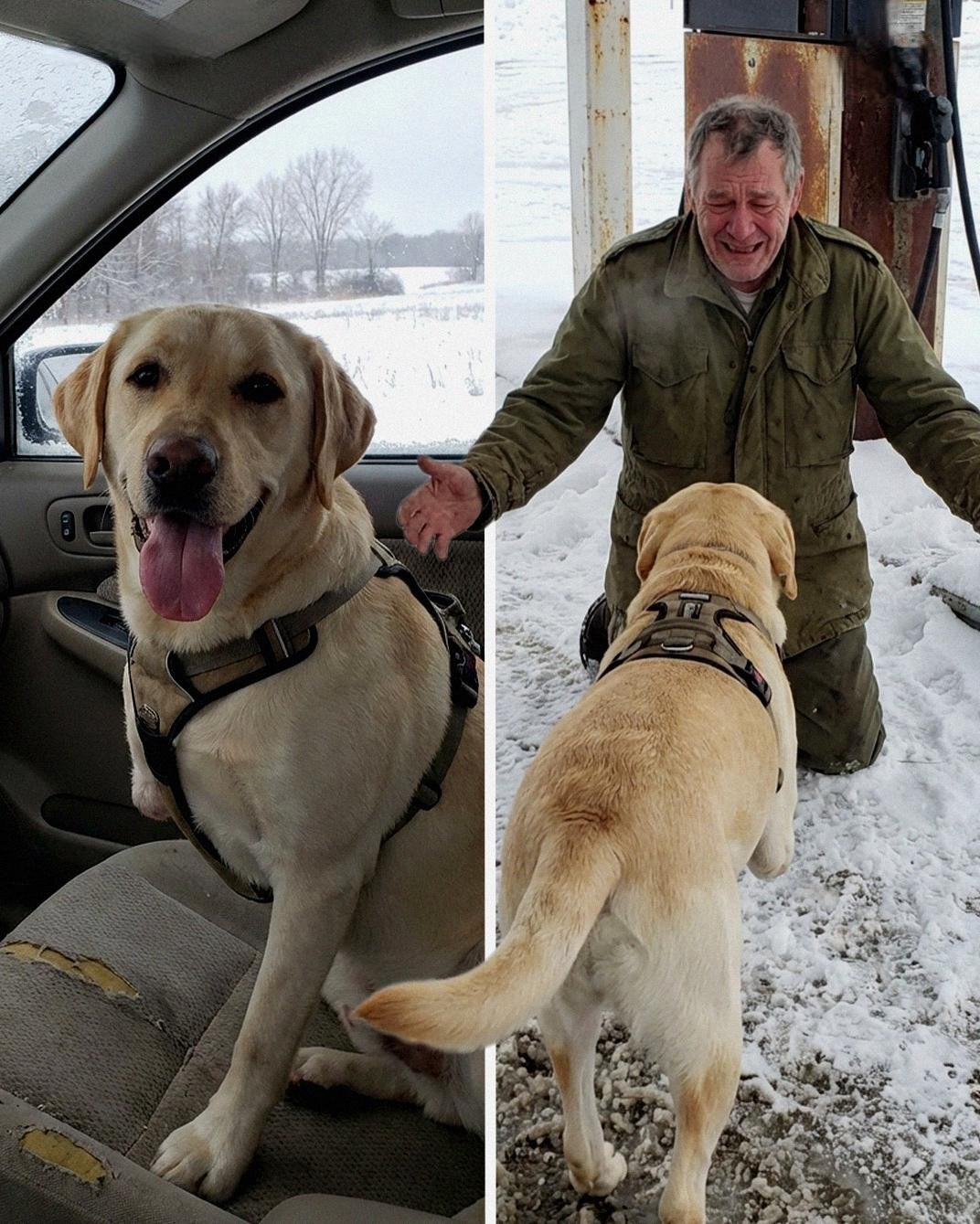
My constant companion is Mooney, a yellow Lab with three legs, a long scar down his shoulder, and an ego large enough to claim the passenger seat as his throne. His front left leg is gone, but he still rides shotgun like he owns every mile. He watches gas stations, porch lights, and anyone who gets too close to my truck with unwavering suspicion.
I didn’t adopt Mooney because I wanted a dog.
I took him in because I needed a reason not to vanish.
After my best friend Bennett was killed overseas, the funeral passed in a haze—uniforms, rehearsed condolences, a folded flag. I remember breathing. I remember the weight in my chest. I remember not being able to meet his family’s eyes without feeling like I’d failed a test I didn’t know I was taking.
When it ended, one of the guys from our unit came up to me holding a leash like it was something dangerous he was eager to hand off.
On the other end stood a thin Lab with stitches, a cone around his neck, one leg bandaged, eyes sharp and defiant.
“Stray got hit near base,” he said. “Bennett wouldn’t let it go until they fixed him.”
I stared at the dog. Then the leash.
“Why me?”
He shrugged. “Bennett said if he didn’t make it, give the dog to you. Said you needed someone who wouldn’t leave.”
Then he pressed the leash into my hand and walked away like the job was done.
Mooney came home with me. He learned stairs on three legs. Learned the sound of the treat bag faster than any dog I’d known. Learned which neighbors were safe and which made my shoulders tense. Learned to bark at anyone approaching my truck like they were about to steal it. And somehow, he learned when my thoughts spiraled—pressing his heavy head into my lap until I came back to myself.
A year passed that way. Driving. Delivering. Functioning. Convincing myself I was fine because I was still useful.
Then came a brutal night in January that dragged on too long.
The windchill was below zero, the kind of cold that shrinks your lungs. I’d been on the road since before sunrise, dropping oxygen tanks at homes that smelled like antiseptic and fear. People don’t meet your eyes when they’re scared someone won’t last the night.
On the way back, I pulled into a gas station beside a big-box store. I needed fuel and coffee or my reflexes were going to slow down dangerously.
Mooney sat up and fogged the window.
“Two minutes,” I told him. “Don’t steal the truck.”
He snorted like I was insulting his intelligence.
That’s when I noticed the van.
Rusty white, parked near the edge of the lot. One window covered with plastic. It looked like it had been losing fights with life for a long time.
An older man stood beside it, pouring a red gas can into the tank and getting almost nothing. He wore a faded Army jacket, no gloves, no hat. His hands were cracked and raw, one knuckle split and bleeding. He moved stiffly, like someone whose body had taken too many hits and never had the chance to heal.
Something tugged at my chest.
I walked over and held out a twenty.
“Sir, please—get something warm. Coffee. Food.”
He straightened immediately.
“I’m not begging,” he said. His voice was rough but steady, pride welded into every word. “I’ve got a pension coming. Just waiting on paperwork.”
I froze, then nodded.
“You just look cold,” I said, because it was true.
He looked at the bill, then away.
“I’m waiting on someone,” he added. “I’ll be fine.”
That kind of pride—I recognized it. Bennett had worn it the same way.
I slipped the money back.
“Understood. Stay warm.”
I turned toward my truck.
That’s when Mooney exploded.
He slammed into the passenger window, barking wildly, the cab shaking. His claws scraped the glass. A broken, desperate whine cut through the noise—something I’d never heard from him before. This wasn’t warning. This was recognition.
“Mooney!” I shouted, running back.
He didn’t even look at me.
I opened the door and he bolted past me, hit the ice, slipped once, then sprinted across the lot on three legs faster than he had any right to.
Straight at the man.
“Mooney! Heel!”
He ignored me completely.
He crashed into the man’s knees and glued himself there, whining like he’d finally found someone he’d been searching for. The gas can hit the pavement. The man dropped to one knee, hands sinking into Mooney’s fur.
“Easy,” he murmured. Then softly, clearly:
“Hey, Moon.”
My stomach dropped.
No one called him that.
Mooney pressed into his chest, tail wagging low, torn between joy and grief.
The man looked up at me. His eyes were blue—Bennett’s blue—just older, worn thin by time.
“You’re Caleb,” he said.
Not a question.
“Yeah,” I managed. “Who are you?”
He swallowed.
“I’m Graham. Bennett’s dad.”
The world tilted.
He pulled a creased envelope from his jacket, worn soft from being handled too often.
“My boy told me to find you,” he said. “Said you’d keep driving. Said you’d have him with you.” He nodded at Mooney.
Anger and guilt hit at once.
“Why didn’t you reach out? It’s been a year.”
“Didn’t have a phone half the time. Lost the house. VA lost my file twice.” He nodded toward the van. “Been waiting.”
Then he added, “Bennett said if anything happened, not to let you disappear.”
That one hurt the most.
I nodded toward the diner.
“You eaten?”
“I’m fine.”
“That’s not what I asked.”
I changed tactics.
“I’ll buy dinner. You tell me one story about Bennett I don’t know. Fair trade.”
He studied me, then huffed.
“You sound like him.”
We ate soup and terrible coffee. Mooney curled at his feet, guarding him.
Stories came. Quiet laughter. Shared weight.
One night became many.
Mooney still barked at strangers—but when Graham knocked, he lost his mind with joy.
“Hey, Moon,” Graham would say.
And every time, Bennett felt closer—not like a wound anymore, but like proof.
Because on a frozen night at a gas station, my three-legged dog recognized family before I did.
And he was right.