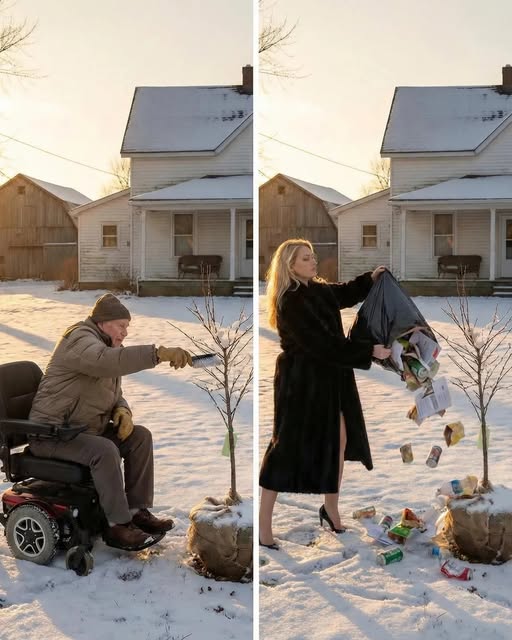
I am seventy-three years old. I’m retired, and I move through life in a wheelchair—but my world hasn’t shrunk. If anything, it has become more focused, more intentional. What once stretched wide has now gathered itself into something smaller and more meaningful. My yard may be modest, but it is my sanctuary, my daily proof that I am still present, still contributing, still alive in ways that matter to me.
Two young maple trees stand watch at the front, their branches reaching upward with the quiet optimism of youth. Along the side of the house, old evergreens form a steady, protective wall, their needles holding decades of memory. Between them lies my garden, every square foot tended with care and patience. I know every plant, every stone, every uneven patch of soil. Even in winter, I don’t abandon it. I bundle up and roll outside to wrap delicate trunks against the cold, brush heavy snow from bending branches, salt the narrow path in neat, deliberate lines. Every morning, without fail, I fill the bird feeder. The finches and cardinals arrive like faithful visitors, bright flashes of color against the gray. This yard isn’t just property—it’s purpose. It gives structure to my days and meaning to my time.
So when trash started appearing, it didn’t feel like coincidence. It felt invasive. Personal.
At first, it was small enough to ignore. A greasy takeout bag crumpled near the fence. A soda can half-hidden in the snow. Napkins snagged in the shrubs. I cleaned it up quietly, telling myself it was accidental, that maybe the wind had carried it over. I didn’t want conflict. I didn’t want drama. But the pattern became impossible to deny. It always appeared near the same property line. It always showed up after my new neighbor moved in—loud, careless, dismissive, someone who moved through the world as if space belonged to her by default.
Then came the morning after a heavy snowfall.
I rolled outside and stopped cold. Beneath my young maples sat an entire overturned trash can. Food scraps spilled everywhere. Beer-soaked cardboard. Wrappers frozen into the snow. The smell of rot clung to the crisp winter air, defiling the stillness I cherished. And there, stamped clearly in the fresh snow, were footprints—leading straight from her gate into my yard.
I went to her door. I didn’t raise my voice. I didn’t accuse. I simply asked her to explain.
She laughed.
She told me it was “just trash.” She said I had all the time in the world. She suggested I might as well clean up hers along with mine. And then she glanced at my wheelchair and smirked—as if my body, my time, and my care for this place made me lesser. As if my yard existed for her convenience.
I left without arguing. Not angry—focused. I’ve learned that some people confuse patience with weakness. I don’t.
What she didn’t know was that I’ve lived next to that house for more than thirty years. The owner isn’t just my landlord neighbor—he’s my oldest friend. And long before that confrontation, I had already documented everything. Photos. Dates. Times. Footprints preserved in snow. Weeks of quiet evidence. I sent it all to him with a brief note.
Ten minutes later, my phone rang. He was furious.
The lease was month-to-month. Yard responsibilities were clearly spelled out. He took it from there.
A few days later, I returned to her door with a small box. Inside were copies of everything I had sent. When she opened it, the truth landed heavier than any shouted argument ever could. She was livid. I was calm. I hadn’t raised my voice once. I had simply used my time exactly the way she told me to.
By Friday, the house was empty.
The noise disappeared. The chaos vanished. My yard was clean again. Fresh snow fell overnight—untouched, quiet, perfect. I rolled outside and breathed deeply, the cold air sharp and clean, no longer tainted by the smell of garbage. A cardinal shook snow from a branch above me, and I gently brushed the evergreens clean. I sat there for a while, letting the silence settle into my bones.
I may be old. I may use a wheelchair. But I am not anyone’s trash collector—unless I choose to be. And if you decide to turn my garden into your dumping ground, don’t be surprised when I calmly, carefully, and completely take out the trash.