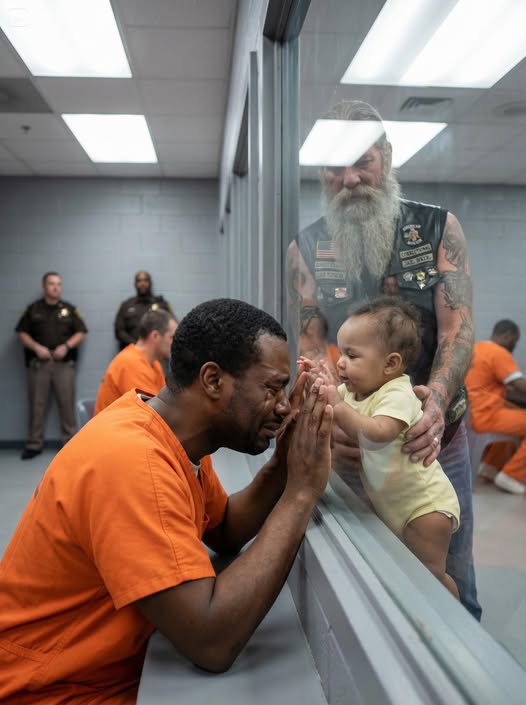
The Man Who Kept His Word
I didn’t truly understand what mercy was until I saw it through bulletproof glass.
For three years, a man I’d never met—a biker named Thomas Crawford—brought my infant daughter to the prison every single week. No excuses. No missed visits. No “something came up.” Just a steady, unwavering commitment that made the world feel a little less cruel, hour by hour.
My name is Marcus Williams. I’m serving an eight-year sentence for armed robbery. I was twenty-three when I went in. Twenty-four when my wife, Ellie, died a day and a half after giving birth. And twenty-four when Thomas became the reason my daughter didn’t vanish into foster care before I could ever hold her.
I’m not asking for pity. I made my choices. I walked into a convenience store with a gun because I owed people I couldn’t pay on time. I didn’t hurt anyone physically, but I scared someone whose only crime was doing their job. The trauma was real—I earned my sentence.
But Destiny, my daughter, didn’t deserve this. And Ellie didn’t deserve to die alone in a hospital room while I sat sixty miles away, trapped in concrete, barred from saying goodbye.
Ellie was eight months pregnant when they arrested me. She showed up in court anyway. I’ll never forget her, hands pressed against her belly, trying to shield our child from everything happening in that room.
The judge didn’t yell. He didn’t have to.
“Eight years,” he said.
Ellie’s chair scraped back. She collapsed. Stress pushed her into early labor. She was rushed out, and I remained in shackles, hearing my name like a label, not a person.
I begged to see her. They didn’t care. Rules don’t bend for desperation.
I learned of Ellie’s death from the prison chaplain. Sixteen words:
“Your wife passed due to complications. Your daughter survived.”
Ellie was gone. Destiny was alive. And I’d never held her.
I knew foster care. I grew up in it. Conditional love, temporary homes, strangers’ kitchens. Ellie was the first person who chose me deliberately.
When she died, CPS took Destiny. She was three days old and already a file number, a case worker, a “future” decided by strangers.
Two weeks later, they told me I had a visitor. Expecting lawyers or chaplains, I entered the visitation room and froze.
On the other side of the glass was Thomas—an older man, long gray beard, motorcycle vest, hands like tree bark. In his arms, wrapped in pink, was Destiny.
My knees nearly gave out.
“I’m Thomas Crawford,” he said. “I was with your wife when she died.”
He explained how Ellie had asked him to protect Destiny, to keep her from foster care. He fought the system—forty-three witnesses, attorneys, parenting classes—until he secured emergency custody.
“I told the court I’d bring Destiny to see you every week until your release,” he said.
Every week. Without fail.
I asked why he’d do this for a stranger.
“Because fifty years ago, I lived your life,” he said quietly. “I lost my son to foster care when my wife died. I never saw him again. I vowed to make it right whenever I could.”
Thomas showed me mercy. Not forgiveness. Not pretending I hadn’t done wrong. But showing up, week after week, keeping a promise to a dying mother, so a little girl would never believe she was alone.
Through bulletproof glass, I saw my daughter’s first smiles, her first laughs, her recognition of me. And I knew: one man’s commitment can be enough to make a world that feels cruel, feel a little kinder.
That’s what mercy looks like.