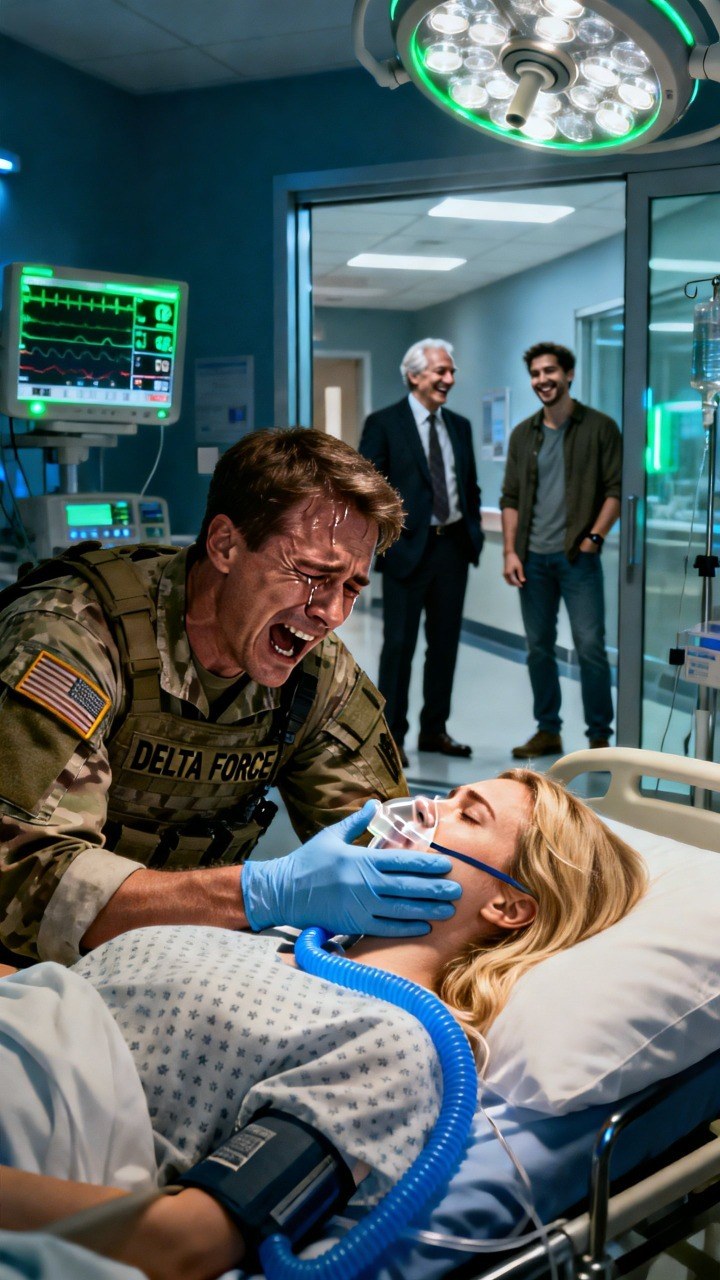
A phone ringing at midnight is enough to unsettle most people, but for a soldier, fear doesn’t come from noise. It isn’t the roar of gunfire, the snap of a sniper round, or the ground-shaking impact of an explosion. Those dangers are familiar. The real horror is coming home from the dark and finding that the place meant to keep you safe has become something lifeless and wrong.
I’ve spent my adult life operating in the shadows with Delta Force, moving through deserts where survival depends on discipline and silence. I’ve seen entire villages erased and felt explosions tear through armor and flesh. Still, none of that prepared me for seeing my wife, Tessa, lying unconscious in an ICU bed. The doctors didn’t describe injuries—they described devastation. Thirty-one broken bones. Massive blunt-force trauma. The face I had memorized in moments of exhaustion and distance, the anchor that kept me sane during deployments that officially never happened, was swollen and bruised beyond recognition. Yet the most unbearable part wasn’t her condition. It was knowing that the men responsible were waiting just outside her room, dressed in tailored suits and pretending to care.
The flight home from deployment is usually filled with anticipation. You rehearse the moment you walk through the door—the sound of your gear hitting the floor, the rush of footsteps, the feel of your wife throwing her arms around you. That image is what keeps you human when you spend months hunting monsters. But when my taxi arrived at two in the morning, the house was dark. Tessa always left the porch light on when I was coming home. It was her way of guiding me back.
The front door stood slightly open. Training took over. I moved through my own home like it was hostile territory, instinctively clearing rooms, reaching for a weapon that wasn’t there. The air didn’t smell right. Bleach burned my lungs, sharp and artificial, barely masking the metallic scent beneath it. Blood. Anyone who’s been to war knows that smell. In the dining room, the rug was gone and the floor still damp. Someone had tried—and failed—to erase what happened.
A call from Detective Miller sent me straight to St. Jude’s Medical Center. The nurses’ expressions told me everything before a word was spoken. Outside the ICU, I found an obstacle. Victor Wolf—Tessa’s father, a man who owned half the county and the politicians that ran it—sat checking his watch like this was an inconvenience. Around him stood his sons, the so-called Wolf Pack: seven loud, entitled men who believed everything had a price. They’d never accepted me—the soldier husband who didn’t fit their image.
Dominic, the oldest, tried to stop me from entering her room. I met his gaze without blinking. “Touch me again,” I said quietly, “and you’ll be the one in that bed.” He stepped aside.
Tessa barely looked like herself. Her jaw was wired shut, her scalp stitched, her body marked by violence. Detective Miller suggested a failed robbery. I knew better. Her nails were clean—no skin beneath them. A woman trained in kickboxing wouldn’t go down without a fight unless she trusted the people close enough to hurt her.
Victor’s eyes held no grief when I confronted him—only irritation. Mason, the youngest brother, trembled nearby, barely holding his coffee. I told them I would find out what really happened.
Back at the house, I stopped being a husband and became what the military had shaped me into. The blood patterns told a story—controlled, vertical. Not chaos. Punishment. Four sets of heavy boot marks. They’d restrained her. Then I remembered Tessa’s words before I left: If something happens, check the table.
Taped beneath the dining table was a small voice recorder. When I played it, the truth spilled out. Victor demanding she sign documents to exploit my military identity. Tessa refusing. Then orders. Commands. The sound of blows. Her brothers holding her down while they broke her for saying no.
Grief vanished, replaced by focus so sharp it felt cold. I opened the hidden safe in the garage. I didn’t take a gun—guns are quick. I took what I needed.
At a 24-hour hardware store, I moved with purpose. Plastic sheeting. Staples. A heavy framing hammer. I tested its weight. Balance matters.
They’d be celebrating at Victor’s club, convinced they’d won. They thought silence meant victory. They forgot that hunters don’t stop being hunters just because they come home.
I pulled my hood up and chose my starting point. Mason. The weakest. The one who held her legs. The night was quiet—for now. That was about to change.
I wasn’t calling the police. Justice had already been bought. By morning, the Wolf Pack would learn that some things can’t be purchased—and some men don’t break.
And I was on my way.