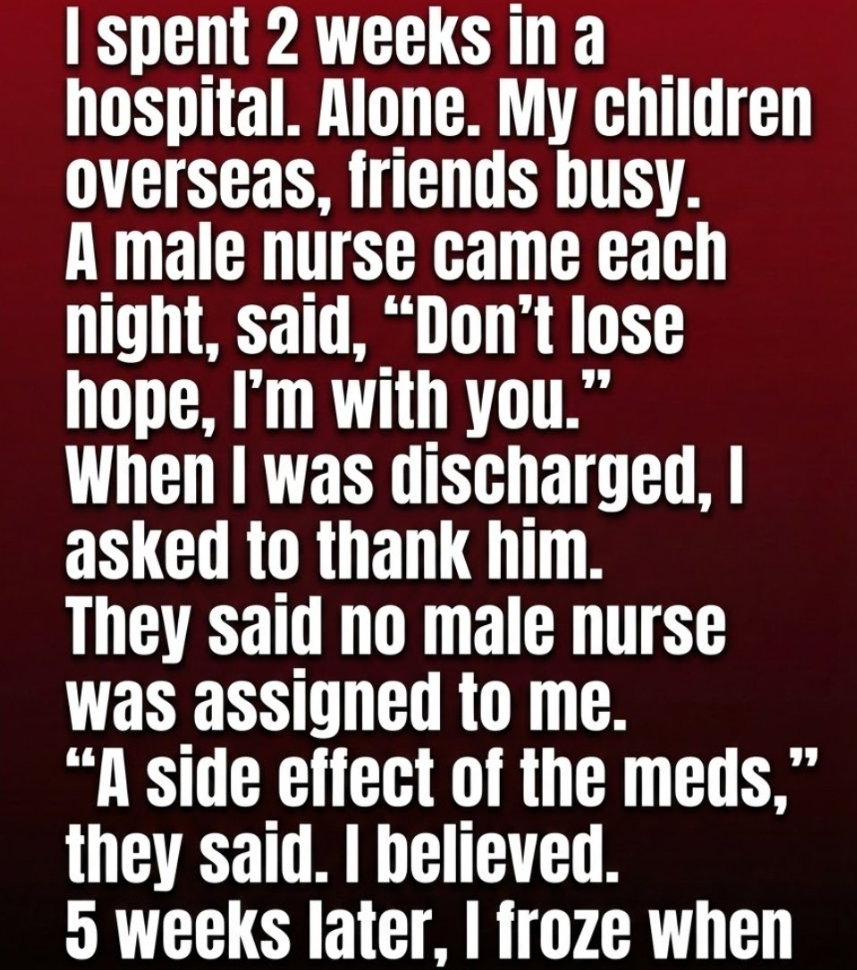
During my two-week stay in the stark, white corridors of the municipal hospital, silence became something tangible. It wasn’t merely the absence of sound—it was a presence, constant and unrelenting. Confined to a hospital bed, the outside world didn’t just feel far away; it felt unreachable, like a separate reality continuing without me.
My children were grown, scattered across different cities, separated by long drives and the relentless pull of their careers. They loved me, I knew that, but love didn’t shorten distances or create free time. Friends checked in when they could, their messages kind and sincere, yet they were absorbed in the demanding weight of midlife—responsibilities I no longer had the strength to carry alongside them. Visiting hours came and went, often leaving no familiar face behind. Each day blended into the next, measured only by the sterile rhythm of monitor alarms, the hiss of curtains being drawn, and the steady footsteps of nurses changing shifts.
I worked hard to stay hopeful. I told myself this was temporary, a pause meant for healing. I reminded myself that recovery is quiet, slow, and rarely dramatic. Still, loneliness has a way of sharpening itself at night. When the lights dimmed and the ward sank into a bluish hush, I was left alone with my thoughts. Doubt crept in, whispering fears about whether I would ever fully return to who I once was.
Yet in that isolation, one steady presence anchored me.
Every night, just before silence fully settled over the floor, a nurse came into my room. He was calm, unhurried, almost out of place in a hospital where urgency ruled everything. His movements were careful, intentional. His voice was low and soothing, as if designed to quiet anxiety itself. He didn’t simply take my vitals—he adjusted my blankets with care, checked the monitors, and before leaving, offered words that felt uncannily precise.
“Rest now.”
“Don’t give up.”
“You’re stronger than you realize.”
They were simple words, but in that sterile room, they felt life-giving. In those moments, I wasn’t just a patient or a chart—I was seen. His nightly visits became the one thing I looked forward to, a quiet reassurance that I wasn’t facing the darkness alone.
When discharge day arrived, I felt steadier, though still fragile. As I prepared to leave, gratitude pressed heavily on me. Before exiting, I stopped at the nurses’ station.
“I’d like to thank the male nurse who checked on me every night,” I said. “He was assigned to room 412.”
The staff exchanged confused looks. They checked schedules, staffing logs, and assignments from the past two weeks. Finally, the head nurse looked at me gently.
“I’m sorry,” she said. “There hasn’t been a male nurse on this floor during your stay. Night shift has been all female this month.”
They suggested medication side effects, exhaustion, or stress-induced hallucinations—common explanations, they said. I nodded and accepted it outwardly, though something uneasy settled in my chest. I left the hospital telling myself the mind can create comfort when it needs it most.
Weeks later, back at home, life slowly resumed its familiar rhythms. The hospital began to feel unreal, like a dream colored in blue light and mechanical sounds. One afternoon, while unpacking the small bag I had brought with me—untouched since returning—I felt something tucked deep inside a pocket.
I pulled out a small, folded note, creased and worn.
Inside, written in careful, unfamiliar handwriting, were the same words I had heard so many nights:
“Don’t lose hope. You’re stronger than you think.”
There was no name. No date. Nothing to explain how it got there.
I sat quietly, the paper resting in my hand, replaying those nights in my mind. I searched for logic—perhaps a staff member, another patient, or even something I’d written myself and forgotten. But the handwriting wasn’t mine.
In the end, the explanation mattered less than the message.
That note stayed on my nightstand. It became a reminder that comfort doesn’t always come with answers, and kindness doesn’t always announce itself. Sometimes strength is not something we create alone—it’s something awakened by the right words at the darkest moment.
The mystery of the night nurse never needed solving. Whether he was real or something my spirit summoned, the outcome was the same. What mattered wasn’t who spoke the words—but who I became because I heard them.