The mystery of what awaits after our final breath is perhaps the one concern shared by every human being. Across cultures and throughout history, we have created intricate myths and religious frameworks to explain the transition from life to death: scales of judgment, pearly gates, or cycles of reincarnation. Yet, despite centuries of philosophical debate, the true nature of the afterlife remains hidden behind an impenetrable veil—unless, like Brian Miller, you happen to cross it and return to tell the story.
Brian Miller, a 41-year-old truck driver from Ohio, lived a life rooted in tangible reality. His days were measured by the weight of a steering wheel and the steady hum of the highway. But in 2014, his reality shifted in an instant from the concrete to the celestial. While at home struggling with a stubborn container lid, he was suddenly struck by a crushing, white-hot pressure in his chest. Recognizing the signs of a serious heart event, he dialed 911. “I’m a truck driver, and I think I’m having a heart attack,” he told the dispatcher, his voice strained as he described the onset of a “widowmaker” event.
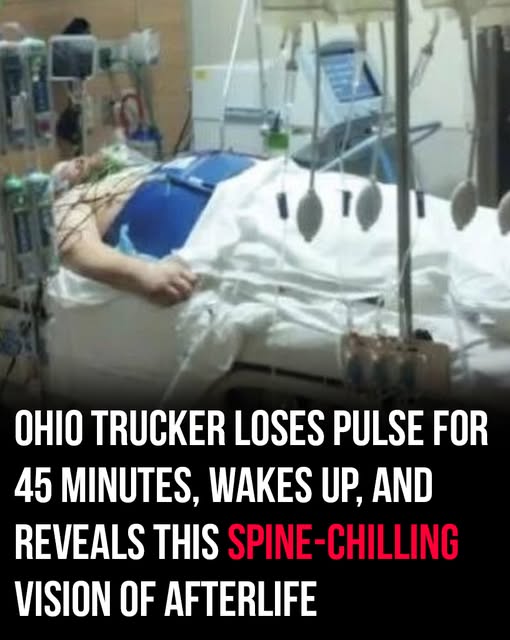
Rushed to the emergency room, doctors worked with surgical precision to clear a total blockage in his main artery. For a brief moment, it seemed Brian had survived. But the human heart is a delicate electrical system, and the trauma triggered a fatal malfunction: ventricular fibrillation. His heart stopped beating properly, quivering chaotically instead of pumping blood to his brain and vital organs. Brian Miller flatlined.
Emily Bishop, an ICU nurse on duty that day, recalls the scene as an absolute void. Brian had no pulse, no heartbeat, and no blood pressure. By all medical measures, he was dead. Doctors launched into frantic CPR, breaking ribs in an effort to manually circulate blood. They administered four high-voltage shocks via defibrillator, trying to restart his heart. Nothing worked. After nearly forty-five minutes of unsuccessful resuscitation, the medical team faced a grim reality: Brian Miller was pronounced dead.
For forty-five minutes, his body sat in the silence of clinical death. His brain was deprived of oxygen—a duration usually enough to cause irreversible brain damage. Yet while the hospital room in Ohio was heavy with loss, Brian says he was elsewhere.
He describes the experience not as fading into darkness, but as awakening into a radiant, vibrant realm. “The only thing I remember,” he recounted, “is seeing the light and walking toward it.” He found himself on a path unlike anything on Earth, lined with flowers of colors more vivid than he had ever seen. There, he encountered his late stepmother.
The reunion was nothing like the sorrow of a funeral. She appeared as the most beautiful thing he had ever seen, youthful, radiant, and brimming with joy. She didn’t lecture or philosophize—she simply took his arm and spoke with the certainty of someone who knew the grand design. “It’s not your time,” she told him. “You don’t belong here. We have to take you back; you have more to do.”
Back in the hospital, as staff prepared for the paperwork of a failed code, the impossible happened. Without medication or electrical shock, Brian’s pulse returned “out of nowhere.” His spontaneous revival stunned the medical team. Typically, patients whose hearts restart after such prolonged periods remain in a persistent vegetative state—but Brian returned fully aware, sitting up, laughing, and talking with the very people who had just witnessed his death.
Brian’s story has become a cornerstone for near-death experience research. Skeptics often suggest that such visions are the result of physiological brain activity, like DMT release or hypoxia-induced neuronal firing. But for Brian, forty-five minutes of clinical death offered more clarity than forty-one years of life. He returned with a clear message for those still navigating life: “There is an afterlife, and people need to believe in it, big time.”
His experience transcends medical anomaly. It speaks to the human need for hope. For those who have lost loved ones, his description of a joyful reunion offers a peace that science alone cannot provide. Brian no longer fears death. He sees his return not just as a medical miracle, but as a divine opportunity to share that the end of the line may, in fact, be the beginning of a far brighter journey.
Today, Brian continues his life in Ohio, but with a perspective forever changed. He has stood on the threshold of the ultimate unknown and found it to be not emptiness, but a destination. His story reminds us that even when monitors fall silent and the pulse disappears, there may be a path lined with light and flowers—and perhaps a familiar hand guiding us home—or, if we are lucky, sending us back.