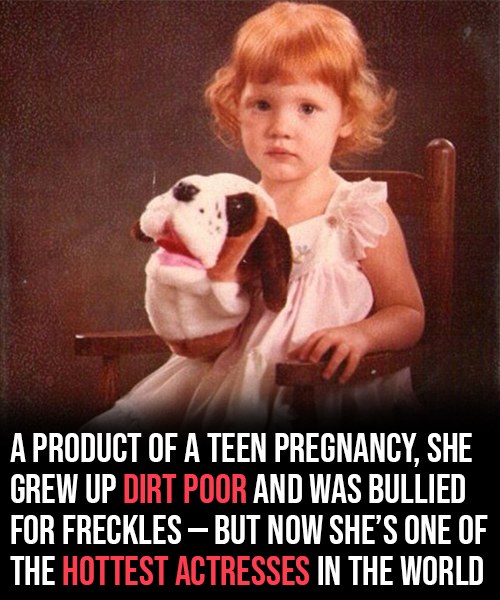
From the hardships of poverty and the scars of childhood bullying to the glittering stages of Hollywood’s most prestigious awards, Jessica Chastain’s journey is a testament to the power of resilience and determination. Today, she stands as one of the most respected and formidable talents in the film industry—an actress whose name evokes both emotional depth and intellectual sophistication. Yet her rise to stardom was far from easy; it was shaped by struggle, hunger, and an unyielding refusal to let circumstances define her future.
Born on March 24, 1977, in Sacramento, California, she entered the world as Jessica Howard. Her mother, Jerri Hastey, was a teenage parent and vegan chef, working tirelessly to keep the family afloat. Her stepfather, Michael Hastey, a firefighter, offered as much stability as he could, but life was far from easy. For young Jessica, reality was often defined by scarcity. She has spoken openly about her “very difficult upbringing,” recalling nights when she and her siblings went to bed hungry. Those early experiences left an indelible mark, cultivating a deep empathy for those marginalized by society. Chastain has said that her childhood taught her to consider others’ struggles, a quality that would later infuse her performances with authenticity and nuance.
Her family life was further complicated by the absence of her biological father, Michael Monasterio, a rock musician who was largely absent during her formative years. His absence was so complete that no father was listed on her birth certificate. Despite the challenges at home, she shared a close bond with her younger sister, spending countless hours outside playing and escaping the difficulties inside. Tragedy, however, would strike: in 2003, her sister died by suicide at their biological father’s home, leaving a void in the family that would never fully heal. Later, when Monasterio passed away from bronchitis in 2013, Chastain chose not to attend the funeral, maintaining boundaries around a past that offered “little proof of anything.”
School life presented its own challenges. Chastain was relentlessly bullied for her striking red hair and freckles, mocked daily with cruel words and rejection. Yet these attacks did not break her; instead, they sparked a rebellious streak that became both armor and motivation. This defiance shielded her curiosity and determination, ultimately helping her transcend the limitations imposed by her environment.
Her love for acting began at the age of seven when her grandmother took her to see Joseph and the Amazing Technicolor Dreamcoat. While other children imagined ordinary futures, Chastain experienced an “aha moment” of clarity: acting was not a hobby—it was her calling. Her imagination became a sanctuary, and she pursued classes at a performing arts school in exchange for work, since tuition was beyond her family’s means. These years taught her the value of community; she encountered individuals who stepped in to support her when she was most vulnerable. She also credits access to Planned Parenthood for providing reproductive healthcare and choices that allowed her to pursue her ambitions, rather than being trapped by the cycle of teenage pregnancy she witnessed around her.
Her talent eventually earned her admission to the prestigious Juilliard School in New York City, a dream that seemed almost unattainable due to the financial burden. Fate intervened in the form of Robin Williams, a Juilliard alumnus who had funded scholarships covering tuition, books, rent, and travel to see family. Though she never met Williams before his death in 2014, she wrote him countless letters of gratitude. His generosity allowed her to focus entirely on her craft, transforming her from a girl who had grown up in scarcity into a classically trained artist ready to step onto the global stage.
Chastain’s rise in Hollywood was gradual. She spent years honing her skills on stage and taking small television roles before making her film debut at age 31 in Jolene. But 2011 marked her breakout year: six films, including Take Shelter and Terrence Malick’s The Tree of Life, introduced the world to the striking redhead whose talent seemed boundless. Her performance as Celia Foote in The Help earned her an Academy Award nomination and cemented her status in Hollywood, with appearances at Cannes alongside Sean Penn and Brad Pitt signaling a new era in her career.
Chastain continued to challenge Hollywood norms with roles that defied gender expectations. In Christopher Nolan’s Interstellar, she played a character originally written for a man, asserting her presence in a major sci-fi blockbuster. Her portrayal of a driven CIA analyst in Zero Dark Thirty earned a second Oscar nomination and reinforced her commitment to complex, empowered female characters. Chastain intentionally selects roles that explore feminist themes, refusing to be reduced to a conventional sex symbol.
Her dedication culminated in the ultimate recognition: in 2021, she won the Academy Award for Best Actress for her transformative performance as televangelist Tammy Faye Bakker in The Eyes of Tammy Faye. Beyond accolades, Chastain has leveraged her fame to advocate for gender and racial equality, as well as mental health awareness. She remains deeply connected to her roots, frequently stating that her success fuels a sense of anger for those still denied a voice, a meal, or an opportunity.
In her personal life, she is married to Italian fashion executive Gian Luca Passi de Preposulo. The couple wed in Italy in 2017 and now reside in New York City with their two children. Despite her fame, Chastain maintains privacy, attending events alone when possible to protect her family. She values substance over celebrity, never forgetting the girl who once went to bed hungry. Jessica Chastain’s story is a reminder that while one’s beginnings may be rooted in struggle, the trajectory of life—its middle and its end—can be shaped by perseverance, humility, and unwavering self-belief.