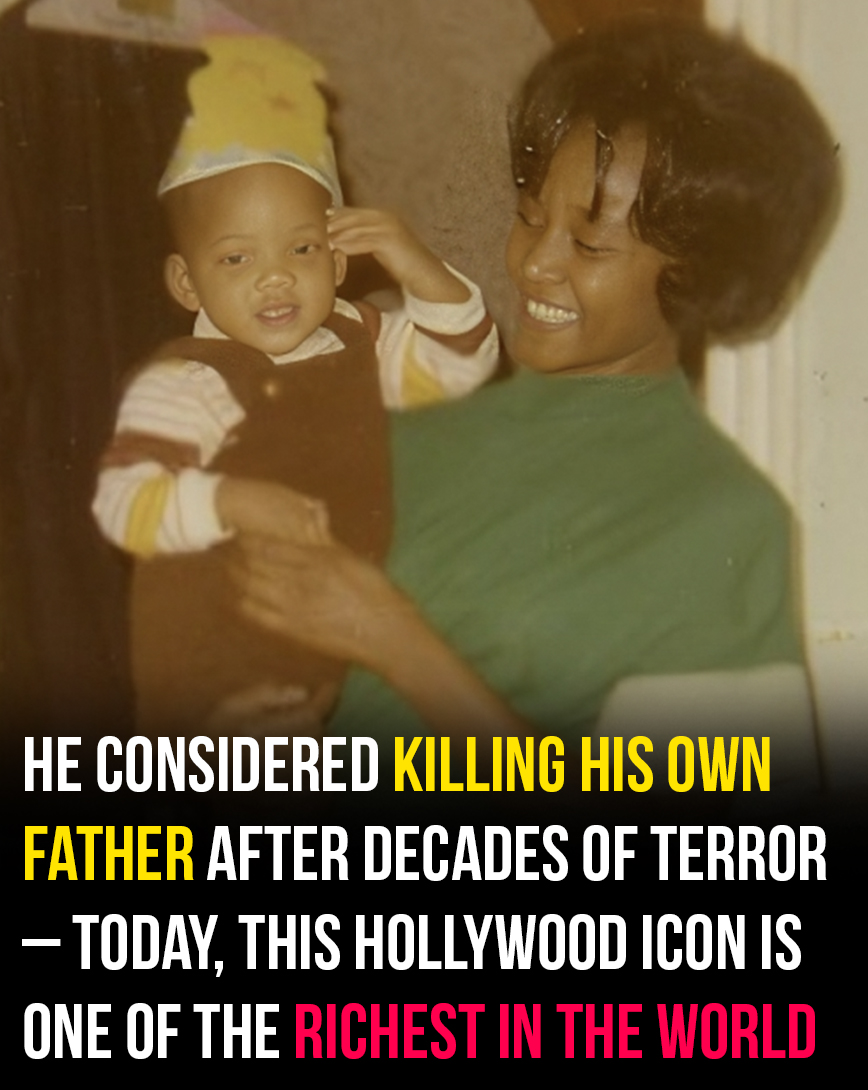
The truth about Will Smith’s past is far more brutal than the blockbuster smile he shows the world ever allows. The charm, the infectious laughter, the effortless charisma—all of it masks a childhood steeped in fear, tension, and silence. Behind the grin was a boy who learned to freeze, to hide, to become small whenever the world erupted around him. One memory, vivid and unrelenting, remains burned into his mind: a moment when his mother, in the chaos of domestic violence, spit blood onto the floor. The sound, the sight, the helplessness—it became a soundtrack to his early years, a warning signal that life could turn violent in an instant. He adored his father, yes—but he feared him in a way that no amount of love could erase. That fear was complex, layered, sometimes hidden even from himself, yet it shaped the contours of the man he would become.
Years later, even as fame and wealth separated him from the streets and homes where he grew up, those memories persisted. He could stand at the top of a stairwell and imagine the pus, the pain, the anger, the rage that had once filled his father’s world. He remembered the heavy hand, the raised voice, the sense of being both cherished and endangered at the same time. It was a contradiction he carried like a secret weight, a constant, silent companion to the life he built afterward.
Will Smith’s life is, in many ways, a study in contradictions. He is a son shaped by violence, yet he became obsessed with protection, with shielding those he loves from the same harsh realities he endured. He is a global superstar, admired and adored, yet still haunted by the silence of a nine-year-old boy too scared to speak, too paralyzed to challenge the very figures who were supposed to protect him. His father’s iron-fisted “love” left a wound, deep and raw, a wound that even the adoration of millions could never fully heal. Every joke he cracked, every action-hero role he embodied, every standing ovation he received, each became an unspoken apology to his mother and a plea for his own redemption. Fame, in this sense, was not just success—it was a defense mechanism, a shield, a way to transform fear into something the world could applaud rather than pity.
And yet, it is in the choices he made, the moments when he refused to surrender to the cycle of violence, that his true story emerges. There was a time when he could have pushed his dying father down the stairs, when vengeance whispered in the quiet corridors of his mind. But he did not. That act of restraint, almost invisible to the outside world, rewrote the narrative he had been living since childhood. He embraced care over revenge, presence over perfection, vulnerability over performance. He learned that power was not always exerted through control or fear, but through patience, attentiveness, and the quiet discipline of love.
As a father, this understanding transformed him. He vowed, consciously and deliberately, to be a gardener rather than a drill sergeant, tending carefully to the unique seeds of Willow, Jaden, and Trey. Each child was different, each personality a delicate ecosystem requiring attention, nurturing, and respect. His goal was not to dominate, not to impose, but to cultivate, to observe, and to guide with the wisdom born from having lived through fear himself. The lessons of his own youth—the silences, the terror, the unspoken grief—became the foundation for a new kind of fatherhood, one where fear was replaced by presence and love, where trauma was acknowledged rather than repeated.
The infamous Oscars slap, which riveted the world and sparked endless debate, became another mirror for Smith to confront himself. That moment forced him to face the rage still buried inside, the impulsive responses that could erupt when pain met public pressure. But it also opened a doorway to deeper honesty. For the first time, perhaps, he was not only facing his audience but facing himself—his imperfections, his history, and the choices that defined him. That journey is far from complete. Every interview, every public statement, every reflection on past missteps becomes part of an ongoing narrative of learning and reconciliation.
Will Smith’s journey is no longer merely about escaping the shadows of his past. It is about learning, painfully and publicly, to live with it—to sit with the discomfort, to recognize the ways it shapes him, and to actively choose love, accountability, and humility over pride, secrecy, or aggression. His life illustrates a paradox: the world may see a polished superstar, a man who embodies confidence, energy, and charm—but beneath that exterior lies someone who has wrestled with the consequences of fear, who has confronted inherited trauma, and who has found the courage to rewrite the script of his own life.
In the end, Smith’s story is not just about Hollywood or fame. It is about survival, reflection, and transformation. It is about breaking cycles of violence, owning the shadows of one’s own upbringing, and choosing, over and over again, to respond with care rather than cruelty. His journey reminds us that strength is not always measured in triumphs or accolades, but in the quiet decisions to heal, to nurture, and to grow in spite of a past that would have defined any ordinary life. The blockbuster smile may be what the public sees, but the real story—the one worth telling—lies in the courage it took to transform fear into love, rage into understanding, and pain into purpose.