The Greenland Confrontation: A Turning Point in Transatlantic Politics
The ongoing controversy surrounding Greenland has evolved beyond quiet diplomatic discussions into a full-fledged political spectacle, and few moments have encapsulated this shift as vividly as a recent speech in the European Parliament. What began as yet another debate over sovereignty, security, and global power dynamics, escalated when a Danish lawmaker abandoned the usual diplomatic decorum and, in bold terms, directly told the American president to “back off.” This exchange marked a dramatic shift in how Europe views U.S. involvement in Greenland’s future and, by extension, broader transatlantic relations.
At the heart of the drama is former U.S. President Donald Trump, whose renewed efforts to bring Greenland under American control have rattled European allies. Framed as a matter of “national and world security,” Trump’s proposal to annex the Arctic island has brought back memories of his earlier interest in acquiring Greenland and intensified fears that the U.S. government is willing to use coercive tactics to achieve its strategic and economic goals. Greenland, an autonomous territory within Denmark, has suddenly become a key geopolitical pressure point.
Trump’s argument for pursuing control of Greenland hinges on its location and resources, which he views as crucial for American defense, especially in the context of rising tensions with Russia and China. He has repeatedly claimed that Denmark lacks the resources or capacity to properly protect the island, a statement that has been firmly rejected by Danish authorities.
Not only did this claim stir tensions in Copenhagen, but it also sparked fierce backlash from Greenland itself. Protests under the slogan “Hands off Greenland” have occurred both on the island and in major cities across Denmark. Protesters accuse the U.S. president of treating Greenland as a mere commodity, disregarding the wishes of its people. According to BBC reports, opinion polls indicate that around 85% of Greenlanders oppose any move to become part of the United States.
Despite the overwhelming opposition, Trump has doubled down on his position. In a series of posts on his Truth Social platform, he asserted that Greenland is “imperative for National and World Security” and that there could be “no going back.” He framed the U.S. as the sole global power capable of maintaining peace, suggesting that American strength—not diplomacy or negotiation—was the ultimate stabilizing force in international relations. This rhetoric echoed a familiar theme in Trump’s foreign policy: America provides security to its allies, and therefore, those allies owe the U.S. their loyalty and compliance.
Such remarks have alarmed European leaders already wary of the state of transatlantic relations under Trump. His comments about Greenland were not isolated; they were part of a broader narrative in which NATO allies were criticized as insufficiently grateful for American protection. To many in Europe, the tone of Trump’s rhetoric sounded less like the language of a partnership and more like the tactics of a bully.
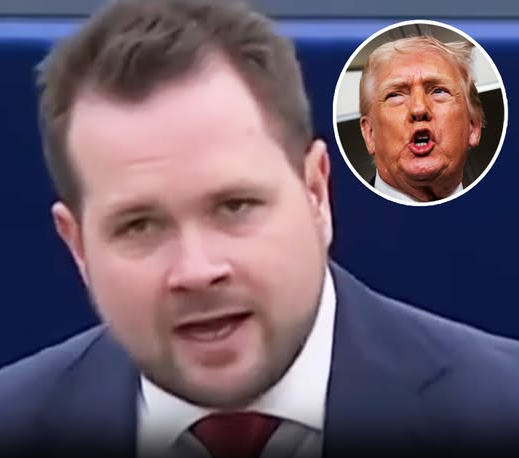
It was during a session of the European Parliament that this tension reached its peak. Danish Member of the European Parliament Anders Vistisen, known for his firm stance on sovereignty and national independence, took the floor to launch a vigorous defense of Greenland’s autonomy and Denmark’s authority. His remarks began with a measured tone, reminding the chamber that Greenland has been part of the Danish realm for centuries and enjoys a clearly defined autonomous status. Greenland, he emphasized, is not a territory up for grabs by any larger power. It is a country with its own people, culture, and political institutions, he stated.
Then, the speech took an unexpected turn. Vistisen, abandoning diplomatic decorum, directly addressed Trump in what would become the most memorable moment of the debate. With clear frustration, he told the American president to “f— off.” The response was immediate. The European Parliament chamber erupted, and the video clip quickly spread across social media, drawing both praise and criticism in equal measure. Supporters hailed Vistisen’s words as a refreshing burst of honesty, while critics decried the outburst as reckless and unprofessional.
The reaction to Vistisen’s speech was swift and polarized. Many saw his remarks as an expression of frustration that had long been simmering beneath the surface of European diplomacy. They believed his words encapsulated the growing resentment towards Trump’s dismissive approach to allies, which, in their view, ignored international norms and treated countries like pawns in a global game. On the other hand, some felt that Vistisen’s choice of language undermined the seriousness of Denmark’s position. His outburst gave Trump an easy way to dismiss European objections as emotional, rather than grounded in rational diplomacy.
The presiding officer of the European Parliament quickly intervened, cutting Vistisen off mid-speech. The speaker reminded him that parliamentary rules prohibit profanity and personal insults, regardless of the emotional intensity behind them. “This is against our rules,” the speaker remarked, stressing that strong feelings do not justify inappropriate language within the chamber. Vistisen was prevented from finishing his remarks, and the session continued, but the damage—or perhaps the impact—had already been done.
The incident underscored a larger rift over how Europe should respond to Trump’s aggressive, confrontational style. While some argue that traditional diplomacy has failed, others caution that engaging in theatrics plays into Trump’s media instincts and risks escalating the situation further. The polarized nature of the response highlighted the delicate balance Europe must strike when confronting Trump’s unorthodox approach to international relations.
But beyond the viral moment, the stakes in the Greenland debate are much higher. Greenland sits at a strategic crossroads, its location becoming increasingly important due to emerging Arctic shipping routes and potential reserves of rare earth minerals crucial for modern technology. With climate change opening up areas of the Arctic that were previously inaccessible, competition for influence in the region is growing. The United States, Russia, and China all have significant strategic interests in the region. But for Denmark and Greenland, the issue of sovereignty is non-negotiable.
Danish officials have repeatedly stressed that Greenland’s future can only be decided by the people of Greenland themselves. While Denmark acknowledges the island’s strategic importance and cooperates closely with the U.S. on defense, it firmly rejects any suggestion that the island could be treated as a bargaining chip. Greenland’s own leaders have echoed this sentiment, emphasizing the principle of self-determination and warning against the dangers of becoming entangled in great-power politics.
Trump’s comments have strained relationships within NATO as well. The alliance relies on mutual trust among its members, and public threats from one ally against another only serve to test that foundation. European leaders worry that framing security as a transactional favor, rather than a shared commitment, undermines the collective defense that NATO was built on. This shift in tone risks weakening the unity of the alliance, especially as global instability continues to rise.
In this context, Vistisen’s outburst can be seen as more than just a breach of parliamentary rules. It symbolizes the growing frustration among European leaders with Trump’s tactics. It reflects a boiling point reached after months of rhetoric that many perceive as dismissive and domineering. While it’s debatable whether Vistisen’s words ultimately helped or hindered Denmark’s case, they certainly crystallized the anger simmering below the surface of European diplomacy.
As the dust settles, it’s clear that the debate over Greenland is no longer just an abstract geopolitical issue. It has become a symbolic battleground for larger questions of power, sovereignty, and the future of international alliances. Trump’s insistence on framing the issue as a test of loyalty has forced European leaders to respond—sometimes with restraint, and sometimes with open defiance.
The moment in the European Parliament will be remembered not just for its language, but for the deeper message it conveyed: Europe is increasingly unwilling to accept being treated as a subordinate in the global arena. As patience with coercive diplomacy wears thin, the clash over Greenland has already reshaped the dynamics of transatlantic politics. Whether this leads to a renewed dialogue or a deeper divide remains to be seen, but the impact of this debate will continue to resonate in future discussions about sovereignty, security, and the future of international relations.