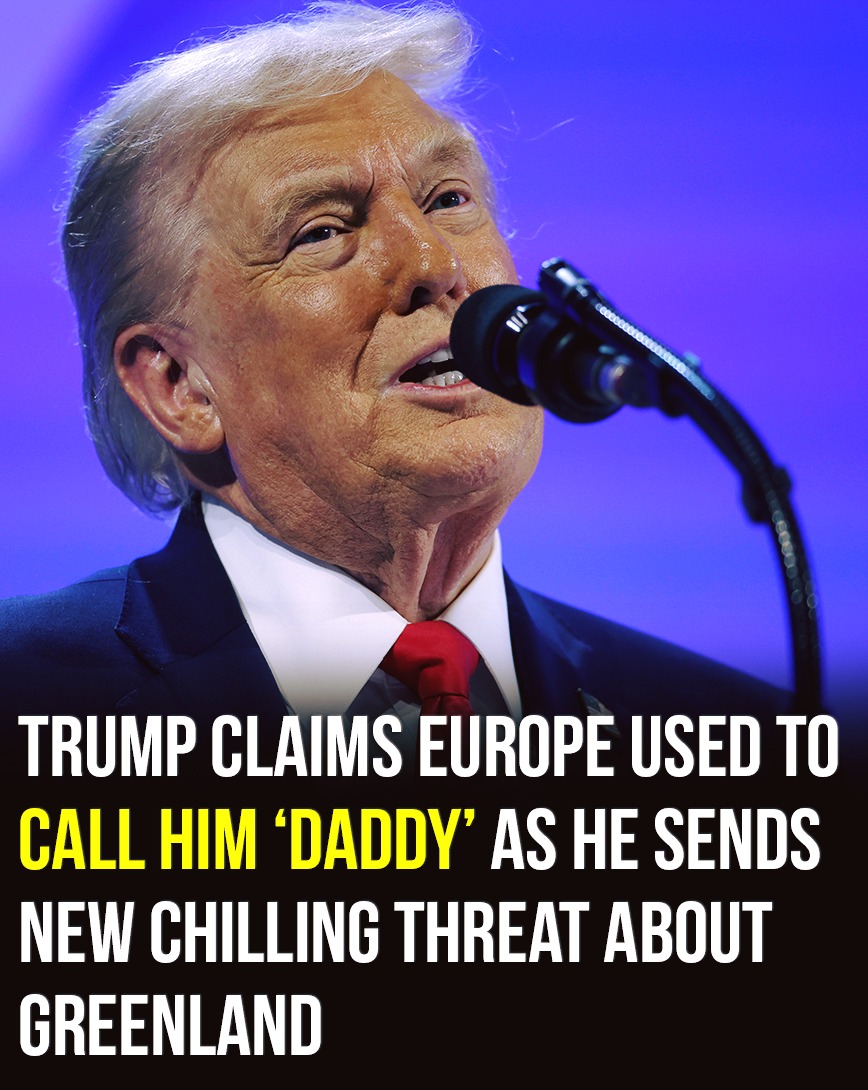
At the World Economic Forum in Davos, Donald Trump took the stage to deliver what seemed like a policy address, but quickly evolved into a geopolitical declaration. The speech blurred the lines between diplomacy and provocation, redefining alliances, territory, and power as personal tests of loyalty. Greenland, a vast and sparsely populated landmass in the Arctic, emerged as the focal point—not as a matter of geography, but as a bargaining chip.
Trump spoke about Greenland not in terms of treaties or international law, but as a symbol of whether America’s allies still understood who, in his view, held the true weight in global security. What might once have been framed as a strategic interest was redefined as a reckoning. Cooperation, Trump implied, was not just preferred—it was owed. Resistance, he warned, would be remembered.
The tone was unmistakable. Trump mocked European leaders, portraying them as dependent on the U.S. and returned to a familiar refrain: that America had long been exploited by allies who took protection but failed to show gratitude. He recounted moments when foreign officials, in his telling, had treated him with exaggerated deference, humorously claiming they called him “daddy.” The remark triggered nervous laughter from the audience, but the message was clear: in Trump’s world, respect was not mutual but hierarchical.
This theme was most evident in his comments on NATO. Trump painted the alliance as something the U.S. largely sustains on its own—shielding Europe while receiving little in return. He suggested that NATO’s survival wasn’t about shared values or collective defense, but because the U.S. allowed it to exist. In this narrative, America’s allies were not partners but dependents, and their dependence was a debt that could be called in.
Greenland was positioned as a litmus test of loyalty. Trump argued that U.S. control over the island was crucial for both national and global security, citing threats from Russia and China. He dismissed Denmark’s claim over the land, labeling historical ownership as flimsy. While he refrained from explicitly threatening military action, he made it clear that no option was off the table—only to pivot almost immediately and assert that he preferred peace. The contradiction was familiar: overwhelming force presented as reassurance, not a threat.
In Davos, where diplomatic restraint is the norm, Trump offered a starkly different perspective. He implied that power is most effective when it is personal, unapologetic, and etched into the memory of those who experience it. Allies who resist should expect consequences—not immediately, perhaps, but inevitably.
Trump’s remarks on immigration only deepened the divide. Speaking in broad, derogatory terms about migrants from Somalia and elsewhere, he framed entire communities as dangerous or intellectually inferior. These were not policy suggestions but boundary markers, defining who belonged in the West and who did not. In his vision, security was maintained not by cooperation or integration, but through exclusion and force.
Canada, too, wasn’t spared. Trump implied that without the protection of the United States, Canada would struggle to survive. This echoed his treatment of Europe—neighbors and allies were depicted as weak, sheltered by U.S. power, and insufficiently appreciative of it. In this worldview, gratitude wasn’t optional; it was the price for security.
Despite the bravado, Trump’s argument followed a predictable pattern. First, there is public pressure—verbal, unmistakable, and unyielding. Then comes humiliation, often wrapped in humor. Finally, the suggestion of overwhelming force, paired with a claim that it would only be used if absolutely necessary. This is a negotiating style that treats relationships as contests and ambiguity as an advantage.
For his supporters, the speech was a refreshing assertion of strength. To them, it proved that Trump remains unafraid to challenge assumptions, disrupt alliances, and demand more from partners who, in their view, have become complacent.
For critics, however, the speech was a stark reminder of the fragility of international trust when diplomacy is replaced by intimidation. Alliances like NATO, they argue, are not protection rackets but collective agreements built on shared interests and mutual restraint. By framing them as one-sided obligations, Trump risks eroding the very structures that have provided global stability for decades.
Greenland, largely absent from the conversation except as a symbol, became collateral in this broader debate. Its people, governance, and legal status were overshadowed by its strategic value in an era of melting ice and rising global tensions. In Trump’s view, the land mattered less for its inherent qualities than for what it represented: a test of whether American demands would still be met with compliance.
The irony of Trump’s speech in Davos was impossible to ignore. In a forum dedicated to global cooperation and economic interdependence, he articulated a vision rooted not in collaboration but in dominance and transaction. He rejected the idea that global stability comes from shared rules, instead asserting that it flows from unmistakable power and the willingness to use it—or at least to make others believe it might be used.
By the end of the speech, it was evident that Greenland was never the main focus. Nor was NATO, immigration, or Canada. The real message was one about memory. Trump was reminding allies and adversaries alike that, in his view, power is not merely exercised in the present; it is something others must remember long after the moment has passed. Who complied. Who resisted. Who showed respect.
In Davos, Trump didn’t offer a roadmap for negotiation or compromise. He issued a warning, brimming with bravado and repetition: the United States, in his view, is done asking politely. Whether this approach strengthens American influence or accelerates its isolation remains to be seen. What is certain is that the speech solidified one of Trump’s defining characteristics: loyalty is demanded, gratitude is expected, and power is never allowed to fade quietly into the background.