The transition from being a wife and new mother to an outcast occurred with a cold, clinical efficiency that I am still struggling to process. Two days after I buried my husband, Caleb, I found myself standing on the threshold of the apartment we had shared, clutching our three-week-old son, Noah. My mother-in-law, Deborah, stood in the doorway, her face a mask of calculated indifference. “You and your child mean nothing to me,” she said, her voice devoid of even a flicker of mourning. Before I could find the words to ask where a grieving woman with a newborn was supposed to go, the lock clicked shut, severing my last tie to the life I had known.
I am Mia, and at twenty-four, I became a widow and a homeless mother in the span of forty-eight hours. As I walked away with nothing but a suitcase, a diaper bag, and Caleb’s old hoodie—which still carried the faint, heartbreaking scent of him—I felt like a ghost. To understand the depth of Deborah’s cruelty, one has to understand the road Caleb and I traveled to bring Noah into the world. We had spent years navigating the exhausting terrain of infertility, marked by silent tears in bathroom stalls and the crushing weight of negative tests. When we finally conceived, we wept on the floor in sheer relief.
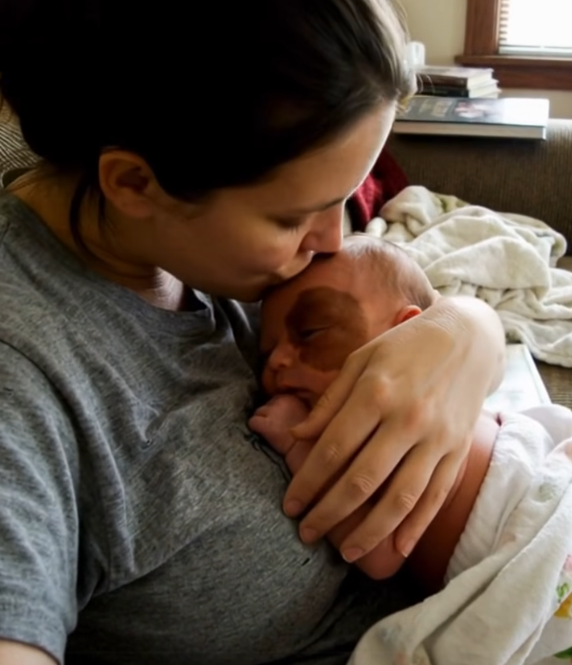
Noah was born with a large, port-wine stain birthmark covering half of his face. In the delivery room, the silence was thick with that brand of pity that feels like an insult. I panicked, already imagining the cruelty the world would inflict on him. But Caleb didn’t hesitate. He kissed our son’s cheek and whispered, “Hey, buddy. We’ve been waiting for you.” He loved Noah without reservation. Deborah, however, saw the birthmark as an opportunity to sow seeds of doubt. She would stare at the infant’s face and make pointed remarks about “not knowing what really happened,” subtly implying that Noah wasn’t Caleb’s child. Caleb always told me to ignore her, believing his mother would eventually come around. He was a man of immense faith in people, a trait that made his sudden death at twenty-seven all the more devastating.
One day he was there, making promises about the future, and the next, a massive heart attack turned my world to ice. The funeral was a fragmented blur of grief, dominated by Deborah’s performative wailing. It was only a week later that she revealed her true nature, informing me that the apartment was in the family’s name and that I was no longer welcome. Her accusation was the final blow: “You got pregnant somewhere else and tried to trap my son.”
For the next several weeks, I existed in survival mode. I drifted between friends’ couches and dilapidated motels, trying to keep a newborn warm and fed while my own spirit was breaking. The turning point came on a rainy afternoon when a car splashed a puddle over us as I walked from a grocery store. The driver, a young woman named Harper, jumped out to apologize, but stopped mid-sentence when she saw my face. I was shattered, and the story poured out of me right there on the sidewalk. Harper, as it turned out, was a lawyer who had experienced a similar betrayal after her own father’s death. She looked at me with a fierce, professional empathy and said the words I hadn’t heard since Caleb died: “I can help you.”
A few days later, Deborah called. Her voice had undergone a miraculous transformation, sounding sweet, warm, and maternal. She invited me to dinner, claiming she wanted us to be “family” again. Despite my intuition, a desperate part of me hoped she had finally seen Caleb’s eyes in Noah’s face. The dinner was a surreal performance of domestic harmony until the masks slipped. Deborah casually mentioned that Caleb had saved a significant sum of money to buy us a house—money he had left to me in his will. Then, her voice turned like a blade. She demanded the majority of the funds, claiming her “sacrifice” as a mother outweighed my rights as a wife. When I demanded to see the legal papers, she threatened to fight me until I was broke.
I left her house shaking, but this time, I wasn’t alone. I called Harper. What followed was a weeks-long legal battle that Deborah was entirely unprepared for. She tried to vilify me in our social circles, painting me as a gold-digging opportunist and even threatening to sue for grandparental visitation rights. But Harper was relentless. We followed the paper trail Caleb had left behind, a trail that proved he had been meticulously planning a secure future for Noah and me. He had structured his assets to ensure that even if he weren’t there to stand between us and his mother’s bitterness, his legacy would.
The day Harper told me it was over, I didn’t feel a rush of triumph. I felt a profound, exhausting relief. The money was mine, and by extension, it was Noah’s. I sat in her office and cried—not for the money itself, but for the realization that love is a force that can reach back from the grave to offer protection. A month later, I signed the deed to a small, modest house with a sun-drenched kitchen and a patch of grass in the back. It wasn’t just a building; it was a sanctuary where Noah would never have to feel like an unwanted guest.
On moving day, I stood in the empty living room and watched the light hit the birthmark on Noah’s face. For the first time, I didn’t see a “mark” or a reason for shame. I saw a beautiful boy who was the living embodiment of his father’s devotion. I whispered a thank you into the silence—to Harper for her strength, to myself for surviving the nights I thought would break me, and to Caleb for building a roof over our heads when he was no longer here to hold it up himself.
Deborah never apologized, and she likely never will. She remains a woman consumed by the need for control, unable to grasp that family isn’t something you can coerce or steal. I learned that real family is defined by the people who show up when the world is at its darkest. Harper became family by choice, standing in the gap when blood relatives walked away. As I rock Noah to sleep in our new home, I realize that Caleb’s love hasn’t ended; it has simply transformed. It exists in the walls of this house, in the legal protections he provided, and in the strength I found to fight for our son. Love doesn’t die; it builds, it protects, and it remains.