I didn’t say yes because I believed I possessed some miraculous ability to heal him. I said yes because my home had become a cavern of echoes, and I had lived with silence long enough to recognize its many shades. My silence was born of grief—the kind that follows three miscarriages and a marriage that crumbled when my husband decided he could no longer build dreams on shifting sand. But the boy’s silence was different. It was alert, guarded, and architectural; a fortress he had constructed to survive a world that had repeatedly failed him.
When Maribel, the caseworker, first spoke of him, she used a tone reserved for “difficult” cases. She told me he was nine years old and hadn’t spoken a single word in years. With a heavy sigh, she admitted that most families walked away the moment they realized he couldn’t—or wouldn’t—offer them the verbal connection they sought. I told her I wasn’t like most families. I knew how to live alongside absence, and I knew that just because a room is quiet doesn’t mean it’s empty.
Jonah arrived on a Tuesday with a single backpack and eyes that moved with the precision of a hawk. He didn’t cry when the caseworker left, nor did he cling to the doorframe. Instead, he entered my home and began a silent inventory of his new surroundings, memorizing the exits and corners as if preparing for a sudden departure. I knelt to meet his gaze, promising him safety, but he simply walked past me to the far end of the sofa, sitting with his hands folded—a small statue of self-preservation.
The months that followed became a masterclass in patience. I made a conscious choice never to weaponize language against him. I didn’t demand answers to “How was your day?” or pressure him to fill the empty spaces in the air. We lived in a quiet partnership. Every night, I read aloud to him, the rhythm of my voice serving as a bridge he wasn’t yet ready to cross. I packed his lunches with handwritten notes—simple affirmations like “I’m glad you’re here” or “I’m proud of you.” For weeks, they came back crumpled or were left behind, until the day I found one of my notes carefully folded on the kitchen counter. He wasn’t just hearing me; he was listening.
Slowly, the fortress began to soften. I would cook and share stories of my own clumsiness and childhood failures, catching the slight tremor of his shoulders—a suppressed laugh that felt like a victory. He began to wait by the door when I searched for my keys. He began to notice when I was tired or sad. One winter, after a flu left me bedridden, I woke to find a glass of water on my nightstand and a small note that read, “For when you wake up.” It was the first sign that he was watching over me with the same quiet intensity I used to watch over him.
Years passed, and the silence between us transformed. It was no longer a wall but a comforting blanket. Jonah grew taller, his movements more fluid, no longer resembling those of a cornered animal. People in our small town were less patient than I was. They asked if he was “fixed” yet or if I felt cheated by his lack of speech. I always gave them the same smile. I told them Jonah didn’t need to speak to be heard; he just needed to stay. And he did stay. He stayed through the awkwardness of middle school and the growing pains of adolescence, finding his place in a noisy world without losing his own quiet rhythm.
When Jonah turned fourteen, I decided it was time to make our bond an ancestral truth. I didn’t ask him for a verbal commitment. I simply handed him the adoption paperwork and told him that if he wanted me to be his mother legally, all he had to do was nod. He studied the papers with an intensity that made my heart ache, then, with a slow, deliberate tilt of his head, he agreed.
The morning of the final hearing was thick with tension. Jonah barely touched his breakfast, his nervous energy spent folding a napkin into increasingly smaller squares. I tried to reassure him that this wasn’t a test, but a celebration of the family we had already become. He didn’t look up, but he squeezed my hand as we walked into the courthouse.
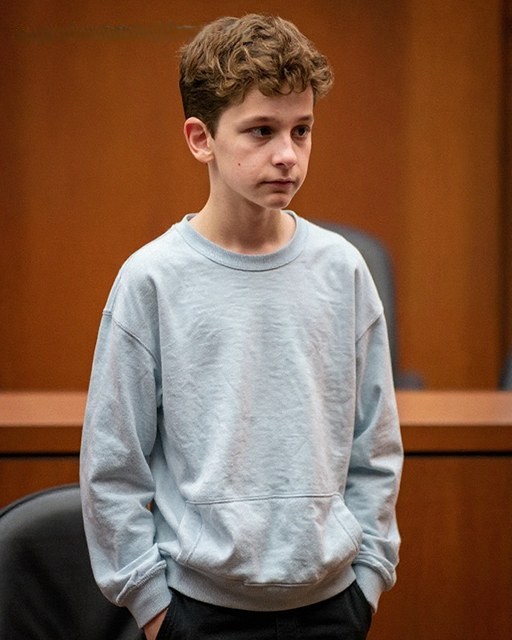
The courtroom was bathed in cold, clinical light. Judge Holloway, a man with kind eyes and a reputation for compassion, looked down from his bench. He addressed Jonah directly, telling him that he didn’t have to speak if he didn’t want to. He could write his answer or simply nod. The judge asked the pivotal question: “Jonah, do you want Mira to be your legal mother?”
The silence that followed was the longest of my life. My chest tightened, old fears of rejection rising like a wave. But then, something shifted. Jonah cleared his throat—a rough, unused sound that grated against the stillness of the room.
“I want to say something,” he whispered. His voice was low, cracking with years of disuse, but it was steady.
The room became impossibly still. Jonah looked down and began recounting a memory I had never asked for. He spoke of being seven years old and abandoned at a grocery store by a mother who promised to return but never did. He spoke of the revolving door of foster homes where his silence was mistaken for defiance and his age for a lack of need. He looked up then, his eyes locking with mine in raw, heartbreaking clarity.
“When Mira took me in, I thought she’d change her mind too,” he said, his voice trembling but gaining strength. “So I stayed quiet. I thought if I didn’t make a sound, I wouldn’t mess it up. But she stayed. She didn’t make me talk; she just loved me. She was already my mom. She just didn’t know I knew.”
He turned back to the judge and said clearly, “Yes. I want her to adopt me.”
Tears blurred my vision as the judge smiled and signed the decree. Outside the courthouse, the air felt different—lighter, as if the world had finally caught up to the truth we had lived for years. Jonah reached into his pocket and handed me a tissue, a small gesture that carried the weight of a thousand conversations.
“You’re welcome, Mom,” he said, the words like music.
That night, for the first time, Jonah picked up the book at bedtime. He sat beside me and read the story himself, his voice filling the house where the echoes used to live. As I listened to the rise and fall of his speech, I realized that our years of silence had never been empty. They were the soil in which a profound, unshakable trust had grown—a trust that had finally found its voice.