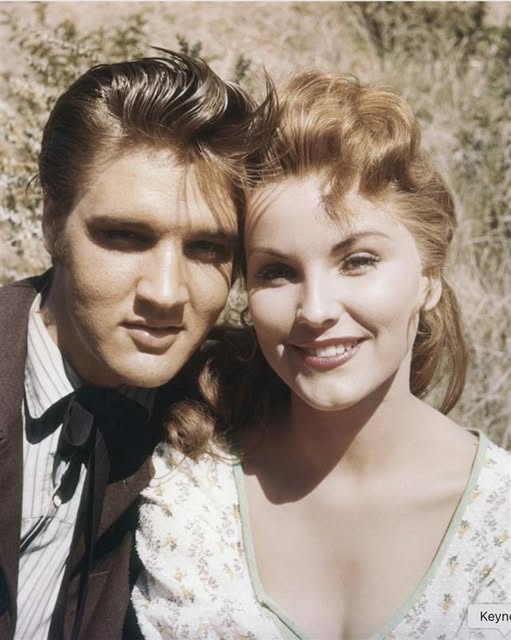
Few pop-culture moments are as charged as witnessing a young Elvis Presley step into the spotlight for the first time—without a microphone, without the roar of a concert crowd, and without the safety of being “just” a singer. Love Me Tender wasn’t simply his first movie; it was Hollywood capturing lightning in a bottle at the exact moment when America’s newest obsession was becoming a permanent legend.
Released in 1956, Love Me Tender is part Western, part family melodrama, and part romance, all set against the uneasy aftermath of the American Civil War. For long-time fans, it’s a time capsule: Elvis before the icon hardened into myth, still looking like a kid with too much charisma for the frame. For newcomers, it’s a surprisingly watchable introduction to his screen presence—warm, earnest, and far more grounded than many might expect.
What’s easy to forget now is that Presley didn’t walk onto that set as “the greatest.” He arrived as a phenomenon in motion—massive record sales, frantic crowds, and a public that had already decided he was different. Such fame can easily flatten a person into a brand, but those who worked on the film described Elvis as polite, humble, and intensely focused on doing the job right. He didn’t show up like a superstar doing a favor for the studio. He showed up like a rookie who wanted to earn his place.
Elvis’s manager, Colonel Tom Parker, had a simple, profitable, and ruthless plan. Elvis’s movies would serve to promote his music. The plot mattered, but the soundtracks mattered more. The films weren’t meant to challenge him as an actor—they were meant to keep him visible, bankable, and constantly in the public eye. Despite this, Elvis reportedly treated acting with respect. He memorized not only his own lines but also his co-stars’, a level of preparation you don’t bother with if you’re just there to pose and sing.
Love Me Tender originally went by a different title: The Reno Brothers, named after the real-life Reno Gang, often cited as among the earliest train robbers in the United States. While the historical reference provided a foundation, the film itself took plenty of creative liberties. Once “Love Me Tender” became a smash hit, the studio leaned into what audiences wanted. The title changed to match the song, and with that shift, the movie became less of a gritty postwar tale and more of a star vehicle with a built-in anthem.
Elvis plays Clint Reno, the youngest of four brothers. Clint stayed behind during the war, the one who didn’t march off to battle, and the one who faces the consequences when the others return home. The story plays with themes that resonated with mid-century Hollywood: loyalty tested by jealousy, love tangled in pride, and a family torn apart by the kind of secrets men bring home from war. Elvis’s role requires him to be both gentle and wounded at times, stubborn and explosive at others. He’s not a complex antihero, but he has enough emotional depth to prove that Presley could do more than simply grin at the camera.
The film’s premiere became something closer to a mass event than a regular screening. At the Paramount Theater in New York City, fans reportedly camped out, pressed against barricades, and screamed so loudly during Elvis’s scenes that dialogue was drowned out. Accounts from the time paint a picture of pandemonium—teenage girls fainting, security overwhelmed—the kind of frenzy that marked a shift in American celebrity culture. It wasn’t just “popularity.” It was the birth of an obsession with a face, a voice, and a body language that felt utterly new.
What makes this moment even more interesting is Elvis’s long-standing relationship with movies. Before becoming a star, he’d worked as a cinema usher in Memphis, watching the same actors everyone else watched—James Dean, Marlon Brando, Tony Curtis. He absorbed their swagger and intensity, how they conveyed emotion without announcing it. He wanted to be taken seriously on screen, not just treated as a novelty. That ambition wasn’t always reflected in the roles he was offered later on, but in Love Me Tender, you can see the effort: the restraint, the focus, the attempt to live inside a scene rather than just decorate it.
A big part of the film’s charm comes from the people around him, particularly Debra Paget, who played Cathy. Paget was a rising star in Hollywood and, by some accounts, she arrived on set with skepticism. She’d heard plenty about this “new singing sensation,” and not all of it was flattering. But when she met Elvis, she was disarmed by his good manners, quiet confidence, and almost formal respect—especially toward her mother. Their on-screen chemistry helps carry the romance, even when the script leans a bit too broad.
The off-screen story surrounding Paget has taken on a life of its own over the years. Rumors circulated that Elvis was so taken with her that he considered proposing, but she reportedly declined, drawn instead to Howard Hughes. What’s more concrete is that Paget’s look in the film—particularly her hair—left an impression that would echo later. Years afterward, Priscilla Presley would adopt Paget’s style, forming a subtle thread that connected Elvis’s early Hollywood life to the world he eventually built around himself.
One of the film’s strangest balancing acts is how it attempts to sit in 1865 while also serving 1956. Elvis’s presence bends the setting. When he sings, the era shifts. The songs don’t feel like Civil War-era folk music but more like a pop idol stepping into a costume drama and bringing his modern magnetism with him. That tension is part of the film’s appeal: it’s a Western story, but it’s also a document of a cultural eruption.
The title song, “Love Me Tender,” carries its own layered history. It’s adapted from “Aura Lee,” a Civil War-era ballad, then reshaped into something softer and more romantic. Elvis performed it on The Ed Sullivan Show before the film’s release, and the public response was immediate and massive. The song didn’t just sell tickets; it became part of his identity, the kind of track people could hum without even knowing where they first heard it.
Then there’s the odd detail fans still point out: the hair.
Originally, Clint Reno was supposed to die in the film—a bold ending, especially for a debut movie starring an idol on the rise. But the story goes that Elvis’s mother, Gladys, was so upset by the idea of audiences watching her son die on screen that the production softened the blow. They added a final moment: Elvis’s silhouette singing “Love Me Tender” over the closing credits. This was meant to comfort the audience, sending them out with music instead of shock.
In doing so, it created a peculiar continuity hiccup. In the closing silhouette, Elvis’s hair appears noticeably darker—dyed black—compared to earlier scenes where it appears closer to his natural shade. It’s not a plot-breaking flaw, but it’s one of those little details that becomes impossible to ignore once you see it, like the movie briefly revealing the machinery behind the magic.
Love Me Tender also includes the kind of old-Hollywood goofs that make vintage films feel human. A zipper appears where it shouldn’t. A modern car reportedly sneaks into a shot. A guitar keeps “playing” after Elvis stops strumming. A gun disappears and reappears depending on the angle. None of this ruins the experience. If anything, it adds to the sense that you’re watching a real artifact: a studio rushing to capture a phenomenon, patched together with practical decisions, imperfect takes, and the confidence that the star would carry it anyway.
Critics have never crowned Love Me Tender as Presley’s greatest film, and it’s not hard to see why. The story is straightforward, sometimes melodramatic, and very aware of its mission to showcase Elvis. But as a piece of pop culture history, it’s hard to beat. It’s the moment the King of Rock ‘n’ Roll becomes a Hollywood leading man, the moment the screaming crowds follow him from the stage to the screen, and the moment you can still see the boy behind the legend, trying to prove he belongs there.
Watch it today, and you’re not just watching a movie. You’re witnessing a turning point—an industry, a culture, and a young man stepping into a new arena, learning in real time how to carry the weight of a name the world had already decided would last forever.