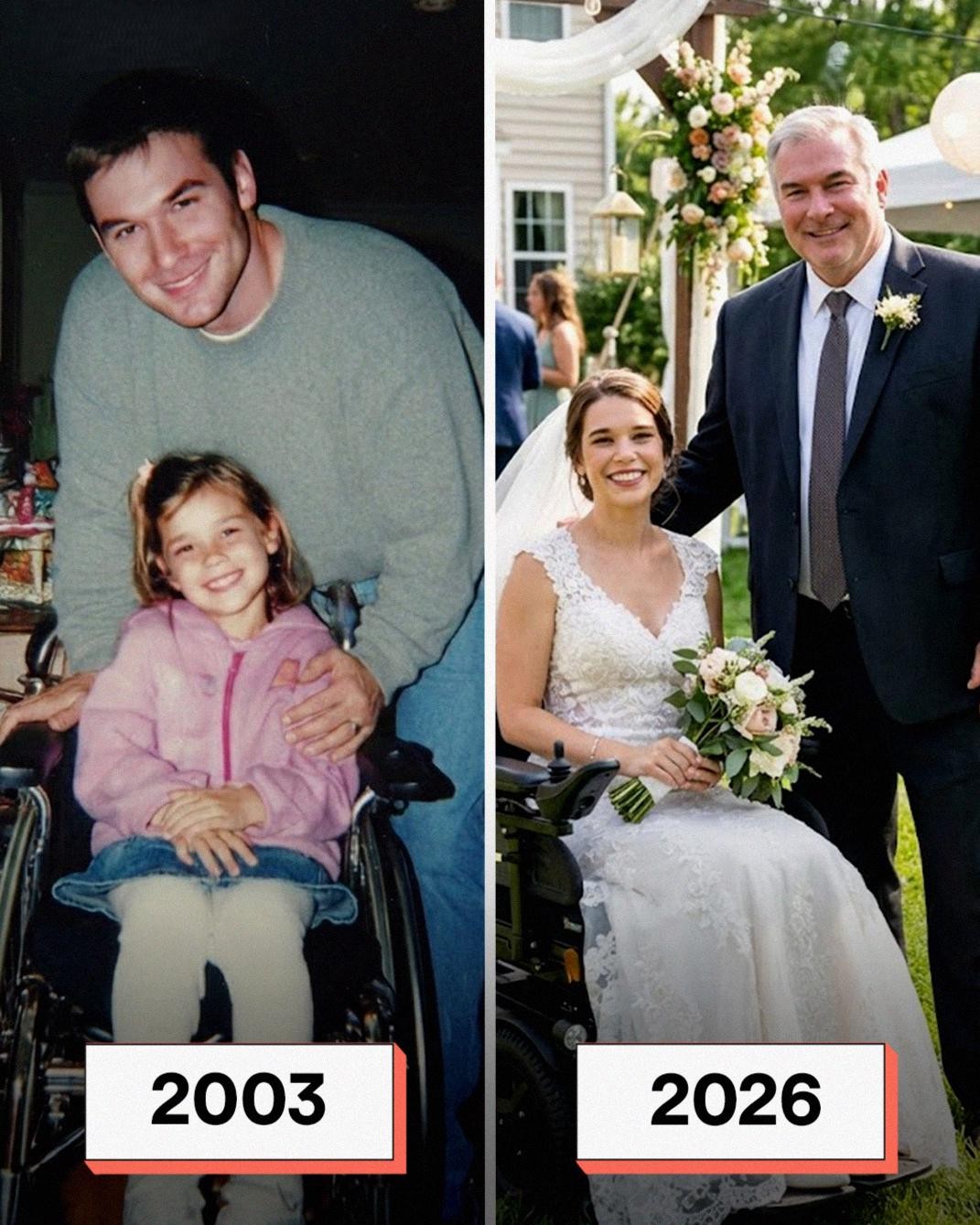
I thought I knew everything about the little girl I raised as my own. I believed there were no secrets between us. Then, on the night of her wedding, a stranger stepped out of the crowd and quietly told me I had no idea what my daughter had been hiding.
My name is Caleb. I’m fifty-five years old, and more than three decades ago, my life ended and restarted on the same night.
There was a car accident. A phone call. A calm voice that sounded practiced, almost rehearsed, explaining that my wife and my six-year-old daughter were gone. Just like that. Mary and Emma. One moment they were real, warm, and alive. The next, they were memories.
I remember standing in my kitchen, the phone still in my hand, staring at nothing. The world didn’t shatter loudly. It went quiet—a suffocating, endless quiet that followed me everywhere—into sleep, into work, into every pause between thoughts.
For years, I didn’t live. I existed. I woke up, went to work, came home, and ate frozen dinners in front of the television without tasting them. Friends tried. My sister called every Sunday. None of it filled the space they left behind. The house stayed empty.
I kept Emma’s drawings on the fridge until they yellowed and curled at the edges. I couldn’t bring myself to throw them away. They were proof she’d been real.
I never planned to be a father again. That part of me felt buried with them. I’d already loved once. I’d already failed to protect them.
Then, years later, on a rainy afternoon I still can’t fully explain, I found myself pulling into the parking lot of an orphanage. I told myself I was just curious. I wasn’t looking to replace anyone. I didn’t even know what I was looking for.
Inside, the building smelled of bleach and crayons. Laughter echoed down one hallway. A child cried somewhere behind a closed door. A caseworker walked me through paperwork and procedures with careful honesty.
And then I saw her.
She was sitting quietly in a wheelchair by a window, her hair neatly tied back, a notebook resting in her lap. While other children ran and shouted, she just watched. Not sad. Not angry. Just waiting.
Her name was Lily. She was five. A car accident had taken her father and damaged her spine. Her mother had signed away her rights not long after. She couldn’t handle the grief. Or the responsibility.
When Lily looked at me, she didn’t smile or look away. She just watched me like someone watching a door, unsure if it would open or slam shut like all the others.
Something inside me broke open.
I didn’t see a diagnosis or a burden. I saw a child who had already learned what it felt like to be left behind.
I started the adoption process immediately. It wasn’t easy. Background checks. Interviews. Home inspections. But I kept coming back to visit her. We talked about animals and books. She showed me her drawings. She loved owls because, she said, they saw everything.
When I finally brought her home, all she owned fit into a worn backpack, a faded stuffed owl, and a notebook full of sketches.
The first night she called me “Dad,” I dropped a towel on the living room floor and laughed and cried at the same time.
From that moment on, we were a team.
Therapy became our routine. I celebrated every inch of progress—ten seconds standing without support, five steps with braces, one more step than the day before. She worked harder than anyone I knew. She refused pity. She hated being underestimated.
School wasn’t always kind, but Lily learned to stand her ground. Slowly, she built confidence, friendships, and a fierce independence. She grew into a warm, stubborn, intelligent young woman who became my entire world.
She loved science. She studied biology. She volunteered at a wildlife center and once cried for hours when an injured barn owl she cared for was released back into the wild.
At twenty-five, she met Ethan at college. He had an easy smile and a ridiculous laugh. She tested him quietly, the way she tested everyone. He passed.
When she told me they were engaged, I nearly choked on my toast.
The wedding, twenty-three years after I adopted her, was small and beautiful. String lights. White lilies. Laughter. I watched her dance, confident and radiant, surrounded by people who had stayed.
Then I noticed a woman standing near the exit.
She didn’t belong. She wasn’t watching the crowd. She was watching Lily.
Our eyes met. She looked down, then walked toward me.
“You need to listen to me,” she said quietly. “You have no idea what your daughter is hiding from you.”
My stomach tightened.
“I’m her biological mother.”
The room seemed to tilt.
She told me that Lily had found her two years earlier. Asked questions. Sought answers. Tried to understand. They spoke for a while. Then Lily stopped responding.
“She deserves to know her whole truth,” the woman said. “And I deserve to be in her life.”
I looked at Lily across the room, laughing, alive, whole.
“You walked away,” I said.
“I was young. Afraid,” she replied. “I thought I was doing the right thing.”
I shook my head. “She rebuilt her life without you. Learned to walk again. Found love. This day belongs to those who stayed.”
I asked her to leave.
She did.
Later that night, Lily and I stood outside under the stars. She already knew.
“I needed to meet her,” she said softly. “But I also needed to know I could walk away. And I did.”
I took her hand. “You are my daughter. Not because of blood. Because we stayed.”
She smiled. “Thank you for choosing me. Every day.”
As I watched her dance with Ethan, I finally understood something I’d spent years learning.
Family isn’t blood.
It’s who stays when everything falls apart—and keeps choosing to stay long after.