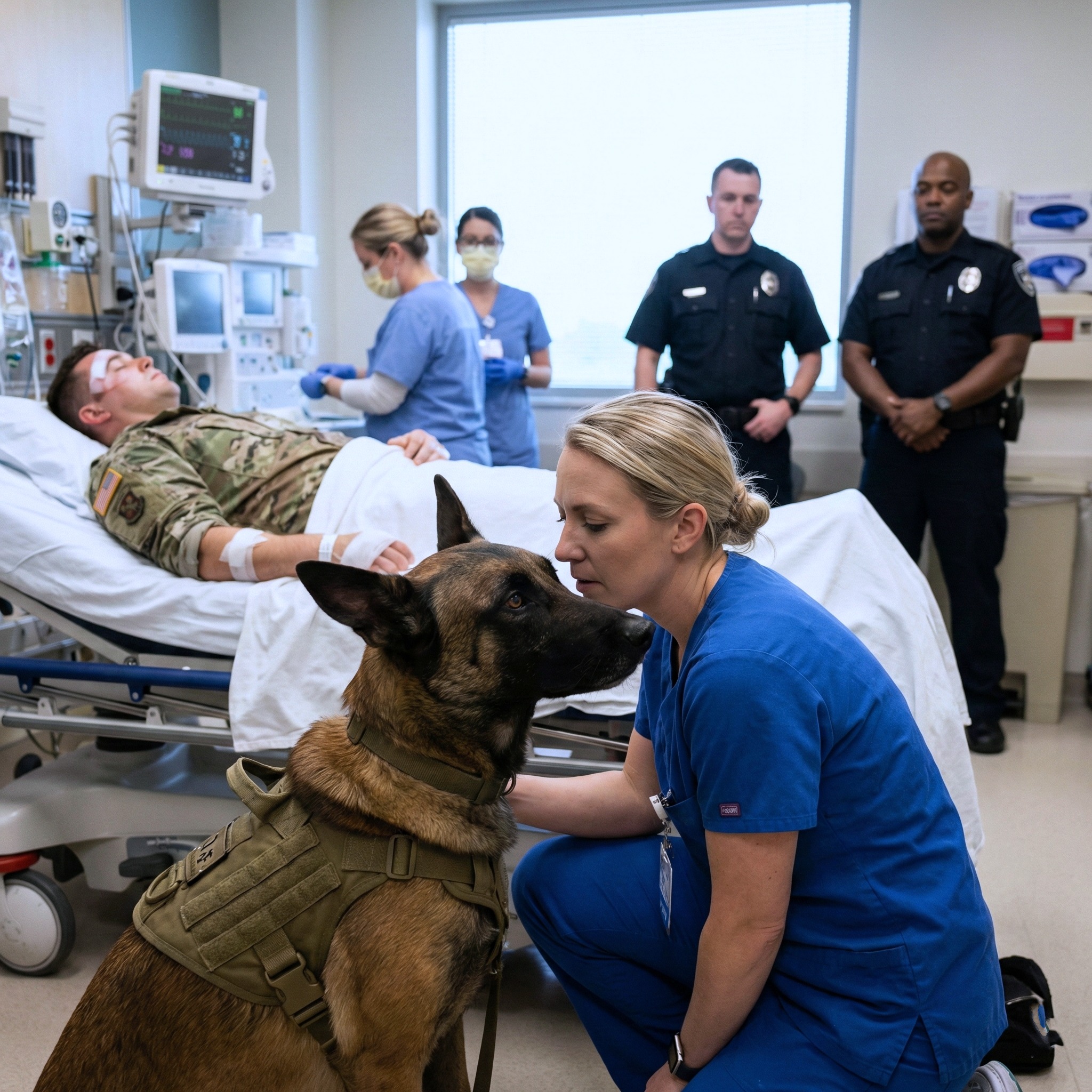
At 2:14 a.m., the emergency room doors slammed open so forcefully they bounced off the stopper. The night staff barely had time to glance up before two soldiers burst inside, racing a stretcher. On it lay an unconscious Navy SEAL, his uniform shredded along the left side, blood seeping through darkened field dressings.
But the first thing everyone noticed wasn’t the blood.
It was the dog.
A military K-9 moved as if welded to the stretcher—shoulder brushing the rail, eyes locked on the SEAL’s chest, alert for the slightest breath. Its body was tense, every muscle ready—not from fear, but trained vigilance. When a nurse stepped forward, the dog bared its teeth. When a doctor reached for the gurney brakes, it growled, low and controlled.
“Who brought the dog?” someone shouted.
“He won’t leave him,” a soldier panted. “That’s his partner.”
The trauma bay erupted into organized chaos. A crash cart rolled in. Monitors beeped alive. A surgeon barked orders even before the stretcher stopped.
“Vitals!”
“Blood pressure dropping. Shrapnel wound, left flank. Possible internal bleed.”
“Training accident,” another voice added. “Grenade malfunction.”
The soldiers guided the gurney into place. One froze as his radio crackled. His face tightened. He looked from the SEAL to the dog.
“We have to go,” he whispered to his partner. “Commander needs us now.”
“The dog—”
The soldier knelt, pressing his hand to the K-9’s neck. “Stay,” he murmured. “Stay with him.”
Then they vanished through the doors, leaving the SEAL and his dog in civilian hands.
The room froze.
A doctor stepped forward, hands raised, trying to assert calm. The dog positioned itself between the gurney and staff. Another tech moved closer, cautiously. The dog lunged slightly—enough to warn: cross this line, and someone gets hurt.
“Get that dog out!” the surgeon snapped.
A nurse muttered, “Animal control.”
“No time,” someone shot back.
Security arrived, tension rising instantly. This wasn’t just a medical emergency anymore—it could turn deadly in seconds.
“If he bites, we put him down,” a guard muttered.
The dog’s eyes flicked to the guard’s weapon. It didn’t flinch. It didn’t retreat. It guarded.
Then, in the tense silence, a woman stepped forward. She didn’t shout. She didn’t gesture. She didn’t ask permission.
Her badge read: AVA.
Blonde hair pulled back, simple blue scrubs, early thirties. New enough to move carefully but with a presence that made her memorable.
She walked forward, slow and deliberate, lowering herself to the dog’s level. She didn’t touch him, didn’t test him. She leaned in and whispered six calm, precise words.
The dog froze. The growl cut off mid-breath. Its tense stance relaxed. It sat down, resting its head gently on the SEAL’s chest.
The trauma bay fell silent.
Security lowered weapons. Nurses stared. The surgeon blinked, incredulous.
Ava straightened. “You can work,” she said. “He’ll let you.”
No one argued.
The shredded uniform was cut away. Jagged shrapnel wounds were revealed. Blood spread across the sheets. The monitor dipped repeatedly.
“Pressure’s falling.”
“Clamp. Suction. Move.”
The dog stayed by the SEAL, eyes tracking every hand but no longer threatening. Ava watched from the wall, calm, focused—a stillness forged from repetition, not luck.
A surgeon glanced at her. “What did you say to that dog?”
“Something they don’t teach in colleges,” she replied.
The SEAL’s heart rhythm wavered. Defibrillator charged. Shock delivered. The dog flinched but remained. Another shock, rhythm stabilized.
At one point, the dog whined softly. Ava immediately focused.
“Left side,” she said. “Internal bleed. You’re missing it.”
They checked—and she was right. The SEAL was stabilized and rushed into recovery. The dog followed like a shadow.
A doctor approached Ava afterward. “You don’t look like animal control… or a first-year nurse.”
“I am a nurse,” she said. “That’s enough.”
Then the building shook. A helicopter landed on the roof without warning.
Minutes later, four men in civilian attire emerged—calm, authoritative, unarmed, yet commanding. The tallest noticed the K-9 beside the gurney.
“Where is she?” he asked.
“The nurse. The one who spoke to the dog,” a staffer pointed.
Ava’s presence shifted the moment they entered. The tallest man froze, then saluted.
“Commander,” she replied, returning it without hesitation.
He whispered, “I didn’t know you were alive.”
“Neither did the world,” Ava said.
Inside a consultation room, the Commander confronted her. “You were declared KIA… Gulf operation. Night ambush. Unit wiped out.”
“I know. I was there.”
He recognized the code she used. “That phrase was retired decades ago.”
“It’s a recall,” she said. “It tells the dog his handler is safe.”
Hours passed. Dawn came. The SEAL awoke, disoriented. The dog guarded him, aware of threats only Ava could sense.
Ava knelt beside him. “Easy,” she whispered.
He looked at her. “Ava.”
“You’re safe. Don’t move,” she said.
He whispered, “You came back.”
She shook her head. “No. You did.”
The dog growled at a man in civilian clothes—silent, precise, protective. Ava realized: the past hadn’t found her by accident. Years of careful hiding had ended with six words—and a buried history was now exposed.