When my granddaughter Cadence’s wedding plans took a shocking turn, my husband Raymond and I were forced to confront her startling entitlement. What had started as a joyful occasion quickly spiraled into a difficult lesson about gratitude and respect that left us both reeling.
Let me set the scene: Cadence, our vibrant and headstrong granddaughter, had just announced her upcoming wedding. Raymond and I were over the moon. We couldn’t wait to help her plan the big day. We envisioned a beautiful celebration, full of love and family memories. But everything changed when we received a letter from Cadence that hit us like a freight train.
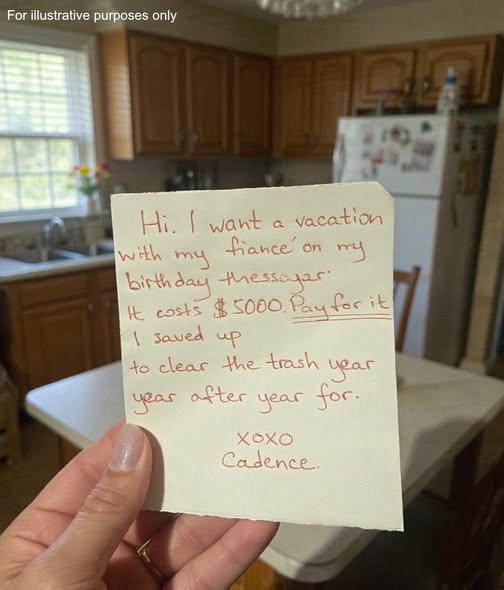
The letter was short, but the words were sharp and painful. Inside was a quote for a $5,000 luxury birthday trip and a note that left us in stunned silence.
“I want a fancy birthday trip with my fiancé,” it read. “Pay for it. I hope you’ve saved enough after all the cheap, junky gifts you’ve given me over the years.”
I still can’t quite express the mix of emotions that flooded over me in that moment. Raymond and I had always done our best to support Cadence. We’re not wealthy, but we’ve given everything we could. We made sure she had handmade quilts I spent hours crafting, passed down cherished family jewelry, and even helped her with a down payment for her car. We were always there, financially and emotionally.
But this letter, this request, felt like a slap in the face.
Raymond and I sat at the kitchen table, staring at the letter. My hands trembled as I held it up to show him. “Can you believe this?” I asked, my voice cracking. “After all we’ve done for her, this is how she repays us?”
Raymond’s expression mirrored my hurt, his voice heavy with disappointment. “This is wrong, Maria. We’ve given so much. And this is how she sees it?”
A part of me wanted to cry, but another part was just plain angry. We couldn’t let this slide. “She needs to learn that actions have consequences,” I said, my voice firm despite the knot in my stomach.
Raymond nodded, but he was equally lost on how to handle this. “How do we make her understand?” he asked.
We decided that, for Cadence to understand the weight of her request, she needed to realize just how much we’d given her. We spent the next few days gathering the things we’d gifted her over the years. The idea of pulling everything together broke my heart, but it felt necessary.
We started in the attic, sorting through the treasures we’d saved over the years.
“Let’s begin with the quilts,” Raymond suggested quietly. He opened a cedar chest, and I ran my fingers over the intricate patterns I had spent countless hours stitching for Cadence. Each one had been a labor of love, something I thought she would treasure forever.
“These were made with so much love,” I whispered, the tears beginning to swell in my eyes. “I really thought she cherished them.”
Raymond placed a comforting hand on my shoulder. “She might realize their value someday, Maria,” he said gently, though his voice too was thick with sorrow. We folded the quilts carefully and packed them into a box.
Next, we went to the guest room where Cadence often stayed when she visited. I opened the jewelry box on the dresser, each piece gleaming with its own history. I picked up a delicate gold necklace that belonged to my mother.
“Remember when I gave her this?” I asked Raymond, holding up the necklace. “She wore it to her high school graduation.”
He nodded, his face somber. “I remember. It’s so sad she left it behind.”
We packed the jewelry up carefully, each piece wrapped in tissue paper. As we went through the box, we found the bracelet I’d given her for her Sweet Sixteen, the locket from her prom, the earrings she’d borrowed for her first job interview—all things she had left behind.
Then, we headed to the garage, where we found the old bike we’d bought for her tenth birthday. It was a little rusty now, but still solid and sturdy.
“She loved that bike,” Raymond said softly. “Rode it every day after school.”
I smiled at the memory, but the sadness was too much. We wheeled the bike out and set it aside with the rest of the items.
Finally, we went through the family photos, the mementos from birthdays, Christmases, and holidays. There were so many happy moments: Cadence blowing out birthday candles, unwrapping gifts, laughing at family cookouts. Each picture held memories I had cherished deeply.
Raymond met my eyes, his expression resigned. “And the quote?”
He picked up the phone to call the bank while I continued to pack. The weight of our decision felt heavy in the pit of my stomach. We had always been generous, but it wasn’t about money anymore—it was about respect.
I made the call to the wedding planner, explaining our decision to withdraw our financial support. The planner was stunned, but she understood once I shared the context.
“We’ve always been generous,” I told Raymond afterward. “But we won’t be walked over.”
We decided to write Cadence one last letter.
Dear Cadence,
Your letter hurt us deeply. We’ve given you our love and support because we wanted to, not because we had to. Your words and actions show a lack of gratitude and respect, and we can’t ignore that. We hope this moment teaches you the importance of appreciation, humility, and understanding the value of those who love you. Love isn’t about things; it’s about valuing the people who care for you. We hope this tough lesson will help you grow.
Love always,
Grandma and Grandpa
We hoped she would understand that this wasn’t about material things, but about respect, gratitude, and the love we’d always given her. Once the letter was sealed, we drove to an orphanage and donated all the gifts we’d once given Cadence.
The fallout was swift. The next day, Cadence called, her voice shaking with anger. “How could you do this to me?” she screamed. “You’re supposed to love and support me! You’re ruining my wedding, my life!”
I took a deep breath, trying to stay calm. “Cadence, we do love you. But love doesn’t mean giving in to every demand. It’s about teaching you the importance of gratitude and respect.”
Her voice turned harsh. “You’re mean! I can’t believe you’d do this!” She hung up, leaving us in stunned silence.
Over the following days, we heard through family that Cadence was telling everyone we were “cold” and “had turned our backs on her.” Some relatives sided with her, others supported us. One cousin called to tell us we’d done the right thing. “She needed a wake-up call,” he said.
Looking back, Raymond and I stand by our decision. We knew it would be painful, but sometimes tough love is necessary for growth. We hope that one day, Cadence will understand the value of gratitude and how important it is to respect the people who have always been there for her.
In a similar situation with our youngest granddaughter, Kinsley, we had to teach her a lesson as well. She was marrying Hayden, and while we were excited for her, we quickly realized that her expectations were far too high. She threw a tantrum over the honeymoon hotel we had arranged for her, accusing us of booking a “lousy” place. Instead of retaliating, Raymond and I chose to let her learn a valuable lesson in humility and gratitude.
We never thought we’d have to teach our granddaughters such hard lessons, but sometimes, life has a way of showing us just how important respect and appreciation truly are. Love, after all, isn’t about spoiling the ones we love, but teaching them the value of what they already have.