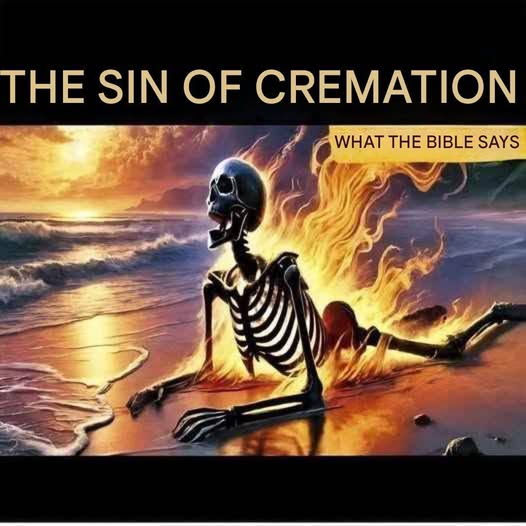
Contemplating what becomes of the human body after the final breath is a profound and deeply personal journey, shaped by the intersection of cultural tradition, individual preference, and spiritual belief. While death is an unavoidable part of life, many people focus almost exclusively on the tangible experiences of existence, postponing consideration of the afterlife—and the handling of the body—until the very end. Among the most discussed topics in this realm is cremation. To some, it represents a practical solution to modern space constraints; to others, it raises theological concerns, often viewed by traditionalists as a potential “sin.” Understanding this choice requires moving beyond initial discomfort and examining the historical, spiritual, and scriptural context surrounding the final care of the body.
Historically, the way societies disposed of the dead reflected their worldview. In ancient Judeo-Christian traditions, burial was more than custom—it was symbolic. It mirrored the agricultural cycle, like sowing a seed in the earth with the expectation of a future harvest. Early Christians regarded the body as the “Temple of the Holy Spirit,” a sacred vessel for the divine spark within. Burial naturally followed from this belief, treating the body as a sleeper awaiting resurrection. The perception of cremation as sinful originates largely from this reverence, stemming from the concern that destroying the body by fire showed disrespect for God’s creation or doubted the promise of physical resurrection.
Theological objections to cremation often focus on the doctrine of the Resurrection of the Dead. Many orthodox interpretations suggest that, at the end of time, the body will be restored and transformed. Critics argue that cremation symbolically rejects this hope, leaving no remains to be “raised.” Biblical examples, from the patriarchs of the Old Testament to the entombment of Jesus Christ, are frequently cited as the model for proper disposal. In this context, burial is seen as both obedient and imitative of the divine example.
Yet, a closer look at Scripture reveals a more nuanced perspective. The Bible does not explicitly forbid cremation nor label it sinful. While burial was the norm among Israelites and early Christians, no specific commandment prohibits burning a body. Modern scholars and clergy often view cremation through the lens of Christian freedom. The New Testament, in particular, emphasizes the eternal soul over the physical body. It describes the earthly form as temporary, while the resurrected body is spiritual and fundamentally different from the one buried or burned.
Many theologians further argue that the method of disposal is irrelevant to an omnipotent Creator. If God fashioned humanity from “dust of the earth” at the beginning of time, dispersing ashes or allowing natural decay presents no barrier to restoration. Whether a body decays slowly in a tomb or is rapidly reduced by fire, the chemical outcome is ultimately the same: dust returns to dust. This understanding has led many religious communities to view cremation as a permissible—and even honorable—option.
In modern society, cremation’s popularity continues to grow, driven by practical considerations. Rising funeral costs, expensive caskets, and limited cemetery space make traditional burials prohibitive for many. Environmental concerns also play a role: cemeteries require land, and embalming chemicals can be harmful. In urban areas, where space is scarce, cremation allows families to honor loved ones without permanent monuments.
Despite practical advantages, the spiritual and emotional weight of cremation remains. For some, burning a body feels violent or irreversible, unlike burial, which seems more peaceful. To address this, modern funeral practices often treat cremated remains with the same reverence as a casketed body. Placing ashes in a columbarium or family plot provides a physical space for mourning while still allowing for cremation’s practical benefits.
Ultimately, the debate over the “sin” of cremation reflects a deeper human need: to find meaning in the face of the unknown. Whether one chooses burial or cremation, the intent is the same—to honor the values, beliefs, and love of the deceased. Our spiritual journey is not determined by how the body is treated, but by the legacy of the life it carried.
As society evolves, conversations about death will become more open and diverse. There is rarely a single “right” choice; it is a balance of faith, tradition, and personal peace. Understanding the origins of beliefs and the lack of explicit scriptural prohibition allows individuals to approach end-of-life decisions without guilt. Death is a transition, and whether the body is returned to the earth or reduced to ashes, it is the life lived and the grace received that define the journey home.