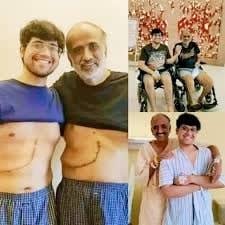
In the world of contemporary medicine, few procedures carry as much emotional weight and physical significance as a living donor organ transplant. It represents a rare convergence of selflessness, surgical expertise, and the raw intimacy of human connection. A living donor voluntarily subjects themselves to major, invasive surgery—not for their own survival, but to give another person a chance at life. Among the many stories of such extraordinary generosity, one has captured the attention and hearts of the public: a son who stepped forward to donate a portion of his liver to his father. Motivated by a bond that surpasses instinct and self-preservation, the young man entered the operating room with one unwavering purpose—to gift his father a renewed chance to live. Yet, in a devastating twist, what was meant to be a tale of triumph and mutual recovery has taken a tragic turn, leaving both family and community grappling with shock, fear, and grief.
Choosing to become a living liver donor is never a decision made lightly. Unlike donating a kidney, where one of two organs can be given, liver donation involves a partial hepatectomy, a complex surgical process where a specific lobe—right or left—is meticulously removed and transplanted. The liver is extraordinary in its ability to regenerate, and under ideal circumstances, both the donor’s remaining portion and the recipient’s new lobe will return to full function within weeks. But the surgery is far from simple: it demands extraordinary precision with blood vessels and bile ducts, leaving little room for error. For a son to volunteer for this journey is a profound act of devotion—a literal offering of his own flesh for his parent’s survival.
Initially, the family’s anticipation was tempered with cautious hope. They had endured the extensive psychological and medical screenings required to ensure the donor’s suitability. Moments of quiet optimism punctuated a tense pre-surgical period, as they envisioned a future where the father’s illness would be a memory rather than a daily struggle. The son’s courage formed the cornerstone of that hope. On the day of the operation, the commitment was total, unwavering, and heroic. But in transplant medicine, the surgery itself is only the beginning; the post-operative period often proves more delicate, unpredictable, and perilous than anyone can anticipate.
Tragically, for this family, recovery did not follow the script of medical success. While the father began the slow process of integrating the transplanted liver, the son—the healthy donor—faced a cascade of unexpected complications. In the medical community, the donor’s safety is sacrosanct; when the donor suffers, the emotional and psychological burden multiplies exponentially. Complications can range from bile leaks and internal bleeding to the most feared outcomes, including acute liver failure or systemic infection. Even in the most advanced hospitals with highly skilled teams, the human body sometimes reacts unpredictably, reminding all involved of the fragile boundary between medical science and the mystery of life itself.
The painful irony of the situation is inescapable. The father, whose life the surgery was meant to preserve, now watches helplessly as his son fights for his own survival. The emotional toll on a parent in this position is nearly unbearable; the gift of life has become shadowed by a sense of guilt and anguish. This heartbreaking reversal has sparked widespread sympathy across social media, within the medical community, and in the hearts of all who hear the story. It is a stark reminder that even amidst the miracles of modern medicine, outcomes can defy expectation, and every surgical triumph is hard-won against a spectrum of unseen risks.
Beyond the immediate tragedy, the case has renewed discussion about the systems of support for living donors. While recipients are carefully monitored and supported post-transplant, donors often receive far less attention after the surgery concludes. This story highlights the urgent need for comprehensive care programs that extend beyond the operating room, encompassing long-term physical monitoring, psychological support, and financial safeguards. The son did not merely donate a portion of his liver; he offered his health, his future, and a piece of himself, risks that demand recognition and ongoing protection.
The narrative challenges the cinematic idealization of organ donation, which often concludes with a celebratory embrace or symbolic sunset. The real-life story is messier, defined by the steady hum of hospital machines, the anxiety of blood test results, and the painstakingly slow work of recovery. For the community following this ordeal, the reaction has been one of collective mourning. The son’s heroism—his courage to give selflessly—is unmistakable, yet the fragility of human life has cast a shadow over that bravery.
For medical professionals, this case has become a moment of reflection. It reinforces the importance of informed consent and meticulous donor counseling, ensuring that every potential donor understands the risks, no matter how altruistic the intent. It also serves as a poignant reminder that the highest form of human courage is often invisible: it is the willingness to face danger for the benefit of another, regardless of personal cost. Even in the face of complications, the son’s bravery remains a beacon. His act was defined not by the outcome, but by the selfless intent behind it. Love, he demonstrated, can surpass fear and physical pain—a profound testament to the enduring human spirit.
The family’s path forward will be long, marked by uncertainty, recovery, and hope. Each day becomes a careful navigation of grief and vigilance, aided by medical expertise and sustained by the outpouring of empathy from strangers, friends, and the broader public. These expressions of solidarity serve as a small comfort, affirming that the son’s sacrifice is recognized, honored, and deeply felt. Through this tragedy, a powerful lesson emerges: the invisible threads of human compassion connect us all, and acts of courage ripple far beyond the individual.
Ultimately, the story of the son who donated part of his liver to his father is one of interrupted grace. It reminds us to cherish our loved ones and to acknowledge the profound courage of those who confront the unknown to save another life. While the family and community hope for a medical miracle to restore the son’s health, his legacy is already secure. He has shown that the human capacity for sacrifice is boundless, and that even in a world often dominated by self-interest, there remain those willing to give everything for family, for love, and for the preservation of life. His bravery will forever be etched in his family’s history—a gift that endures, regardless of the hardships that followed.