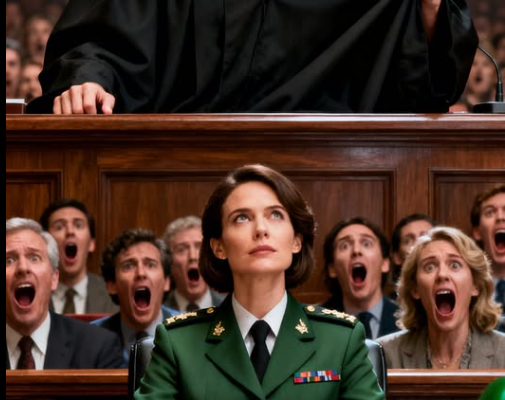
My name is Alyssa Kincaid, and earlier today I found myself sitting directly across from the very people who brought me into this world, watching as they carefully tried to wipe out my existence. Six feet of dull, industrial courtroom carpet separated us in Courtroom 14B, a room heavy with the scent of lemon cleaner and recycled tension. Above us, the fluorescent lights hummed harshly, cold and clinical, throwing skeletal shadows across every face. As the bailiff recited the case number in a flat, uninterested voice, I studied the people on the opposite side. At the plaintiff’s table sat Charles and Loretta Kincaid—my parents. At the defense table, there was only me.
They had taken legal action against me for fraud. The complaint itself read like an elaborate work of fiction, accusing me of stealing the identity of a deceased veteran, falsifying federal paperwork to receive benefits, and fabricating my entire adult life around a lie. They never once looked in my direction. Their gazes stayed fixed ahead, their bodies rigid with moral certainty. I showed no reaction when their attorney, a polished and confident man named Mr. Sterling, began presenting what he called evidence. He pointed out the lack of military photographs in our family home, the absence of discharge records in public databases, and the fact that none of their acquaintances could verify that I had ever served. “This is a case rooted in delusion,” Sterling proclaimed as he paced before the bench. “A daughter seeking attention, inventing a fantasy to exploit government assistance and disgrace an otherwise respectable family.”
I remained quiet, my hands folded neatly in front of me. My uniform wasn’t on my back—it was carefully stored at home in a cedar chest—yet I could still feel the phantom itch where my combat patch once rested. I could still taste the metallic grit of Kandahar dust and hear the strain in the medic’s voice when I took over chest compressions in the rattling Humvee. They mistook my silence for guilt. They failed to understand that silence is often a soldier’s native tongue. Then the judge spoke. Leaning forward, her voice cut sharply through the thick air of the room. “I recognize the defendant,” she said. Mr. Sterling froze mid-step. My parents blinked, clearly confused. “I served with her,” Judge Talia Mendez continued, locking her gaze on me. The courtroom became completely still. “Mr. Kincaid,” she said gently, “you are accusing this woman of stolen valor. Before this continues, I recommend you look closely at the scar on my right shoulder. Your daughter is the one who stitched it while mortar fire rained down around us.”
I was only eighteen when I left that house in Savannah. My mother’s farewell was nothing more than a stiff nod, and my father warned me not to “bring embarrassment” upon them. Being a Kincaid meant earning affection like a debt. My brother Mason was their pride—the star quarterback turned lobbyist. I was the problem. When I enlisted, they told people it was just a “phase” or a “setback.” When I returned three years later, injured and walking with a limp, no one greeted me. My mother peered through the door, opened it slightly, and said, “Oh. You’re back.” They never asked about the ambush or why loud noises made me flinch. Eventually, I stopped explaining and moved into a studio apartment, applying for the benefits I had rightfully earned through a reputable legal aid organization.
Even my survival seemed to offend them. When the lawsuit arrived, I understood they weren’t chasing money—they were trying to erase my past. In court, Mr. Sterling argued that my name did not appear in standard enlistment records. Technically, he was correct. My unit in Kandahar operated under a temporary Joint Task Force handling classified MedEvac routes. For two years, my identity was redacted for security reasons. I was listed as “Active Non-Disclosed,” with my discharge documents stored on a protected server. I couldn’t clarify this without violating my NDA. I stayed silent, honoring the uniform even when others refused to.
After the lunch recess, Judge Mendez took command of the courtroom. “I can tell you exactly where she served,” she said, her voice as sharp as the cold air of the Hindu Kush. “112th Medical Evacuation Battalion. She pulled me from a burning vehicle in the Arghandab Valley. She compressed my femoral artery with her bare hands for forty minutes until extraction arrived.” Silence swept the room. Loretta gripped her pearl necklace so tightly it nearly snapped. Judge Mendez then produced a sealed manila envelope. Under emergency judicial authority, she had declassified my service record for the hearing. The clerk read it aloud: Combat Action Badge, Purple Heart, Bronze Star with ‘V’ Device for Valor. Fourteen wounded evacuated under enemy fire. Each detail shattered my parents’ narrative.
The judge dismissed the case with prejudice. I didn’t smile or cry. I simply released a breath I hadn’t realized I’d been holding for years. As I stepped away from the table, a young Marine in the gallery rose and offered a crisp salute. My father appeared smaller than I remembered, and my mother looked frozen behind a mask of composure. I stayed seated until they left, needing that distance. That evening, back in my apartment, the victory didn’t feel triumphant—it felt like mourning. Not for their actions, but for how easily they carried them out.
The media never splashed my name across headlines, which suited me. My parents never apologized, though my father sent a formal letter weeks later referencing “regretful misunderstanding.” I burned it in the sink. I knew then that Savannah was no longer a place I could stay, haunted by a version of myself that never existed. Three months later, I relocated to the mountains of western North Carolina, settling into a modest home near Pisgah National Forest. I began working as a peer counselor at a veterans’ clinic. Most patients didn’t ask about my past, and I didn’t offer it—they just needed someone who understood why diesel fumes made their hands shake.
One Friday, a Marine veteran with a scar running across his neck came in. He sat across from me and asked, “Are you the one from the trial?” I nodded. He didn’t ask for proof. “You stayed quiet,” he said. “That kind of strength doesn’t get celebrated—but the right people recognize it.” After he left, I checked my mailbox and found an old, grainy photograph of me kneeling beside a smoking Humvee, blood-soaked gauze in my hands. In the corner was one word: Mendez. She had kept it all these years as proof she survived.
I framed the photograph and placed it on the mantle above my fireplace. Truth doesn’t need to raise its voice. Justice arrived in the steadiness of my breathing and in the way my name no longer burned when spoken. I no longer count time by deployments or courtrooms, but by morning light on my porch and the shift of wind before rain. My name is Alyssa Kincaid, and I am no longer missing.