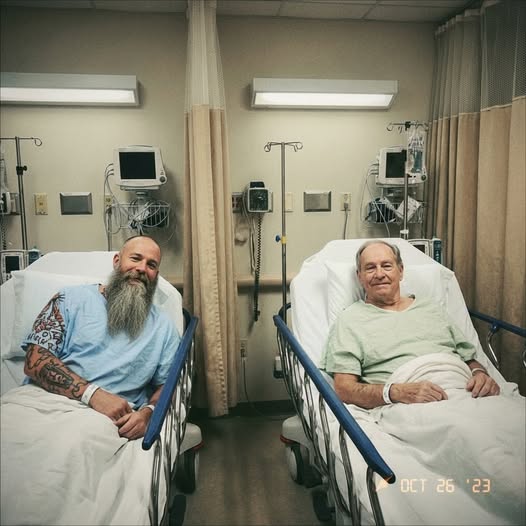
My name is Robert Brennan. I spent twenty-eight years as a district court judge. Over those decades, I handed down sentences to hundreds—maybe thousands—of defendants. I believed deeply in the system. I believed justice meant consistency, restraint, and emotional distance. I believed fairness required detachment.
There was one case I didn’t think about much at the time.
I think about it every day now.
In 2008, Michael Torres stood before me charged with armed robbery. He was twenty-four years old. He had walked into a convenience store with a gun, demanded money, and left with a few hundred dollars before being arrested six blocks away. It was his first offense. No prior record. No history of violence.
He shook uncontrollably as he stood at the defense table. When I read his sentence aloud, he broke down sobbing—deep, helpless sobs that came from a place beyond fear.
The law was explicit. Because a weapon was involved, the charge carried a mandatory minimum of fifteen years. I had discretion beyond that.
I chose twenty.
I remember my own voice that day—steady, formal, detached. I remember the bailiff standing straight, the clerk focused on paperwork, the prosecutor calm and satisfied. I remember Michael’s face collapsing in a way I had seen countless times before and trained myself not to dwell on.
Another case. Another sentence.
I told myself he would be released at forty-four. Still young enough to rebuild a life. I believed that made it reasonable.
Then I forgot him.
That is what the job does, if you let it. People become files. Lives become case numbers. Consequences fade behind procedure.
Last year, my body forced me to stop forgetting.
Kidney failure. Polycystic disease. Genetic and relentless. My doctor explained it plainly: without a transplant, I had months to live. Suddenly my world shrank into lab results, dialysis schedules, and quiet, persistent fear. My daughters tried to be strong, but I could see their terror in the spaces they didn’t know how to hide.
We tested everyone we could. Family. Friends. No matches.
I was placed on the transplant list and learned what real waiting feels like—the kind where every phone call might decide whether you live.
Four months later, the call came.
“We have a donor,” the coordinator said. “A living donor who volunteered.”
“Who?” I asked.
“They’ve requested anonymity until after the procedure.”
When your life is on the line, you don’t ask questions you don’t need answered. I accepted.
The surgery was scheduled for November. The hospital corridors were quiet before dawn. Everything felt clinical and efficient—the calm machinery of survival. As they wheeled me toward the operating room, we passed an open door.
Inside, a man lay on a gurney.
Bald. Tattoos along his arms. A folded leather vest resting neatly on a chair.
Our eyes met briefly.
Something about his face stirred a memory I couldn’t place fast enough.
Then the doors closed. Lights blurred. Anesthesia pulled me under.
I woke up with a new kidney and a nurse smiling down at me, telling me the operation had been a success. Pain radiated through my body, but it was the clean pain of healing.
“Can I meet my donor?” I asked.
“He’s already been moved,” she said. “But he left this for you.”
She handed me an envelope.
Inside was a photocopy of a court document.
My signature sat at the bottom.
Michael Torres. Case 08-CR-2847. Armed robbery. Twenty years.
Written across the top in blue ink were four words:
Now we’re even.
I stared until my vision blurred.
My daughter Rebecca came in later, pale and shaken.
“Did you know?” she asked.
“No,” I said. “Not until now.”
“Why would he do this?” she whispered. “You sent him to prison.”
“I don’t know,” I replied. “But I’m going to find out.”
She told me he had checked himself out of the hospital against medical advice—left two hours earlier.
Gone.
He had given me part of his body and disappeared without explanation.
Doctors were astonished by the compatibility.
“This match is extraordinary,” one said. “Almost like you’re related.”
We weren’t related by blood.
We were connected by something else entirely.
Once home, the house felt emptier than ever. Divorce had stripped it down to silence. I sat in my study holding the photocopy and felt something unfamiliar after decades on the bench.
Doubt.
I pulled Michael’s old case file and read it again—this time as a human story, not a legal one. Unemployment. A pregnant girlfriend. An eviction notice. A borrowed gun.
The gun wasn’t loaded.
The clerk said he apologized repeatedly while demanding money.
He took $347.
He was found crying on a curb.
The prosecutor had argued for the maximum sentence. I had agreed, calling it public safety.
Two weeks later, I hired a private investigator.
Michael Torres was working at a motorcycle repair shop. Clean record. No violations.
I went there myself.
When he saw me, he wasn’t angry. Just aware.
We sat in a diner across the street.
“Why?” I asked him.
He stirred his coffee slowly.
“It means I’m done carrying you,” he said.
He told me how he hated me for years. How prison stripped him of choice. How he learned to let go—not forgive, but release the grip.
“I’m a donor,” he said. “I saw your name. I chose.”
“You had power once,” he told me. “You used it. This time, I had it. I used it differently.”
He didn’t want gratitude.
He wanted freedom.
We stayed in touch.
I started volunteering with re-entry programs. I began seeing the system not just as punishment, but as unfinished responsibility.
Michael spoke to others trying to rebuild.
“People are more than their worst mistake,” he said.
A year later, I rode on the back of his motorcycle with men who refused to be defined by their pasts. Wind in my face. Fear and life colliding.
My doctors call my recovery a miracle.
I call it a reckoning.
Michael once wrote that we were even.
We aren’t.
Because he didn’t just save my life.
He gave me the chance to live it differently.