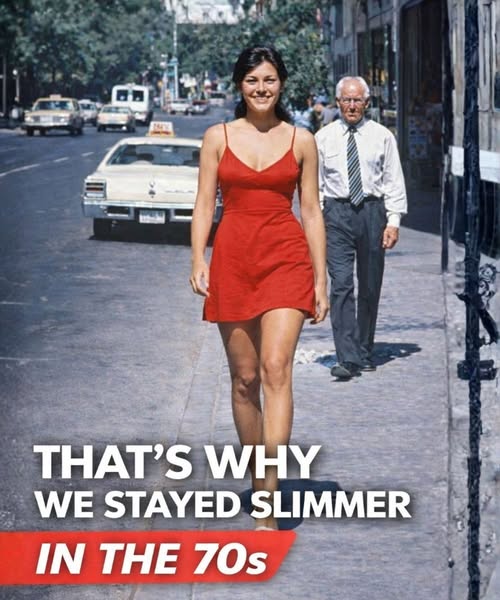
When we look back at the visual archives of the 1970s—flipping through weathered photo albums, lingering over family snapshots, or watching grainy home movies captured on flickering film reels—the most striking observation isn’t the neon hues of polyester, the towering hairstyles, or the unique aesthetic of bell-bottoms. It’s the people themselves, moving through life with a physicality and rhythm that seems almost foreign today. Neighbors, coworkers, relatives, and children generally appeared leaner, more balanced, and naturally resilient. There is an unmistakable sense that their bodies were not simply “fit” by modern standards, but in a state of effortless equilibrium. This was not the result of any societal obsession with aesthetics, gym memberships, or calorie counting—the multibillion-dollar wellness industry that dominates our lives today was only in its earliest infancy. Rather, the physical condition of the average person in the 1970s emerged organically, as a byproduct of daily routines, environmental expectations, and social structures that required movement, moderation, and engagement with the physical world without demanding conscious discipline.
To understand why the human body appeared so different fifty or sixty years ago, we must delve into the subtle systemic differences in daily life. Movement was not something scheduled into a day as an optional commitment; it was a requirement for existence itself. People moved because life demanded it, and those movements added up cumulatively, forming an undercurrent of physical activity that was both habitual and functional. In suburban neighborhoods and urban centers alike, households often owned a single car, if any, making walking the default mode of transportation for short to mid-range errands. Children walked or biked to school, traversed long blocks to visit friends, and spent hours engaging in unstructured outdoor play—climbing trees, running through fields, or inventing games that required stamina and dexterity. Adults walked to bus stops, carried groceries, climbed staircases, and stood for substantial periods at workstations. Even the most sedentary office roles of the time included “incidental activity”—walking between departments, filing documents, delivering messages—which might seem trivial in isolation but collectively represented hundreds of calories burned per day, seamlessly woven into ordinary existence.
Nutrition further distinguished the era from today’s hyper-processed culture. Grocery stores were smaller, often independently owned, and stocked items that were recognizable as actual food rather than industrially engineered substances. Meals were typically composed of fresh vegetables, seasonal fruits, grains, dairy, eggs, and meat prepared in straightforward ways. Highly processed, hyper-palatable products—prepackaged frozen dinners, giant sugary soft drinks, protein bars, and snack foods engineered to maximize craving—were virtually nonexistent or considered occasional indulgences. Sugar, salt, and fat were used sparingly as seasonings rather than in quantities designed to override the body’s natural satiety cues.
Cooking itself required sustained engagement. Preparing dinner was rarely a one-step process of microwaving or heating pre-packaged food. People washed, peeled, chopped, kneaded, stirred, and simmered. These tasks were physically engaging, providing small but meaningful bursts of activity while also cultivating an intentional connection with the food being consumed. Meals were not a mindless experience; they were deliberate acts of nourishment. Because cooking took effort and attention, eating became purposeful—people ate when hungry and stopped when full, guided by innate hunger cues rather than the constant environmental pressures of snacks and digital advertising that bombard us today.
The predictability of daily life contributed significantly to metabolic health. Meals generally followed a consistent structure: breakfast, lunch, and dinner, often eaten at roughly the same times each day. Snacking between meals was rare, socially discouraged, and logistically inconvenient. Without a continuous stream of portable, hyper-processed foods, the body’s internal signaling for hunger and satiety operated with much greater accuracy. Hormones such as leptin and ghrelin functioned as they were biologically intended, regulating appetite, energy balance, and fat storage in a far more precise manner than is typical today.
Portion control was often embedded into the environment. A standard soft drink came in a 6-ounce glass bottle; restaurant servings were moderate, dinner plates were smaller, and the culture of “supersizing” had yet to be invented. People consumed fewer calories by default, not by counting, restricting, or dieting. Food was primarily nourishment, not entertainment, a distraction, or a coping mechanism for stress. This implicit guidance reduced the cognitive and emotional effort associated with regulating intake, allowing the body to maintain homeostasis with less conscious effort.
Time management and attention allocation also played a significant role in physical health. Television existed, but it was finite; programming was scheduled, and when shows ended, the set was typically turned off. There were no smartphones, social media platforms, video-on-demand apps, or endless streams of content designed to trap attention in sedentary loops. In the absence of these digital distractions, boredom was not a problem to be solved with screens, but an opportunity to act. Children went outside to play; adults tended gardens, engaged in hands-on hobbies, walked to visit neighbors, or simply explored the surrounding world. The world itself became an arena for incidental movement, exploration, and play, organically keeping people physically active without conscious effort.
Stress, too, was managed in ways inherently tied to movement, social connection, and tangible tasks. While the 1970s had its own political and economic uncertainties, people were not immersed in constant notifications of global and personal crises. Stress was intermittent rather than chronic, and when it arose, it was often alleviated through practical, physical engagement—yard work, DIY home projects, recreational sports—or by spending time with family and friends. Sleep routines were more consistent, largely unperturbed by screens emitting blue light late at night, supporting hormonal balance and healthy circadian rhythms. Together, these factors ensured a body naturally in equilibrium, responsive to genuine need rather than environmental coercion.
Translating these lessons into the 2020s is not about attempting a literal return to the past—it is about selectively engineering our modern environments to replicate the beneficial conditions of that era. We can recapture the 1970s “movement by necessity” by taking intentional small steps: walking for errands under a mile, incorporating standing or walking tasks into workdays, and seeking hobbies that require physical engagement rather than purely passive consumption. We can emulate their dietary success by embracing whole foods, preparing meals actively, and limiting hyper-processed, high-sugar convenience items. By reducing the omnipresence of digital devices, we allow boredom to become a catalyst for exploration and activity once again. Prioritizing regular sleep, managing stress through real-world social connections and tactile engagement, and creating a consistent daily structure can restore some of the metabolic and hormonal balance that was once taken for granted.
The overarching lesson of the 1970s is that our physical well-being was inseparable from the rhythms of daily life. The people of that era were not unusually disciplined or ascetic; rather, their environment demanded functional movement, sensible eating, and social engagement as an unavoidable part of living. By intentionally constructing modern routines that honor these principles—incorporating movement into ordinary tasks, reconnecting with real foods, reclaiming the kitchen as an active space, and limiting the dominance of screens—we can foster physical resilience and vitality in a world that often prioritizes convenience and consumption over health. In essence, our modern bodies can thrive if we rebuild the scaffolding of life to align with our timeless biological design. By looking backward to the simple, effective routines of the past, we may uncover the blueprint for a future where balance is not a constant struggle but the default state of being, allowing human health to flourish organically, naturally, and sustainably.