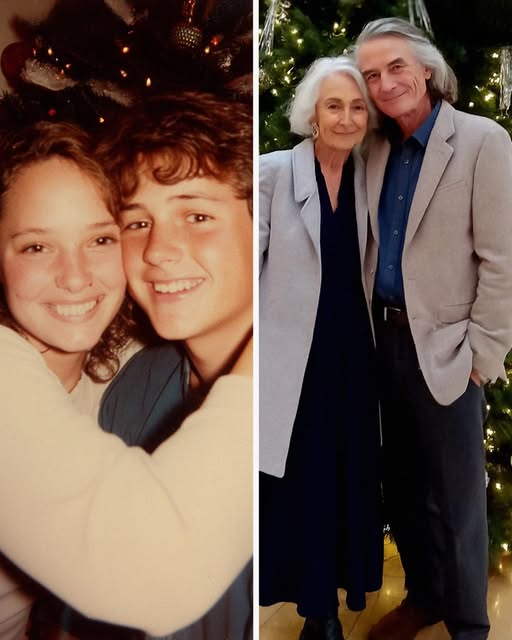
At sixty-two, Anne was convinced her life had already settled into its closing, familiar rhythm. After nearly four decades as a high school literature teacher, her days followed a dependable pattern shaped by bell schedules, hallway supervision, Shakespearean analysis, and stacks of essays that never seemed to shrink. December had always been her favorite month—not because she believed in miracles, but because the season softened even the most restless teenagers. Each year, she assigned a holiday project that asked students to interview an older adult about a meaningful memory. What Anne never anticipated was that this assignment would quietly unearth a chapter of her own life she believed had long been sealed away.
That shift began with Emily, a reserved yet perceptive student who insisted on choosing Anne as her interview subject. Anne initially resisted, brushing off her life as ordinary and uneventful. But Emily’s calm determination—and her observation that Anne made stories “feel real”—eventually persuaded her. The conversation started gently, with harmless recollections of crooked Christmas trees and overbaked holiday desserts. Then Emily asked a question that struck deeper than Anne expected: had she ever experienced a love story tied to the holidays? The question unlocked the memory of Daniel—the boy she had loved with the reckless, wholehearted intensity only a seventeen-year-old can feel.
Daniel had once been her constant in a life marked by uncertainty. Together, they dreamed of escape, of California sunlight and fresh beginnings, plans built on hope rather than money. Then, without warning, he disappeared. A financial scandal involving his family forced them to flee overnight, leaving Anne with no explanation and no goodbye. The silence stretched across four decades. Anne offered Emily a carefully edited version of the story, insisting she had moved on. But after Emily walked away, Anne felt something stir. The past, once dormant, had begun to breathe again.
A week later, Emily burst into the classroom, flushed with excitement and clutching her phone. She had discovered a post on a local community forum titled, “Searching for the girl I loved 40 years ago.” The description was unmistakable—a teenage girl with a blue coat, a chipped front tooth, and dreams of becoming a teacher. Attached was a photograph of Anne at seventeen, laughing in that same coat, Daniel’s arm wrapped protectively around her. The realization hit hard: Daniel hadn’t been reminiscing—he had been searching for her all these years.
With Emily’s help, contact was made. Suddenly, Anne found herself anxious in ways she hadn’t felt in decades—questioning her clothes, visiting a hairdresser, worrying about time’s cruelty. They agreed to meet on a Saturday afternoon at a small café by the park. As Anne drove there, doubt followed her. What if memory had been kinder than reality? What if too much time had passed? But the moment she entered the café, she recognized him. His hair had turned silver, and life had etched its lines into his face, yet his eyes were unchanged—warm, observant, and familiar.
Their conversation bridged two lifetimes. Daniel spoke of the shame that had kept him away—how his father’s crimes made him feel tainted, undeserving of her until he had built a life on his own terms. He had searched for years, thwarted by Anne’s name change after marrying Mark, a marriage that had ended when her husband left after twenty years. They spoke honestly, not as idealized versions of their youth, but as two people shaped by loss, endurance, and quiet resilience.
Then Daniel reached into his coat and revealed something that stopped Anne’s breath: the locket she had lost forty years earlier—the one containing the only photographs of her parents. It had been packed during his family’s sudden departure, and he had kept it ever since, holding onto it as a promise to find her again. Seeing her parents’ faces, untouched by time, Anne felt a burden lift that she hadn’t known she still carried. Daniel wasn’t asking to relive the past—only to see what might still be possible now.
The following Monday, Anne shared the news with Emily at her locker. The student’s delight shone brightly amid the crowded hallway, proof that stories sometimes do come full circle. Anne stood there not only as a teacher of literature, but as the central character in a story she never believed she’d get to finish. At sixty-two, she understood that hope does not belong solely to the young. With the locket in her pocket and Daniel’s smile in her thoughts, she realized she wasn’t returning to the past—she was stepping through a door she thought had been closed forever.
This reunion became a quiet reminder that life can offer renewal when least expected. It revealed how deeply the heart’s foundations endure, even when buried by time. Anne’s journey—from a tea-drinking teacher to a woman rediscovered by her first love—affirmed a simple truth: it is never too late for a guiding star to lead someone home. The locket was home. And, perhaps, so was Daniel.
As winter break approached, the school felt different. The stories Anne taught no longer seemed distant or theoretical—they echoed her own life. After years of helping students uncover meaning in fiction, she realized her own story held an arc more moving than any assignment she had given. Through Emily and through Daniel, Anne found restoration, connection, and belonging. At sixty-two, after forty years of waiting without knowing it, she finally stood exactly where she was meant to be.