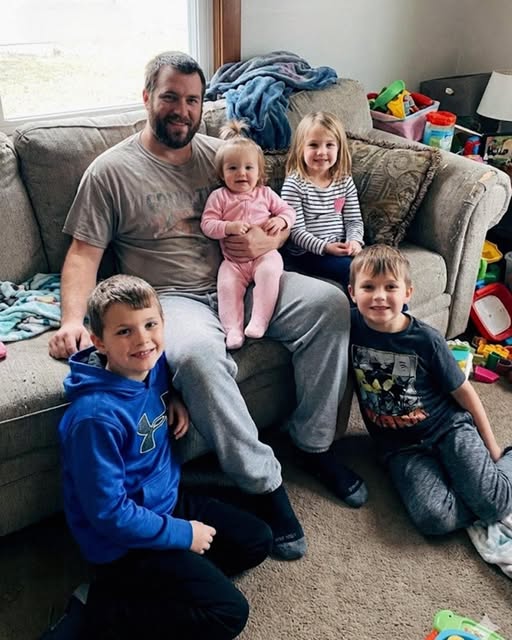
The knock on my door came the morning after what had been, by all appearances, an ordinary grocery run. At the time, I had no idea it would mark the moment my life quietly shifted in a way I never could have anticipated.
The day before had been chaos, the kind that most parents know too well. Grace was crying because she’d misplaced her favorite teddy bear. Lily stood in front of the mirror, furious that one braid looked “wrong.” Max had managed to drip maple syrup across the kitchen tiles, with the dog happily following behind to lick up every sticky footprint. Noah, already nine and convinced that hunger was a permanent state of being, kept asking what was for dinner while the breakfast dishes were still soaking in the sink.
I wasn’t expecting anything unusual. Just another long day of keeping the wheels from falling off.
My name is Lucas. I’m forty-two, a widower, and a father of four. Two years ago, my wife Emma died of cancer less than a year after her diagnosis. At first, we thought the exhaustion was from caring for a newborn. We were wrong. By the time we understood what was happening, life had moved too fast to catch.
Now it’s just me and the kids: Noah, Lily, Max, and little Grace. I work full-time at a warehouse and take whatever extra shifts I can. The house leaks when it rains. The dryer only works if you kick it twice. The minivan rattles like it’s surviving out of sheer stubbornness. But the kids are fed. The lights stay on. And they know they’re loved. That’s what matters.
That Thursday afternoon, after school pickups and daycare runs, we stopped at the grocery store for basics: milk, apples, diapers—whatever I could stretch the week’s budget to cover.
Max had wedged himself into the lower rack of the cart, narrating our trip like a race announcer. Lily was critiquing bread rolls as if she were judging a cooking show. Noah knocked over a display and muttered, “My bad.” Grace sang the same line of “Row, Row, Row Your Boat” while dropping crumbs everywhere.
I was steering the cart down the produce aisle when something caught my eye between the apples.
A ring.
Gold band. Diamond center. Heavy in a way that fake jewelry never is.
I picked it up slowly and glanced around. No one nearby. No frantic searching. No raised voices.
For one brief, dangerous second, a thought crossed my mind. That ring could fix a lot. New brakes for the van. A dryer that worked without violence. Groceries without counting every dollar. The braces Noah would need sooner than I wanted to admit.
The thought vanished as quickly as it came.
I looked at my kids: Grace with syrup on her fingers, Lily watching my face closely, Max upside down in the cart, Noah standing a little taller than his years.
I couldn’t be the kind of father who taught them that honesty was optional when life got hard.
I slipped the ring into my pocket and headed toward customer service. Before I got there, a trembling voice called from the end of the aisle.
“Please… please, it has to be here…”
An older woman rushed toward me, her cardigan slipping off one shoulder, purse half-open, eyes darting across the floor in panic.
“Ma’am?” I said gently. “Are you okay?”
She saw the ring in my hand and gasped, clutching her chest.
“My husband gave me that,” she whispered. “On our fiftieth anniversary. He passed three years ago. I wear it every day. It’s all I have left of him.”
Her hands shook as she took it back, pressing it to her heart like it was the only thing holding her upright.
“Thank you,” she said. “You don’t know what this means.”
“I think I do,” I replied quietly.
She looked past me at my kids and smiled softly. “They’re beautiful. You’re raising them with a lot of love.”
She asked my name, nodded as if committing it to memory, and walked away, clutching the ring like she’d been given back a piece of her life.
I thought that was the end of it.
We went home. I stretched the groceries. Wiped syrup off Max’s face. Tucked the kids into bed. Life returned to its usual rhythm of exhaustion and quiet determination.
The next morning, the knock came. Sharp. Deliberate.
When I opened the door, a man in a charcoal coat stood on my porch. A black Mercedes idled behind him.
“Lucas?” he asked.
“Yes.”
“I’m Andrew,” he said. “You met my mother yesterday.”
He told me she had called him in tears after coming home. About losing the ring. About finding it again. About the man who returned it without hesitation while wrangling four kids in a grocery store aisle.
“She’s been barely holding together since my father died,” he said. “Losing that ring nearly broke her.”
He handed me an envelope.
“Before you open it,” he added, “my mother wanted me to tell you something. She said your wife would be proud of the man you are.”
I didn’t trust myself to speak.
He nodded toward the house, toward the sound of my kids arguing inside, then walked back to his car.
I opened the envelope later, sitting in the minivan after dropping the kids at school.
Inside was a check for fifty thousand dollars and a short note thanking me for my honesty—for giving his mother back something irreplaceable and for reminding him that decency still exists.
I rested my forehead against the steering wheel and let myself breathe for the first time in a long while.
The money didn’t make us rich. It made us stable.
The van got fixed. The fridge stayed full. Grace got new bedding that helped her skin. Lily declared pizza night the fanciest evening of her life. We started a jar labeled “Vacation,” covered in crooked drawings and impossible dreams.
“Are we rich now?” Max asked.
“No,” I said. “But we’re safe.”
That night, I pulled all four kids into my arms and held them longer than usual.
Life takes a lot. Sometimes more than feels fair. But every once in a while, it gives something back—not because you demanded it, but because you chose to do the right thing when no one was watching.
And sometimes, that’s enough to change everything.