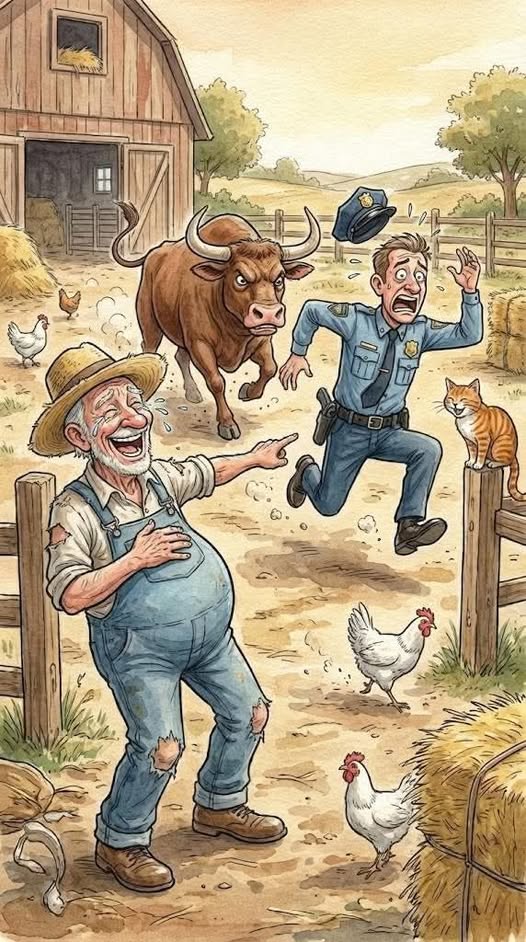
The officer arrived at the ranch under the assumption that the rules of the world bent neatly to his will. He carried himself like a man who had never been refused, whose badge had more weight than the ground beneath him. His suit was impeccable, crisply pressed, each crease a declaration of authority. His boots gleamed faintly despite the dust of the road, and the badge at his hip seemed to flash with a message: respect me, or regret it. He walked with a measured gait, not the hurried step of someone uncertain, but the deliberate stride of a man convinced he was owed compliance. Every door, every conversation, every object in his path was expected to yield to the invisible force of his presence.
The rancher watched from the shade of his weathered barn, leaning against a post worn smooth over decades by the touch of hands that had built and repaired, nurtured and endured. His eyes narrowed slightly, not with suspicion, but with the quiet patience of someone who understood that life rarely unfolded according to desire. Time had taught him that force could move people, but it rarely moved the world itself. The heat rose off the ground in waves, carrying the smell of hay, sunbaked earth, and livestock—subtle fragrances that spoke of years of work and observation. The officer’s polished steps echoed against this natural rhythm, an intrusion of sharp angles in a world of slow curves.
“I need to cross that field,” the officer said, pointing past the fence line toward the wide swath of green that shimmered in the sun, the grass bending and rolling like tiny waves across a calm sea. There was no question in his tone, only expectation.
The rancher followed the motion with his eyes, then shook his head once, slow and deliberate. It was a gesture that carried the weight of inevitability. “Can’t do that,” he said evenly, final.
The officer’s smile appeared—sharp, practiced, and too tight at the edges. “You don’t understand,” he said, tapping the badge with two fingers, letting the sunlight catch it just so. “I’m authorized.”
The rancher’s eyes remained steady, unflinching, as if weighing not the badge but the man himself. “That field’s got a bull in it,” he said softly, without raising his voice, without flinching from the truth. “A mean one. Best go around.”
Authority bristled at caution, especially when it came without fear, without supplication. Pride rarely listens to warnings, and badges are powerless against instinct honed over decades. The officer straightened his chest, lifted his chin, and spoke with the certainty of law. “I don’t take instructions from civilians,” he said, his words clipped, commanding. “Especially not about where I can and cannot go.”
He unclipped the badge and held it up like a sword, letting it gleam in the heat. “This says otherwise.”
The rancher let the badge catch his attention for a moment, then turned back to the man’s face. There it was—the confidence, the impatience, the conviction that rules were universal and that the world would bend to the wearer of metal and title. He said nothing for a beat, letting the moment stretch, thick with expectation and simmering caution.
“All I’m saying,” the rancher said finally, “is that bull doesn’t care much for shiny things or big speeches.”
The officer laughed, a short, dismissive sound that lacked humor, meant to dismiss the warning. “Animals respond to authority like anything else,” he said. “They sense confidence.”
The rancher pushed off from the post, stepping closer to the fence at a measured pace, each step deliberate and calm. “That bull,” he said, “senses movement. And challenge.”
The officer waved him off, dismissing the gravity of the statement, and unlatched the gate. He stepped onto the grass, shoulders squared, badge raised as if it could ward off consequences. The air itself seemed to pause, holding its breath.
For a moment, there was silence. The field rippled faintly under the sun, the grass bending lazily in the breeze. Insects hummed, birds trilled in the distance, and the officer took a step forward, confident and unyielding.
Then it came—a vibration through the earth, subtle at first, almost imperceptible. The officer froze, adjusting his stance, but the rancher felt it immediately through the thick leather of his boots. Every rancher knows this sound. It is a primal declaration: you are not in control here. The earth, the creature upon it, the life that inhabits the field—none of it obeys authority simply because it is demanded.
The officer turned his head, scanning the field. And there it was: the bull. It emerged from the far end like a moving hill, massive and unyielding. The muscles rolled beneath its skin, the shoulders broad and knotted with strength, the neck thick like a column of living stone. Its eyes locked onto him, unblinking, assessing, deciding if this intruder was worth attention. Not curiosity, not respect—judgment.
Confidence evaporates in moments like these. The badge trembled, and the officer’s stride faltered. He took a step back, then another, instinct clawing at the edge of his certainty. The bull snorted once, low and deliberate, an audible warning that life would not yield to papers, titles, or posturing.
The officer laughed nervously, trying to reclaim bravado. The sound lacked conviction. The bull shifted, pawing the ground. It was not charging, yet the threat was undeniable.
The rancher leaned against the fence, hands crossed. He had seen men like this before—men who believed the world owed them compliance, who mistook pride for armor, who assumed that authority alone could bend reality. They learned, sometimes violently, that the world has its own rules.
The bull lowered its head slightly, testing, measuring, the air vibrating with tension. The officer’s face drained of color. He tried to move backward, then forward, then froze entirely. The badge slipped in his hand, catching light uselessly, a symbol stripped of power. Every step the bull took was a lesson in inevitability.
Finally, instinct overrode ego. The officer turned and ran, the ground crunching beneath his dress shoes. His suit jacket flapped, his polished shoes skidding on dirt, the badge bouncing, catching brief flashes of sun. Panic replaced authority. Fear replaced certainty. He tumbled over a small rise, rolled in the dirt, and gasped like a man who had just discovered that respect is earned in ways the badge cannot command.
The bull stopped at the fence, snorted one last time, and turned away. Satisfaction marked every line of its massive form. It had reminded an intruder of his true place in the world.
The rancher approached slowly, deliberately, as though he had all the time in the world. He did not scold. He did not lecture. There was no gloating, only the calm, quiet weight of inevitability. The lesson had been delivered.
The officer scrambled to his feet, chest heaving, face pale and slick with dirt. He opened his mouth to speak, to argue, to summon authority, but the words caught in his throat.
The rancher cupped his hands around his mouth and called out, carrying his voice across the field. “Next time,” he said, “you might want to show your badge to the bull first.”
No regulations, no law, no statute could counter the truth that had just been taught. Authority ends where reality begins. Experience surpasses ego. And some lessons, it turns out, come only when metal, titles, and pride meet a living force that doesn’t recognize either.