On a quiet, weary Thursday afternoon, Lucas found himself in the produce aisle of the local grocery store, navigating the relentless tide of single fatherhood. At forty-two, he was a man defined by fatigue and devotion. Two years earlier, his wife, Emma, had been taken by an aggressive cancer, leaving him to raise four children alone: Noah, Lily, Max, and baby Grace. Life had become a series of calculated maneuvers—patching a leaky roof with one hand while soothing a crying toddler with the other, and picking up every available odd warehouse shift just to keep the lights on in their aging home.
That day, the supermarket felt like a battlefield. Max had turned the lower rack of the shopping cart into a racing cockpit, narrating his high-speed maneuvers. Lily was engaged in a passionate debate over the structural integrity of the bread rolls, and Noah wandered the aisles with pre-teen detachment. In the seat of the cart, two-year-old Grace smeared mystery cracker crumbs onto her shirt. Lucas steered their rattling cart toward the fruit section, mind preoccupied with the dwindling balance in his bank account, when a flash of light caught his eye.
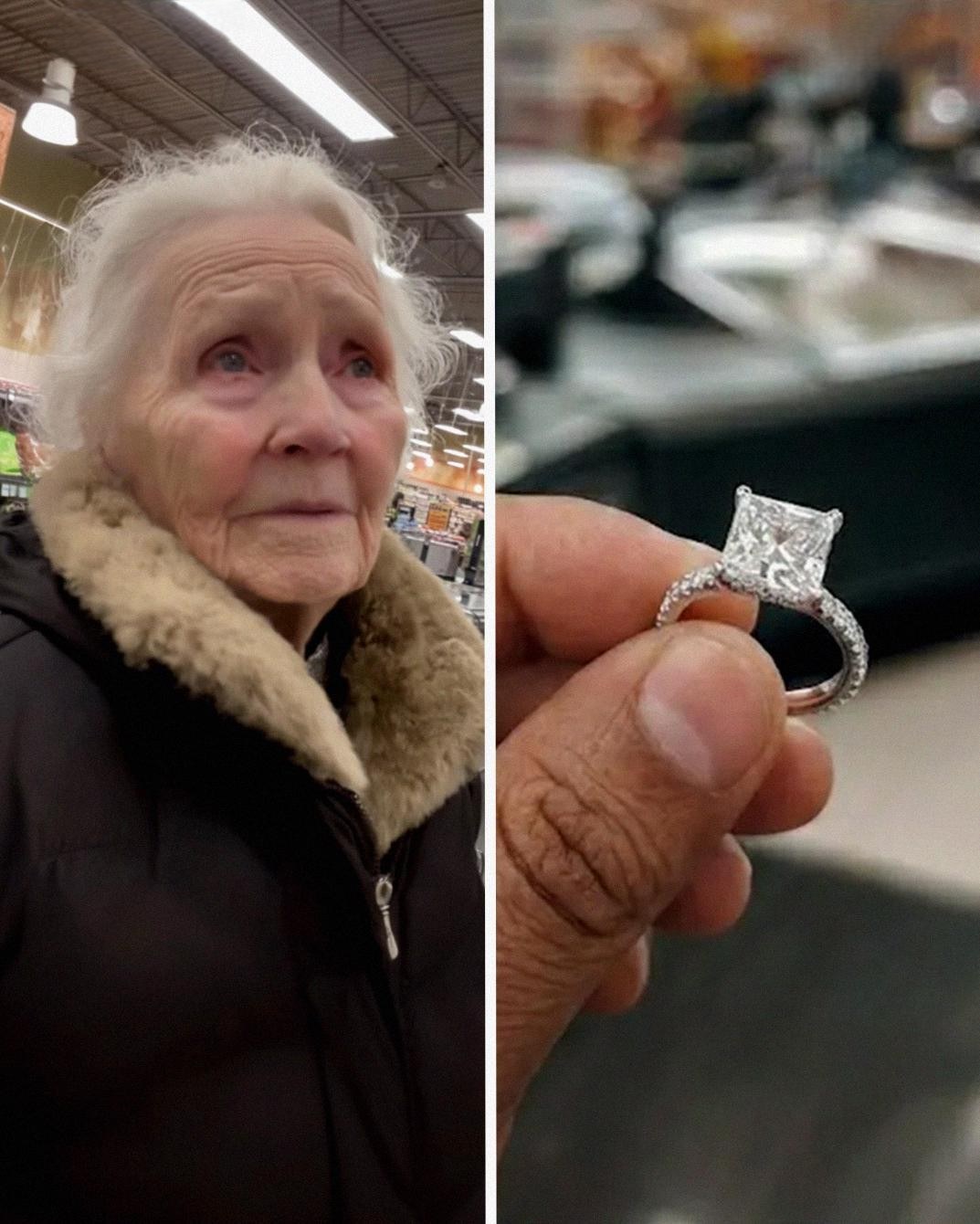
Tucked among a cluster of bruised apples was a band of gold topped with a brilliant, unmistakable sparkle. Lucas paused, instinctively closing his fingers around the cold metal. At first, he assumed it was costume jewelry, but the weight told a different story. It was a diamond ring—of significant quality—the kind of object that represented a fortune to a man worried about cereal and diapers.
For a fleeting moment, Lucas’s mind ran through his mounting expenses. The ring could pay for the overdue brake repair on his minivan, replace the temperamental dryer, or even start a college fund for Noah. But as he looked at his children—Lily marveling at an apple’s colors, Grace smiling with sticky innocence—the temptation vanished. He realized that the legacy he left his children wouldn’t be in money, but in the character he modeled when no one was watching.
Before he could reach the customer service desk, a soft, frantic whimpering broke the aisle’s quiet. An older woman, her cardigan askew and eyes clouded with panic, rounded the corner, scanning the floor with trembling hands clutching a half-open purse. Lucas stepped forward, opening his palm.
Her gasp was pure relief. This wasn’t just jewelry—it was her life’s history. She explained that her husband had given her the ring on their 50th anniversary. Since his passing three years ago, it had been her most tangible connection to him, a piece of their shared past she wore every day. Tears streamed down her face as she thanked Lucas, looking at him and his four boisterous children with deep appreciation.
“My name’s Lucas,” he said, and she nodded, eyes lingering on the chaotic, loving scene before disappearing around the corner, her treasure clutched to her chest. Lucas paid for his meager groceries—exhausting the last fifty dollars of his monthly budget—and headed home, assuming the encounter was simply a brief moral triumph in an otherwise difficult week.
The next morning, the usual symphony of spilled juice and lost school supplies was interrupted by a sharp knock. On the porch stood a man in a tailored charcoal coat, entirely out of place against Lucas’s cracked sidewalk. Behind him, a sleek black Mercedes idled. He introduced himself as Andrew, the son of the woman from the grocery store.
Andrew explained that his mother, Marjorie, had been unraveling since his father’s death, clinging to routines and memories to manage her grief. Losing the ring had nearly shattered her fragile peace. She had been so moved by Lucas’s honesty that she asked the store manager about him. Thanks to the manager’s description of “the man with the laughing toddler” and a quick check of local records, Andrew had tracked him down.
Standing in his doorway, surrounded by backpacks and berry-stained toddlers, Lucas received a thick envelope from Andrew. Initially, he tried to refuse, insisting he hadn’t returned the ring for a reward. He admitted, with raw honesty, that he had briefly considered the ring’s value for his family, but ultimately couldn’t look his children in the eye if he kept it.
“My mother asked me to tell you,” Andrew said quietly, “that your wife would be so proud of the man you are.”
The words hit harder than any financial struggle. Alone later, Lucas opened the envelope. He expected a thank-you note or a modest gift card. Instead, he found a check for $50,000.
The note read: “For your honesty and kindness. For reminding my mother that there is still hope after loss. Use this for your family, Lucas.”
The impact was transformative—not because it made them rich, but because it provided the safety Lucas had been missing. A week later, the van’s brakes worked silently, the refrigerator was stocked, Grace had new bedding, and the house felt warmer, as if the repairs had mended their spirits.
That Friday, for the first time in years, Lucas ordered a stack of pizzas. Around the table, the children’s faces glowed with simple joy. Max asked, “Are we rich now?”
“Not rich, buddy,” Lucas whispered into his son’s hair, “but we are safe. And that’s everything.”
Life had stripped Lucas down to the bone, taking his partner and security, but in a quiet produce aisle, a single act of integrity had sparked a chain reaction of grace. Honesty cost nothing, but its value proved immeasurable. Looking at his four children’s watchful eyes, he knew he had given them the most important gift of all: a father who truly lived the values he taught.